Saints of the day
Tucindan — the day before Christmas Eve
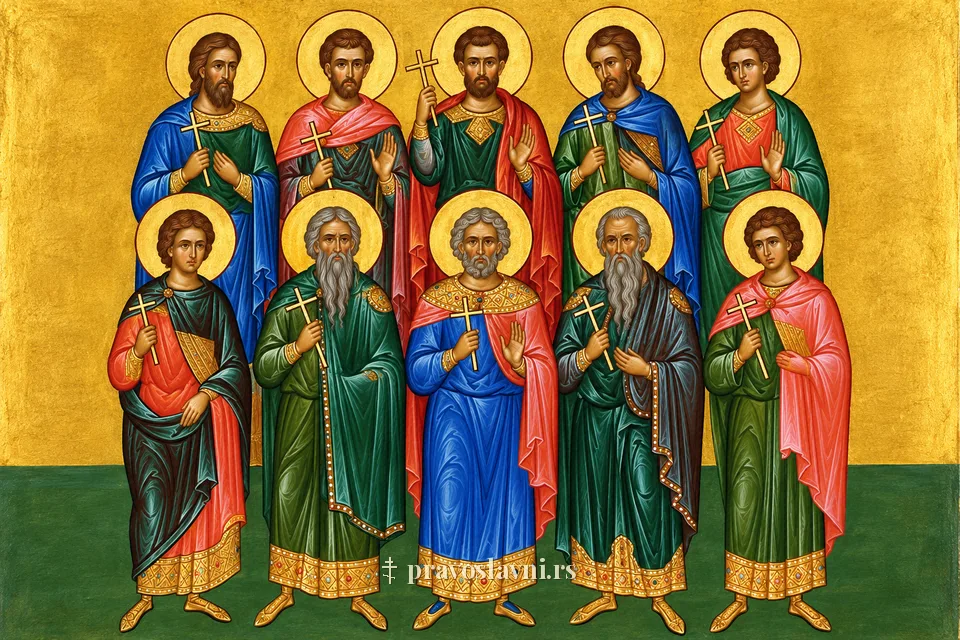
Holy Ten Martyrs of Crete
What happenedTen distinguished Christians of Crete went joyfully to their execution, vying with one another to be the first to reach Christ.
Read the LifeOrthodox Calendar · 23 December according to the Julian calendar
Monday, 5 January 202623 December (according to the Julian calendar)Save your slava — you'll get a reminder a week and a day before.
Send a greeting card →What happenedTen distinguished Christians of Crete went joyfully to their execution, vying with one another to be the first to reach Christ.
Read the Life
No meat, dairy products, eggs, fish or oil — food cooked in water.
This is a recommendation — for your own fast, consult your priest or spiritual father.More about the fast →
Many families celebrate their Krsna slava (family patron saint's day) today
More about the feast →
“But rejoice to the extent that you partake of Christ’s sufferings, that when His glory is revealed, you may also be glad with exceeding joy.”
— 1 Pet 4:13Tucindan is the day that falls two days before Božić (Christmas). The name of the day keeps the memory of the former way of killing the Christmas animal, which was first stunned with a blow: in ancient times with a lump of salt, and later with the blunt side of an axe. That is why it used to be said that the pečenica (the Christmas roast) was “beaten” (tukla). Tucindan belongs to the Christmas season, which among the Serbs begins with Nikoljdan (St Nicholas Day) and ends with Savindan (St Sava's Day).
On that day the Church remembers the ten martyrs of Crete, who suffered in the time of Decius, and St Naum of Ohrid, a disciple of Sts Cyril and Methodius.
The people believe that on that day children should be neither beaten nor punished, for otherwise they would be naughty and disobedient throughout the year, and would get boils as well. By folk custom, on Tucindan the animal for the Christmas table is prepared, most often a piglet or a lamb, and in some regions and homes, alongside them or instead of them, a turkey, a goose or a hen. The roots of this custom perhaps reach back to old pagan sacrifices. Nevertheless, it is held that the Church accepted it and gave it her blessing, because in the winter cold and after a six-week fast more plentiful food is welcome.
Tucindan falls during the Nativity Fast; for more on fasting, see the guide “Fasting — simply explained”.
The Ohrid Prologue preserves the memory of ten Christians from Crete: Theodulus, Saturninus, Euporus, Gelasius, Eunician, Zoticus, Pompius, Agathopus, Basilides and Evaristus. They gave their lives for Christ when the Emperor Decius, in the year 250, raised a persecution against the Church. In their own city they were men of great standing and honour.
Yet their standing was not more important to them than their faith. Death did not frighten them; the Prologue even records their joy in that hour. Not one of them wanted to wait for his turn — so greatly did they long for Christ.
Before their death they turned to God with the words: “Forgive, O Lord, Thy servants.” That prayer embraced also those who were remaining behind them: their whole homeland, their friends, their kinsfolk. They were thinking, too, that the light of the faith might reach their people.
The sword did not spare a single one of them. And so all ten arrived at the place to which they had so hastened — to Christ.
Their example is simple and clear. Faith in Christ gives a person joy even where others see only fear. And whoever truly loves God thinks of others even in his last hour and prays for them.
Among those whom Crete gave to Christ, the Ohrid Prologue mentions ten martyrs. They were not people from the margins of society but, according to the Prologue, citizens of great standing and honour. They had, therefore, a great deal that they could lose. And yet, when they had to choose between all of that and Christ, they chose Christ.
The Prologue also preserves their names: Theodulus, Saturninus, Euporus, Gelasius, Eunician, Zoticus, Pompeius, Agathopus, Basilides and Evarestus. Ten names, ten lives and one and the same faith.
They suffered in the persecution of the Emperor Decius, in the year 250. These ten men did not renounce Christ. Neither standing, nor position, nor the fear of death was stronger in them than their love for Him.
The Prologue speaks of their end in only a few lines, but in them there is one unforgettable detail. Among them too there was rivalry, yet not for honour or property, but over who would be the first to go under the sword. Each one wished to be with Christ before the others, and the Prologue also records their joy on the way to the place of execution.
For them death was not a defeat, but the way to the One in whom they believed. Each of them was hurrying in one direction only — towards Christ.
Before their death they prayed. The Prologue gives their words: “Forgive, O Lord, Your servants”. Their prayer did not stop at themselves alone. They thought of the homeland they were leaving, of their friends and relatives, as well as of themselves, and for all of them they offered their blood to God. Their wish was that the people among whom they had lived should also be set free from ignorance and come to God.
The sword did not spare a single one of them. And so all ten arrived at the place to which they had been hurrying so eagerly — with Christ.
The Prologue does not say much about these martyrs. What has remained is ten names, joy in the face of death and a prayer for others. The Prologue does not draw any particular lesson, but the picture speaks for itself: a true Christian, even in the hardest hour, asks God for forgiveness and prays for the enlightenment of his neighbours and of his people. And one follows Christ gladly — not as if going to a loss, but as if going to a meeting.
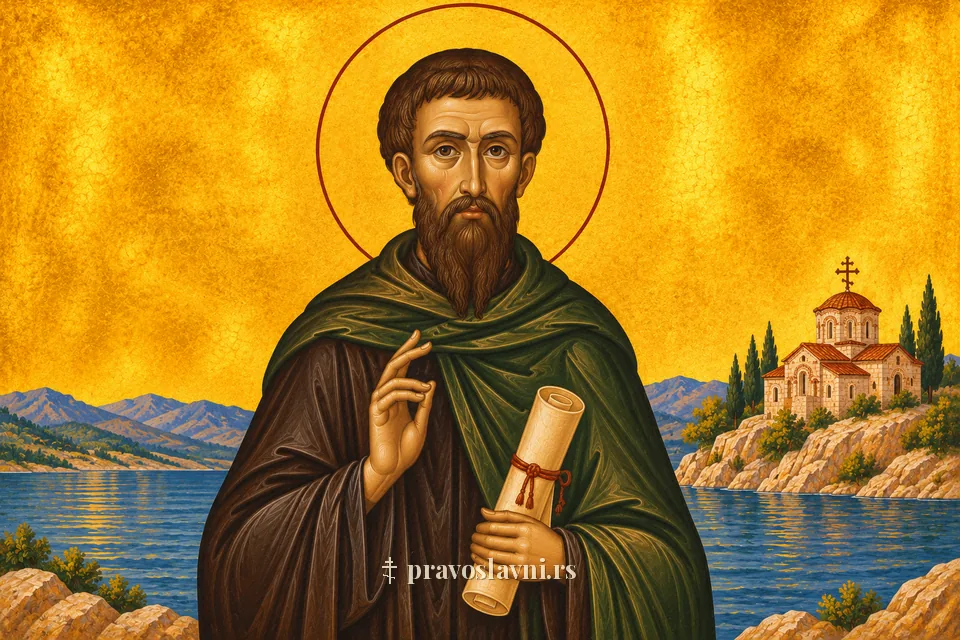
Of all the disciples of Sts Cyril and Methodius, five were their most faithful fellow workers — the Five Disciples (Petočislenici) — and one of them was Venerable Naum. The Slavs are indebted to him for a great labour of translation: he tirelessly rendered the Holy Scriptures and other books needed by the Church into their language. When, after his stay in Rome, he came to Lake Ohrid, he already had the name of a man of great learning, skilled in many languages, and of a wonderworker. Boris Michael helped him to settle by the lake, and his Life says that Clement was with him at that time as well. Clement became bishop in Ohrid, while Naum built a monastery at the southern end of the lake, and that monastery still exists today. Monks from various parts of the Balkans came under his care, and he was their teacher, guide and spiritual father, who himself showed them the way by prayer and ascetic struggle. His Life also ascribes to him a gift of healing so strong that for a believing sick person to recover nothing more was needed than Naum's glance. He passed away before the middle of the tenth century, but his help to people did not cease. The gravely ill are healed by his relics, and most of all those whose minds are darkened, and so, according to his Life, the pleas of those seeking a miracle have flowed into his monastery for centuries.


