Great feast
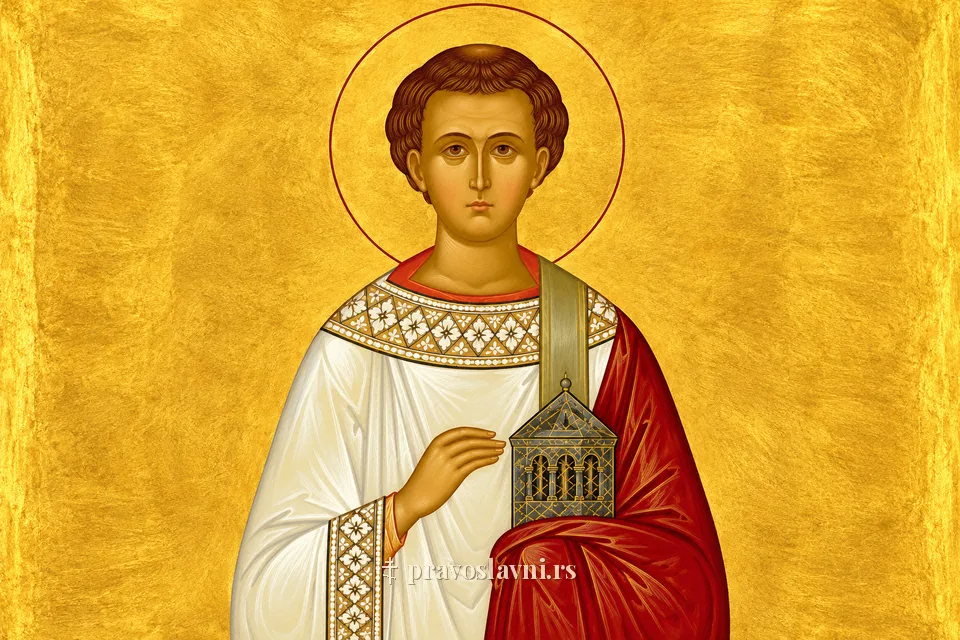
Holy Protomartyr and Archdeacon Stephen
What happenedSt Stephen, the first martyr for Christ, was stoned to death, and his Life records that as he died he prayed for his killers.
Read the LifeOrthodox Calendar · 27 December according to the Julian calendar
Friday, 9 January 202627 December (according to the Julian calendar)Save your slava — you'll get a reminder a week and a day before.
Send a greeting card →What happenedSt Stephen, the first martyr for Christ, was stoned to death, and his Life records that as he died he prayed for his killers.
Read the Life
You may eat meat, eggs, milk and dairy products, as well as any other food — but try to be moderate.
More about the fast →
Red Letter day — great feast; by custom, no work is done
More about the feast →
“Then he knelt down and cried out with a loud voice, ”Lord, do not charge them with this sin.” And when he had said this, he fell asleep.“
— Acts 7:60Sung at the Slava (family patron saint's feast) and on the saint's feast day (9 January).
With a good struggle didst thou strive, O first martyr of Christ and apostle, and didst expose the impiety of the tormentors; for, being stoned by the hands of the lawless, thou didst receive a crown from the right hand on high, and didst call unto God, crying: O Lord, lay not this sin to their charge.
Translation: pravoslavni.rs
St Stephen, the Archdeacon, is the first martyr of the Christian Church. He was a Jew who spoke Greek and a kinsman of Saul of Tarsus, the future Apostle Paul. The Church in Jerusalem was growing, and so the apostles ordained seven chosen men, full of the Holy Spirit and wisdom, to care for the poor as deacons. Among the seven Stephen stood at the head — hence the title archdeacon.
His faith was such that great signs and wonders were worked through him. From every dispute with men from the various synagogues Stephen emerged as the victor, for his words were wise and inspired by the Spirit. That is why they resorted to bribery: they bribed certain men, and turned the people, the elders and the scribes against him. False witnesses accused him of blasphemy against God and Moses. To those who looked at him his face seemed like the face of an angel.
In his speech Stephen went through the past of Israel, from Abraham to Moses: God had unceasingly done good to the people, and the people had constantly resisted Him. He told them that they were stiff-necked, that they resisted the Holy Spirit and that they had betrayed and murdered the Righteous One. Then, filled with the Holy Spirit, he declared his vision to them all: before him were the heavens opened, the glory of God and the Son of Man standing at the right hand of God.
They led him out of the city and there they stoned him. The witnesses laid their garments at the feet of Saul, who consented to his death. The Most Holy Theotokos and St John the Theologian were at a distance; they watched and prayed for him. His Life also records his last prayers. First, standing, he said: “Lord Jesus, receive my spirit.” Then he knelt down and prayed for his murderers: “Lord, do not charge them with this sin.”
His Life says that the martyr's body had no grave for a whole day and night. A grave was in the end given to him by a respected teacher of the Law, on his own estate, secretly and by night. The Prologue says of that man that his name was Gamaliel and that he was a Jewish leader who secretly believed in Christ.
St Stephen stands at the beginning of a long line of Christian martyrs, and he has gone into the Kingdom of Christ. His courage in confessing Christ and his forgiveness of his murderers remain an example to every believer: whoever suffers for Christ has the heavens opened before him.
St Stephen is the first Christian who laid down his life for Christ. That is why the Church calls him the Protomartyr. A Jew by birth, he spoke Greek and belonged to the so-called Hellenists. His Life notes that these were not pagans, who at that time were not yet being received into the Church; the first among them would be the centurion Cornelius, who was baptised by the Apostle Peter. Stephen was also a kinsman of Saul of Tarsus in Cilicia, who would later become the Apostle Paul.
After Pentecost the Church in Jerusalem was growing. The Life, following the Acts of the Apostles, says that the Hellenists complained that their widows were being neglected in the daily distribution of help. The twelve apostles then asked the faithful to choose seven men of good reputation, full of the Holy Spirit and wisdom, so that the apostles might devote themselves to prayer and to the preaching of the word. Those chosen were Stephen, Philip, Prochorus, Nicanor, Timon, Parmenas and Nicolas, a proselyte from Antioch. After praying, the apostles ordained them as deacons, to care for the poor in Jerusalem.
Stephen bears the title of Archdeacon because he held the first place among the seven. According to the Life, the beauty of his soul surpassed even the beauty of his body.
Through his faith great signs and wonders were worked. The Life says that in his conversations with the Jews he took the Law and the Prophets as proof that the Messiah is precisely Jesus, whom they had unjustly put to death. In the disputes with Stephen the Freedmen, the Cyrenians, the Alexandrians and the Jews from Cilicia and Asia raised their voices, but not one of those who argued with him had an answer to the Spirit and the wisdom that guided him. The Freedmen, as the Life explains, were descendants of Jews to whom the Roman Pompey had given their freedom; and so, the Life adds, Stephen prevailed over people from three continents — from Europe, Asia and Africa.
Since they had not succeeded in debate, his opponents resorted to bribery: they paid men and stirred up the people against Stephen, and with them the elders and the scribes. False witnesses added the charge of blasphemy against God and Moses, supposedly because Stephen was announcing that Jesus would destroy the temple and change what Moses had handed down. The Life says that he was brought before the council of the chief priests. To those who looked at him, his face seemed like the face of an angel; the Prologue compares it to the face of Moses when he was speaking with God.
The speech that Stephen delivered before the council passed through the history of Israel, from Abraham to Moses: God did good to the people, and the people resisted Him. The Life states that he said that God does not dwell in temples made with hands, and that he quoted the words of the Prophet Isaiah that heaven is God's throne and the earth is the footstool of His feet. At the end he told them that they were stiff-necked, that they were resisting the Holy Spirit, and that they were the betrayers and murderers of the Just One.
His words, according to the Life, enraged the council to the point of gnashing their teeth. At that moment Stephen, full of the Holy Spirit, declared to all who were present the vision that had been given to him: the heavens were opened, and he saw the glory of God and the Son of Man standing at the right hand of God. According to the Life, he spoke of the vision so that the faithful might receive strength, the unbelieving shame, and the future martyrs encouragement.
He was led outside the city and stoned there. The Life gives as the place the Valley of Jehoshaphat, between Jerusalem and the Mount of Olives, near the Brook Kidron. The witnesses laid down their clothes at the feet of Saul, who was consenting to his death. The Most Holy Theotokos and St John the Theologian were at a distance; they watched what was happening and prayed for him.
The Life says that Stephen, standing, prayed: “Lord Jesus, receive my spirit.” Then he knelt down and asked the Lord on behalf of those who were killing him: “Lord, do not charge them with this sin.” And so he departed into the Kingdom of Christ. The Life states that he had only just passed his thirtieth year.
The Life says that Stephen's body lay unburied for a whole day and night, exposed to the beasts and the birds. The sources agree that in the end one man buried him on his own estate, but they differ as to who he was. The Prologue calls him Gamaliel and describes him as a leading man among the Jews who kept his faith in Christ hidden. The Life passes over his name in silence and speaks only of a renowned teacher of the Law in Jerusalem, to whom faith in Christ, together with his son Abibas, would be opened only later. The Life adds that he carried the body away in secret, under cover of night, and mourned bitterly over it; the place where he laid it, Caphargamala, lies about four kilometres from Jerusalem. Much later, on the site of Stephen's suffering in Jerusalem, the Life mentions a church dedicated to him, built by the Empress Eudocia, the wife of the Emperor Theodosius the Younger.
St Stephen teaches us the courage to confess Christ and the strength to forgive those who do us evil. For the one who dies for Christ, heaven opens as it did before the Protomartyr.
The brothers Theodore and Theophanes were natives of Palestine and were well educated in both secular and spiritual learning. Their parents sent them to the monastery of St Sabbas the Sanctified, where they studied, received the monastic tonsure and were later ordained priests. Their Life says that the Patriarch of Jerusalem, after an Arab attack on the monastery, sent Theodore to Constantinople to rebuke the iconoclast Emperor Leo the Armenian. According to the Prologue, they suffered for the holy icons under three emperors: Leo the Armenian, Michael and Theophilus. Under Theophilus, according to their Life, they were scourged before the prefect of the city and sent into exile, and after two years they were brought before the Emperor himself and beaten again. By the command of Theophilus, mocking verses were cut into their faces with iron, and so they came to be called the Branded; their Life gives the poem itself as well. Then they were shut up in prison in Apamea of Bithynia. Theodore did not survive the torments in prison, and the Prologue gives 833 as the year of his death. Their Life adds that he died an old man and still in chains, on the feast of St Stephen, that Theophanes buried him in a wooden coffin, and that his relics were later translated to Chalcedon, where healings took place. Iconoclasm came to an end in the reign of Theodora and Michael; Theophanes was then set free, and Patriarch Methodius appointed him to the metropolitan throne of Nicaea. The brothers, who bore wounds even on their faces for the honour of the icons, bear witness that confessing Christ is worth any humiliation.
Separate page: Venerable Theodore and Theophanes the Branded →


