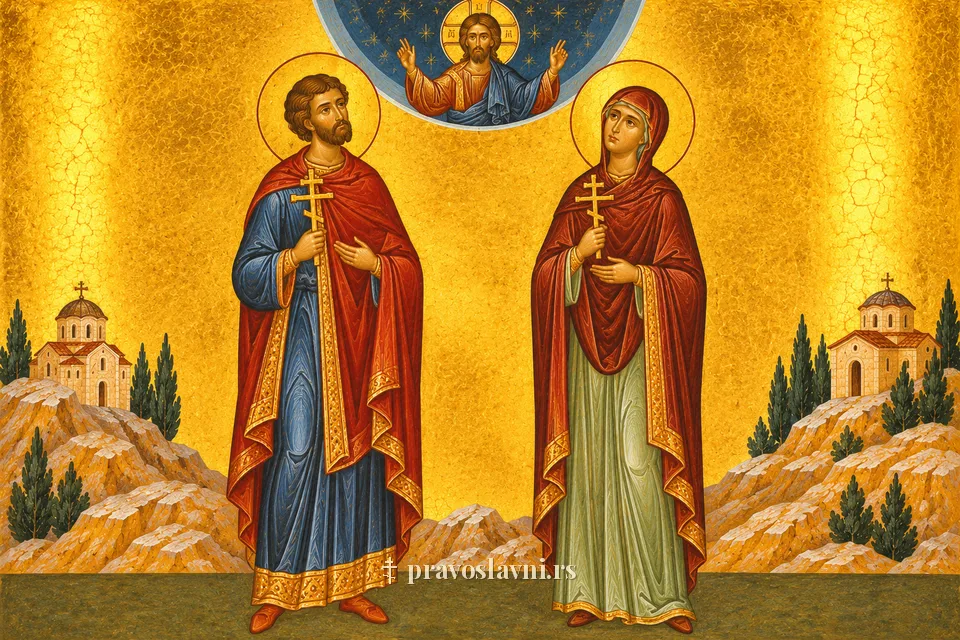
Saints of the day
Holy Martyrs Julian and Basilissa
What happenedJulian and Basilissa were married, yet lived in purity as brother and sister, built great monasteries and remained faithful to Christ to the end.
Read the LifeOrthodox Calendar · 8 January according to the Julian calendar
Wednesday, 21 January 20268 January (according to the Julian calendar)What happenedJulian and Basilissa were married, yet lived in purity as brother and sister, built great monasteries and remained faithful to Christ to the end.
Read the Life
No meat, dairy products, eggs, fish or oil — food cooked in water.
This is a recommendation — for your own fast, consult your priest or spiritual father.More about the fast →
Today the Church keeps the commemoration of a saint · not a Red Letter day.
More about the feast →
“Blessed is the man who endures temptation; for when he has been approved, he will receive the crown of life which the Lord has promised to those who love Him.”
— Jas 1:12St Julian and St Basilissa glorified God in two ways: as a husband and wife who preserved their virginity, and as confessors who did not betray the faith even in the time of persecution.
They came from distinguished and wealthy families. Julian had loved purity from his youth, and so, when his parents were hurrying him to marry, he fasted and prayed for seven days. His Life says that the Lord then assured him in a vision that his bride would remain a virgin and that both of them would be received into the Kingdom of Heaven. And so it was: Julian and Basilissa were married, but they made a vow to live as brother and sister and kept this hidden from their parents.
They gave the wealth they had inherited to the poor, and then they received the monastic tonsure. Julian founded a monastery for men and Basilissa one for women; the number of monks with him reached ten thousand, and of sisters with her a thousand.
The persecution of Diocletian brought Basilissa one care: that not a single sister should give way under the threat of torture. The answer to that prayer was unexpected: by the end of half a year not one of the sisters was any longer among the living, and Basilissa was the last to depart. Before her death she beheld, radiant with light, those who had departed before her.
Julian's monastery was burnt down when he and the monks refused to offer sacrifice to the idols. The tortures he endured were severe, but the power of God within him was stronger. His Life records a whole series of miracles: idols fell to pieces, a man who had gone blind in one eye received his sight, and even a dead man rose up. In the prison twenty soldiers came to believe.
The Prologue says that Celsus and Marionilla, whom the Life calls the son and the wife of the governor Marcian, came to believe as they watched Julian bear his tortures. The sword united them with Julian, and together with them the presbyter Anthony, Anastasius who had been raised from the dead, seven brothers and twenty soldiers. This was around the year 313.
Julian and Basilissa remind us that nothing on earth is more precious than Christ. Basilissa's sisters were kept safe in the faith, and Julian gained a double crown — that of virginity and that of martyrdom.
Sts Julian and Basilissa are remembered for a twofold struggle: as husband and wife they preserved their virginity, and in the end Julian also bore witness to the faith by martyrdom. The persecution in which they suffered is linked with the Emperor Diocletian — the Life mentions Maximian alongside him as well — and the Prologue says that they suffered around the year 313.
They came from distinguished, wealthy families. The Life places Julian in Antinoe in Egypt, where he grew up as an only son, studied Greek learning, and even more so Holy Scripture and the faith, and chose virginity early on. He did not refuse the marriage that his parents asked of him at the age of eighteen, but before giving his answer he spent seven days in fasting and prayer. The answer, according to the Life, was given by the Lord: he may accept the marriage, for the bride too will preserve her virginity, and both of them will enter the Kingdom of Heaven.
The bride was Basilissa, likewise the only child of a respected house. The Life surrounds their vow to live as brother and sister with signs: a sweet fragrance in the middle of winter, which Julian ascribed to Christ as the lover of purity, and a vision of Christ and the Theotokos among a multitude of virgins, in which they were shown their own names written in a golden book. Their parents did not know of the vow and believed that the marriage was an ordinary one.
The inheritance that was left to them on the death of their parents they used for the poor. Then they received the monastic life and founded two monasteries — Julian one for men, Basilissa one for women — and each of them governed their own. The number of monks in his monastery reached ten thousand, and that of the sisters in hers a thousand.
The Prologue says that Basilissa, when the persecution began, asked one thing for her sisters: that fear should not separate a single one of them from the Orthodox faith. The Life adds that Christ answered her that before her, within half a year, all her virgins would repose, and so not one of them would fall. Both the Prologue and the Life say that this is indeed what came to pass: for half a year the convent was emptied by death, until in the end only the abbess remained, and then she too followed her own. Before her own departure she saw, radiant, those who had gone before her, calling her to them. She was buried by Julian, as the Life says.
The governor Marcian arrived, according to the Life, with his wife Marionilla and his son Celsius, and demanded sacrifice to the idols. Since Julian and the monks refused this, the monastery was set on fire; the Life says that about ten thousand monks perished in the flames, and that later, on that spot, at the hours of prayer, chanting was heard and the sick found healing there. The Prologue says of Julian that he was cruelly tortured, but that God strengthened him and that he glorified Christ to the end. The Life also preserves Christ's word of encouragement from a vision: “Be of good courage! And let not your heart be afraid!”
The Life also relates a series of miracles. When the governor's kinsman lost the sight of one eye during the torture, the pagan priests could not help him — the demons themselves admitted that they were powerless, and some fifty idols crumbled into dust; Julian healed him with the sign of the Cross and by calling upon the Lord, and the man who was healed confessed Christ and was beheaded for it. The governor's only son Celsius, after he saw radiant young men crowning Julian, renounced his father and the idols and stayed with the saint, even though his mother implored him to come back. In prison they were joined by twenty soldiers who had come to believe, and then also by seven orphaned brothers with the presbyter Anthony, for whom, according to the Life, an angel opened the way; Anthony baptised Celsius and the soldiers. When the governor mocked them, Julian, after a prayer of about an hour, raised a dead man, as Christ raised Lazarus; Anthony baptised him with the name Anastasius, “the Risen One”. Nor did fire, according to the Life, do them any harm, and when Marionilla saw her son alive and well, she herself also received the faith and baptism.
The sword, according to the Prologue, united Julian in death with all who had stayed with him to the end: with Celsius and his mother Marionilla, with the presbyter Anthony and Anastasius, with the seven brothers and with the twenty soldiers. The Life adds that after the execution the priests did not know which body was whose, until, after prayer, the souls of the martyrs were shown to them. They were laid beneath the altar, and there, according to the Life, water sprang forth that heals. The Life also remembers the words of the saints before Christ: “Here are we and the children whom You have given us.”
Julian and Basilissa remain an example of a husband and wife who chose virginity and raised great monasteries. Basilissa's sisters were preserved from falling away, and Julian gained a double crown — that of virginity and that of martyrdom. The Life reminds us that neither comfort nor kindred is worth as much as Christ.
St George, an ascetic of the seventh century, was born on Cyprus, in a devout and wealthy family. When he was left an orphan, he refused the marriage that one of his relatives had arranged for him and secretly went to Jerusalem and to the Jordan, where his elder brother Heraclides was already a monk in the Lavra of Calamon. Since he was still very young, Heraclides directed him to the Chozeba Monastery of the Theotokos, on the road from Jerusalem to Jericho; there George received the tonsure from a strict elder who was a native of Mesopotamia. His Life also records a miracle because of which the elder, who had once struck George in anger, had to bow down, at his disciple's word, before the tomb of the five holy fathers so that the strength might return to his hand. So that this miracle would not lead him into pride, George secretly returned to Heraclides and shared with him a life of extreme poverty. Through their prayer with tears, his Life says, God brought back to life the dead only child of a farmer from Jericho. After the death of Heraclides he returned to Chozeba, where he received the name Chozebite, and his food was the scraps from the kitchen, his clothing old rags. At the time of the Persian attack on Jerusalem he took shelter by the Jordan, and then he returned and strengthened the brethren. To his disciple Antony, who later wrote his Life, he gave his blessing, and he spoke his last words turned towards the east: “Go forth now, my soul, go forth in the Lord!” He was buried in the tomb of the holy fathers. His life teaches humility, obedience and patience, and shows that humble prayer brings healing and the mercy of God.
Separate page: Venerable George the Chozebite →
St Gregory was a bishop in Ohrid; the Prologue mentions him as a devout teacher and shepherd of the faithful, who reposed in the year 1012. In the church of St Sophia in Ohrid there is preserved an inscription which calls him “Gregory the most wise”.


