Saint of the day
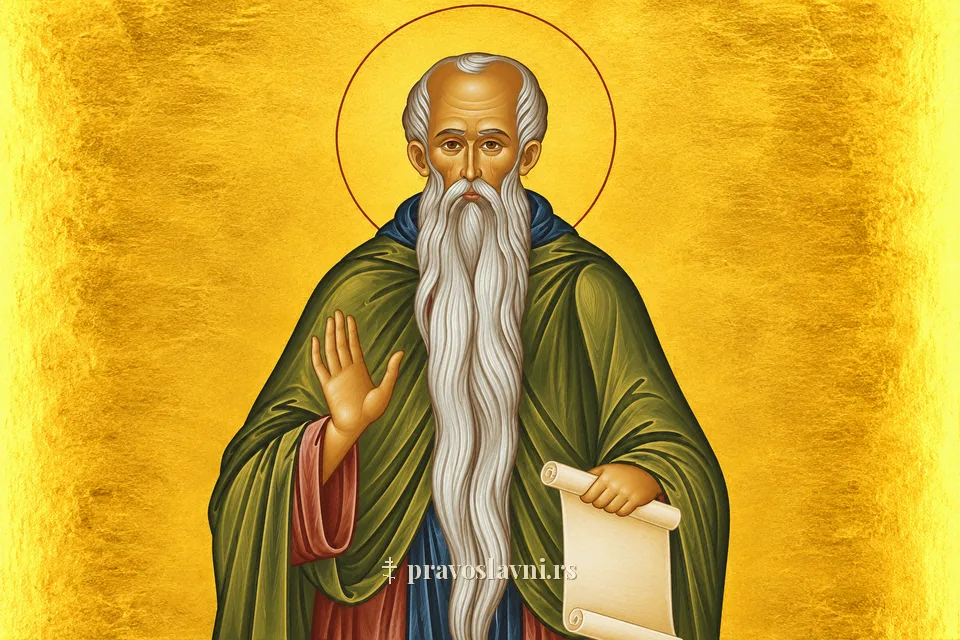
Venerable Euthymius the Great
What happenedBefore his death St Euthymius charged his disciples to keep hospitality and never to close the monastery gate to guests.
Read the LifeOrthodox Calendar · 20 January according to the Julian calendar
Monday, 2 February 202620 January (according to the Julian calendar)What happenedBefore his death St Euthymius charged his disciples to keep hospitality and never to close the monastery gate to guests.
Read the Life
You may eat meat, eggs, milk and dairy products, as well as any other food — but try to be moderate.
More about the fast →
Today the Church keeps the commemoration of a saint · not a Red Letter day.
More about the feast →
“So He Himself often withdrew into the wilderness and prayed.”
— Lk 5:16“What salt is to bread, love is to the other virtues” — so, the Prologue records, St Euthymius the Great used to teach. He did not merely speak those words; he lived by them for almost a whole century.
His mother, as the Prologue and his Life record, obtained him from God by prayer, and before his birth she also had a vision from heaven; he came into the world around the year 377 in Melitene, not far from the Euphrates. He began the ascetic life early, and as a presbyter he was given, against his will, the care of the monasteries of his native city. In his twenty-ninth year he went to Jerusalem and remained in the desert between Jerusalem and Jericho. He had nothing and lived by the work of his own hands. There he gained a faithful friend, Theoctistus.
There came to be more and more monks around him, so that a great lavra grew up while he was still alive; yet fame did not please him and he would withdraw deeper into the desert. He used to tell the brethren that they should earn their bread with their own hands and that they should not change monasteries, for “a tree that is often transplanted does not bear fruit”. Nor did he allow the young to set themselves apart from the rest by fasting, lest this lead them into pride.
According to the Prologue, God through him gave bread in abundance and water in the desert, and the sick and the possessed found a cure. His Life records that he healed the son of a Saracen chieftain, after which a great number of Saracens were baptised, and that after a long drought his prayer with tears brought abundant rain. His disciples, according to his Life, saw fire around him while he was serving, and he told them that he often saw an angel serving with him. When the heretic Theodosius seized the throne of Jerusalem, Euthymius remained faithful to Orthodoxy and, according to his Life, helped the desert-dweller Gerasimus and the Empress Eudocia to return to it.
Among his disciples were Theoctistus, Cyriacus the Anchorite and Sabbas the Sanctified. He reposed on 20 January 473, in the 97th year of his life. His last message to his disciples concerned guests: hospitality should be offered to everyone who comes.
Euthymius teaches us that love, joined with humility, holds all the other virtues together.
As he was dying, Euthymius asked of his disciples one thing above all — that everyone who came to them should find hospitality and that their monastery should always be open to guests. That openness tells us best what kind of man he was.
His homeland was Melitene, an Armenian city not far from the Euphrates, where he was born around the year 377 into a respected and devout family. The Life says that his father Paul and his mother Dionysia were childless for a long time and that they prayed in the church of the holy martyr Polyeuctus. As the Prologue and the Life record, they received their son through his mother's prayer, after a heavenly vision; according to the Life, the name Euthymius, which points to consolation and joy, was made known to them already in that vision. After his father's death his mother entrusted him to her brother, the presbyter Eudoxius, who brought him to Bishop Otreius. He was taught by the priests Acacius and Synodius. He became a reader, and his mother a deaconess.
He began the ascetic life while still young, near his native city. He was ordained presbyter and, against his will, was given the care of the city's monasteries. In his twenty-ninth year he went to Jerusalem, venerated the Cross and the Tomb of the Lord, and visited the hermits.
He settled in the desert of Pharan, between Jerusalem and Jericho. He had nothing, and he lived by plaiting ropes from palm leaves. There he became close friends with Theoctistus. The Life says that the two of them went away every year into the desert of Coutila for fasting and prayer, and after five years they settled in a cave above a ravine, feeding on wild plants. When shepherds learned of them, monks began to arrive, and so the cave became a church, and around it a coenobitic community arose. Solitude was nevertheless dearer to him, and so he left the care of it to Theoctistus.
Fleeing from fame, he went with his disciple Domitian into the desert of Rouba, and then to Ziph. Later he built his own lavra on the model of Pharan, and Patriarch Juvenal consecrated its church.
The Prologue lists what God did through him: loaves were multiplied, water appeared in the dry desert, unclean spirits departed, the gravely ill recovered, and he prophesied. The Life records the details of this. Terebon, the son of the Saracen chieftain Aspebetus, had half his body withered by a demon. The boy saw Euthymius in a dream, and when the saint prayed and made the sign of the Cross over him, he recovered at once. Euthymius then taught the Saracens for forty days, and Aspebetus was baptised as Peter and later became their bishop. When, in a time of scarcity, about four hundred Armenian pilgrims arrived, he ordered Domitian to feed them, and the storeroom was found full of bread, oil and wine. After a long drought, at the request of the people, he prayed with tears and heavy rain fell. His disciples, the Life records, saw a fire surrounding him while he served, and he told them that he often saw an angel serving with him.
Euthymius supported the Third Ecumenical Council in Ephesus, which condemned Nestorius, and later he also accepted the decisions of the council in Chalcedon. When the heretical monk Theodosius seized the throne of Jerusalem and won over the Empress Eudocia and many monks, Euthymius withdrew into the desert and did not join him. The Empress, according to the Life, came to seek him out on the advice of Symeon the Stylite, and Euthymius's answer was clear — let her accept all four Ecumenical Councils; in this way she returned to Orthodoxy. The hermit Gerasimus, who had fallen into heresy, also repented before him.
He took food on only two days of the week, spoke little and, according to the testimony of his disciple Cyriacus, never lay down to sleep. The bread that a monk eats, he used to say, ought to be the fruit of his own labour. Nor did he approve of moving from monastery to monastery, for good deeds, he taught, have no need of new places. The Prologue preserves his words: “A tree that is often transplanted bears no fruit” and “What salt is to bread, love is to the other virtues.” He knew how to restrain the zeal of the young in fasting: they ate together with everyone, for in excessive fasting he saw the danger of pride.
He buried his friend Theoctistus, appointed Elias as his successor and foretold that Domitian would follow him on the seventh day. He reposed on 20 January 473, in his 97th year. Anastasius, Patriarch of Jerusalem, came to the funeral, the very man to whom Euthymius had once said that he saw him in patriarchal vestments. Domitian, as the Prologue and the Life record, saw him on the seventh day bathed in light and died that same day; he was buried beside his teacher.
Euthymius teaches us that love, when it is joined with humility, binds together all the other virtues: work with your own hands, be obedient, stay where you are and do not close the door to a guest.


