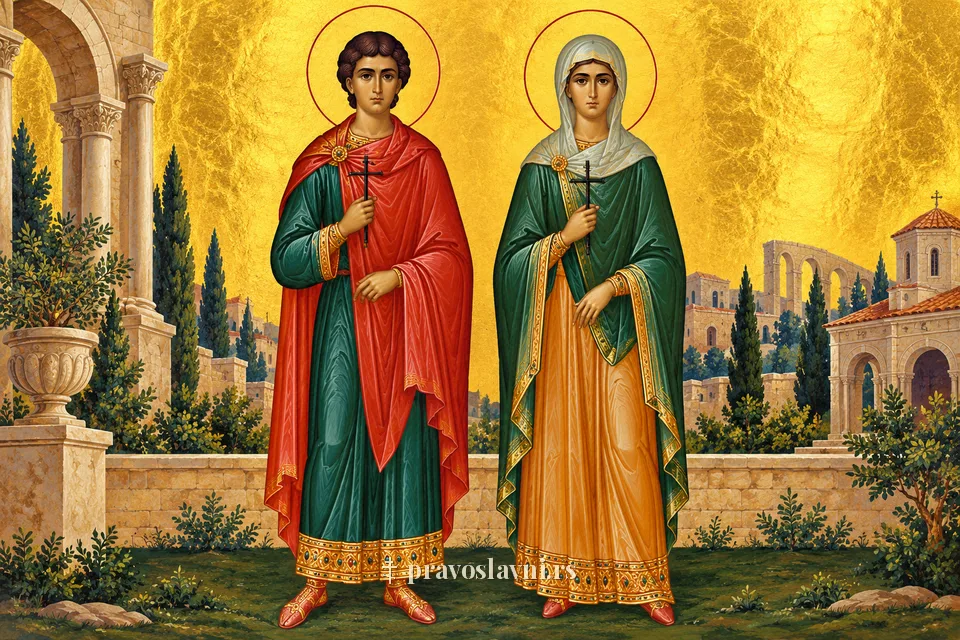
Saints of the day
Holy Martyrs Chrysanthus, Daria and those with them
What happenedSts Chrysanthus and Daria lived in marriage as brother and sister, and for their faith in Christ they were buried alive in Rome.
Read the LifeOrthodox Calendar · 19 March according to the Julian calendar
Wednesday, 1 April 202619 March (according to the Julian calendar)What happenedSts Chrysanthus and Daria lived in marriage as brother and sister, and for their faith in Christ they were buried alive in Rome.
Read the Life
No meat, dairy products, eggs, fish or oil — food cooked in water.
This is a recommendation — for your own fast, consult your priest or spiritual father.Prayer of St Ephraim the Syrian →More about the fast →
Today the Church keeps the commemoration of a saint · Sixth week of Great Lent.
More about the feast →
“I beseech you therefore, brethren, by the mercies of God, that you present your bodies a living sacrifice, holy, acceptable to God, which is your reasonable service.”
— Rom 12:1Chrysanthus and Daria were not an ordinary married couple. They were married by the will of his father, yet they lived as brother and sister, in purity, dedicated to Christ.
Chrysanthus was the son of Polemius, a respected man who had moved from Alexandria to Rome. Although he was learned, he found the truth only in the Gospel and in the Acts of the Apostles, and he was baptised by the presbyter Carpophorus. His father wanted to turn him away from purity, and so he surrounded him with dissolute women, but in vain. Then he brought him Daria as a wife, a pagan woman, according to the Life a servant of the goddess Minerva, who was meant to turn him away from Christ. The Life says that the opposite happened: in conversation Chrysanthus convinced her of the nothingness of the Roman gods.
When his father died, the faith no longer had to be hidden, and the whole household lived in a Christian way. The Life records that around the two of them gathered young men and girls who were resolved to live in purity, in communities resembling monasteries, and that the citizens complained to the authorities because of this.
Under the Emperor Numerian the torments came. According to the Life, Chrysanthus was handed over to the tribune Claudius. The torturer became a brother in the faith, together with everyone in his house. Both he and his two sons lost their lives for the faith, and his wife breathed her last at prayer on the spot where they were executed. Of Daria the Life tells that a lion guarded her and defended her purity, and the Prologue that the pagans called her a goddess: “Daria is a goddess!”
Chrysanthus and Daria were at last buried alive in a deep pit. There, according to the Prologue, a church was afterwards built. Not far away, in a cave, the Christians who had gathered for prayer also suffered, when the pagans closed up the entrance; among them were the presbyter Diodorus and the deacon Marianus. The Prologue commemorates them all as martyrs who suffered in Rome in the years 283 and 284.
Their life bears witness that purity can be kept even amid temptations, that marriage can be lived for Christ, and that patience in torments can convert even the torturer.
Chrysanthus was the only son of the distinguished Polemius, who had moved from Alexandria to Rome. The Life adds that the Roman nobles received him well, and that the Emperor made him a senator. The son acquired all the knowledge that his age could offer, but, as the Prologue records, for all his learning he did not know where the truth lay — until he took into his hands the Gospel and the Acts of the Apostles.
After that reading, according to the Life, he decided to seek the truth of the Christian faith from simple teachers. A relative told him about the presbyter Carpophorus, who knew the Scriptures well and was hiding from the persecutors in a cave in the mountains. Carpophorus instructed him and baptised him; the Life says that the instruction lasted several months. As early as the seventh day after his baptism Chrysanthus began to preach Christ publicly.
His father could not bear his son's faith. The Life records that his relatives warned him that the guilt for his son's blasphemy would fall upon him, and so Polemius shut Chrysanthus up in a dark and neglected room and starved him. The young man, according to the Life, accepted this as a spiritual struggle.
Then his father tried another way: he surrounded him with dissolute women in order to part him from his purity — according to the Life, in a bright and luxurious palace, among slave girls. Chrysanthus kept his purity. The Life says that the women sank into a deep sleep whenever he prayed, and of his prayers these words have been preserved: “O Lord, arise to help me!”
At last his father married him to Daria, a pagan. The Life describes her as a learned maiden, skilled in oratory, who served the goddess Minerva and had been persuaded to turn the young man away from Christ. The opposite happened. Chrysanthus, according to the Life, answered every one of her arguments and showed how worthless the Roman gods and the philosophers' worship of the elements were, and Daria believed. They agreed to live in marriage as brother and sister, in purity.
When Polemius died, Chrysanthus no longer concealed his faith, and in his house everyone lived as Christians. The Life says that he inherited the estate and baptised Daria at home. She quickly came to know the Scriptures. Around Chrysanthus there gathered young men, and around Daria young women, who dedicated themselves to Christ in purity and lived in communities ordered like monasteries.
This did not please everyone. According to the Life, the citizens complained to the prefect Celerinus that marriages were being broken up because of them, and he ordered that they be tortured if they did not offer sacrifice, and handed Chrysanthus over to the tribune Claudius.
They were tortured during the reign of the Emperor Numerian. The Life records a series of miracles: the fetters broke apart, the prison was filled with light, and an iron rod became as soft as a twig. So the very man to whom they had been handed over for torture, the tribune Claudius, became a Christian too, and after him, according to the Life, his wife Hilaria, his sons Jason and Maurus, his relatives, servants and soldiers. His faith cost him his life: the Life says that he was thrown into the sea, and the sword overtook both Jason and Maurus. Hilaria, according to the Life, was seized while she was praying at the grave of her sons; she begged: “Allow me to finish my prayer, and then lead me wherever you wish,” and at prayer she breathed her last.
Daria, according to the Life, was taken to a place of shame, but there she received an unexpected protector — a lion that had broken out of its cage. The lion knocked down a young man who had been sent to dishonour her, and at her word it let him go. The young man went through the city crying out: “Know, all you Romans, that Daria is a goddess!” The Prologue records that the pagans also called her so. The Emperor Numerian, according to the Life, called all these miracles sorcery.
Chrysanthus and Daria were at last buried alive in a deep pit — according to the Prologue, under stones; the Life says that they died singing and praying. Their grave did not remain forgotten: according to the Prologue, a church was later built there, and the Life mentions people who were healed and other miraculous signs at the place of their suffering.
In a nearby cave Christians gathered to pray and to receive Holy Communion on the feast. The pagans closed up the entrance and everyone inside perished, among them the presbyter Diodorus and the deacon Marianus. The Prologue mentions Chrysanthus and Daria together with them, as martyrs who suffered in Rome in the years 283 and 284; the Life places the suffering of Chrysanthus and Daria in the year 283.
Their life bears witness that purity can be kept even in the midst of temptations, that marriage too can be lived for Christ, and that endurance in suffering can convert even the torturer himself.
Venerable Simeon, Sava Popović at his baptism, was born in Cetinje in the year 1854, on the day of St Nicholas, as the only child of Vaso and Stana Popović; his Life says that he was given his name after St Sava. He lost his parents early, and so he was brought up in the faith by his grandfather Milan and by the parish priest of Cetinje, Lazo Popović, who had also baptised him. He studied at the monastery school in Cetinje, which had been founded by Njegoš, and he excelled in Church Slavonic, in chanting and in fine handwriting. His grandfather wanted him to marry and run the estate, but, at the urging of his relative Mihailo and on the recommendation of Metropolitan Ilarion, he went to study in Kiev, at the seminary and the theological academy, and the Life says that he also studied philosophy in Paris and the Protestant teachings in Geneva. He became a monk in the Kiev Caves Lavra, on the feast of the Three Holy Hierarchs, when he received the name Simeon, and soon afterwards he was ordained deacon and priest. On his return to Montenegro he served at the Monastery of St Nicholas on Vranjina, and from 1889 at Ostrog, where he taught in the monastic school, received pilgrims, told them about St Basil of Ostrog and prayed for the sick. The Life says that in the year 1890 a holy hierarch, hidden from the Turks, appeared in a vision to a shepherd from Dajbabe near Podgorica and asked for a monastery and a small church, and Simeon wrote down his account and took the building in hand. The cave church of the Dormition of the Most Holy Theotokos was consecrated on 22 December 1897, and Simeon himself painted the icons and frescoes in the caves. He lived as an ascetic, in prayer and fasting, and people came to him for counsel and for prayer, after which, according to the Life, many recovered their health. He wrote spiritual books for the people, often in verse, and Bishop Nikolaj called him a holy monk. He reposed at dawn on 1 April 1941, after Holy Communion, on the day of Sts Chrysanthus and Daria, having, as the Life says, foreseen the fratricidal war and prayed to depart before it. He wished to rest in the wall of his church, and there he was buried, and his grave became a place of pilgrimage.


