Saint of the day
Great Martyr Irene
What happenedThe Great Martyr Irene, daughter of a pagan ruler, survived many tortures by the power of God and brought a multitude of people to Christ, among them her own father.
Read the LifeOrthodox Calendar · 5 May according to the Julian calendar
Monday, 18 May 20265 May (according to the Julian calendar)What happenedThe Great Martyr Irene, daughter of a pagan ruler, survived many tortures by the power of God and brought a multitude of people to Christ, among them her own father.
Read the Life
You may eat meat, eggs, milk and dairy products, as well as any other food — but try to be moderate.
More about the fast →
Today the Church keeps the commemoration of a saint · not a Red Letter day.
More about the feast →
“My God sent His angel and shut the lions’ mouths, so that they have not hurt me, because I was found innocent before Him; and also, O king, I have done no wrong before you.”
— Dan 6:22The name Irene, according to her Life, was given to her by an angel in a dream, who foretold that many would come to believe through her. Until then she had been called Penelope, and she was the daughter of Licinius, who ruled the city of Magedon as a petty king.
Her teacher Apelian, as the Prologue records, taught her about Christ, and she was baptised by Timothy — according to the Prologue a disciple of the Apostle Paul, according to her Life a presbyter. A dove, an eagle and a raven with a snake, which appeared to her, signified, in her teacher's interpretation, meekness, victory over the passions and victory over the devil.
Because she refused to marry, her father intended to torture her, and she, according to her Life, said to him: “I will not offer sacrifice to demons!” By a miracle, however, her father himself came to believe. The Prologue records that, besides her father, four more rulers tortured her and that God preserved her every time. King Sedekias threw her into a pit with snakes and scorpions, but an angel protected her; nor did a mill wheel do her any harm, because the water stopped flowing. When King Sabah tortured her and drove her out of the city, the earth swallowed up her torturers. In Callipolis King Numerian put her into red-hot metal bulls, and in Constantina the prefect Vaudon laid her on a red-hot gridiron, but each time she remained unharmed and many came to believe. In Mesembria King Sapor had her put to death, but God raised her to life, and so both the king and the people received baptism.
The Prologue says that she brought more than a hundred thousand pagans to Christ. Her Life adds that she also preached and healed in Ephesus. In the end she lay down in a tomb and ordered that it be sealed. When the tomb was opened four days later, it was empty; the Life says that Christ took her into paradise.
Irene bears witness that the power of God guards those who are faithful to Him, and that one steadfast confessor can bring a multitude of people to Christ — even her own persecutors and her own father.
Irene's pagan name was Penelope. She was the daughter of Licinius, who ruled the city of Magedon as a petty king; the Life says that her mother's name was Licinia. The Prologue records that some think she was of Slavic descent. According to the Life, at the age of six she was already of rare beauty, and so her father built her a splendid tower outside the city, full of golden idols, and settled her there with thirteen maidens, her governess Karia and her teacher Apelian. The Prologue says that the teacher Apelian taught her about Christ.
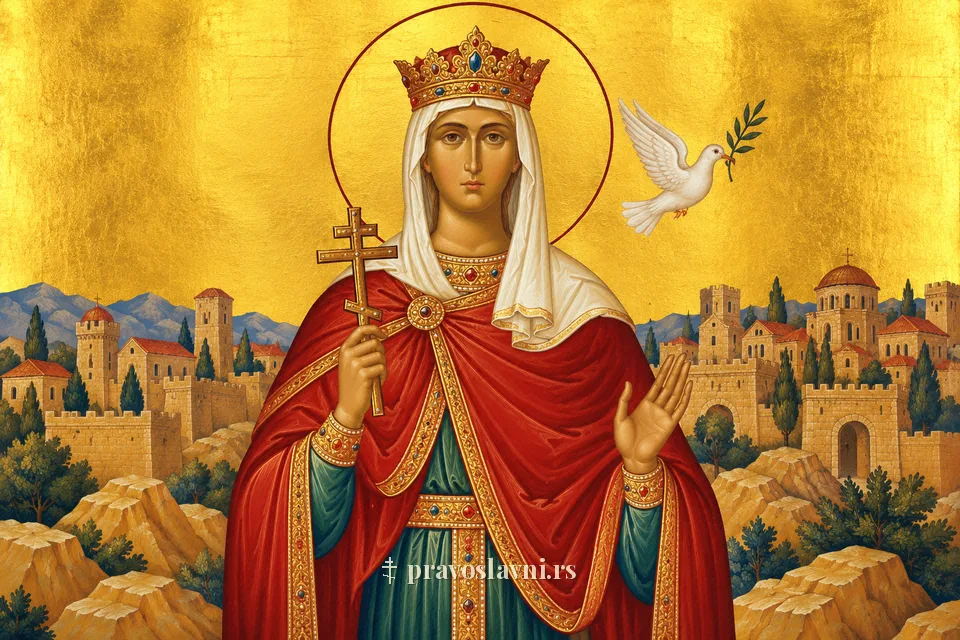
A dove, an eagle and a raven with a snake appeared to her. Her teacher explained to her that they signified her meekness, her victory over the passions and her victory over the devil. The Life adds that the dove was carrying an olive branch, a sign of the grace of baptism, and the eagle a wreath, a sign of the heavenly reward.
The Life relates that, when in her twelfth year her father began to arrange her marriage, she asked for seven days to think it over. She questioned the idols, and they were silent, so she prayed to the God of the Galileans. In a dream an angel gave her the name Irene, foretold that many would come to believe through her and announced the coming of Timothy. Timothy — the Prologue says a disciple of the Apostle Paul, and the Life a presbyter — baptised her and her maidens; the Prologue adds that he brought her the epistles of St Paul to read. After her baptism, according to the Life, she threw the golden idols out of the window.
Her father could not bear that she was renouncing marriage, and so he decided to torture her. The Life records her words: “I will not offer sacrifice to demons!” It also states that in the name of Jesus Christ she cast out a demon that was speaking from the idol of Apollo. According to the Life, her father ordered that she be trampled by horses, but the fiercest horse killed him, and another praised the martyr with a human voice. Through the miracle her father came to believe; the Life says that Irene raised him from the dead and healed his hand, that his wife, his household and about three thousand people believed with him and that he renounced his throne.
The Prologue records that, besides her father, four more rulers tortured her and that God preserved her every time. King Sedekias threw her into a pit full of snakes and scorpions — according to the Prologue, an angel killed the reptiles, and according to the Life, an angel guarded her for ten days. Nor did the saw with which they tried to torture her do her any harm, and when they tied her to a mill wheel, the water stopped flowing.
The Life relates that King Savorus marched on Magedon with a huge army, which at Irene's prayer was struck blind and received its sight again when he begged for this; the Life also records his words: “Now I know that the power of your God is invincible”. Yet Savorus — according to the Prologue, the son of Sedekias — tortured her and drove her out of the city, and the torturers, as both sources record, were swallowed up by the earth.
In Callipolis King Numerian put her into three red-hot metal bulls, one after another, but she came out unharmed and many believed. In the city of Constantina the prefect Babdonus placed her on a red-hot gridiron; she remained whole and many accepted the faith — the Life says Babdonus himself as well, and she stayed there for fifteen years. In Mesembria King Sapor had her put to death, but God raised her up, and so the king and a great many people believed and were baptised.
For almost every one of these events the Life records thousands of converts, and the Prologue sums it all up by saying that she brought more than a hundred thousand pagans to Christ. According to the Life, in Magedon she healed the sick, raised a young man from the dead and taught the people there for three years. Later, after her father's death, she returned once more to Magedon, and then went to Ephesus, where she preached and healed.
In the end she lay down in a tomb — the Life says a new and empty one — and ordered that it be sealed; according to the Prologue this was done by Apelian, and according to the Life by six men. The tomb was opened four days later and found empty. The Life, whose writer presents himself as Apelian, concludes that Christ took her to paradise.
Irene bears witness that the power of God preserves His faithful one through every torture and that one steadfast confessor can bring a multitude of people to Christ — even her own persecutors and her own father.