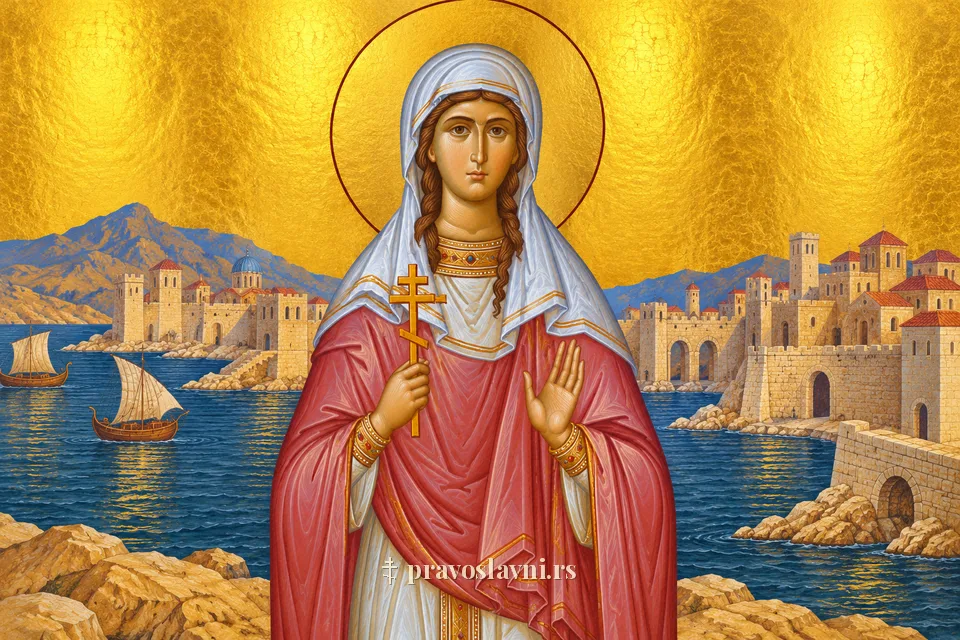
Saint of the day
Holy Martyr Theodosia of Tyre
What happenedSt Theodosia, a maiden of Tyre, encouraged the bound Christians before the court in Caesarea, and herself suffered for Christ as a martyr.
Read the LifeOrthodox Calendar · 29 May according to the Julian calendar
Thursday, 11 June 202629 May (according to the Julian calendar)What happenedSt Theodosia, a maiden of Tyre, encouraged the bound Christians before the court in Caesarea, and herself suffered for Christ as a martyr.
Read the Life
No meat, dairy products, eggs or fish — oil and wine are allowed.
This is a recommendation — for your own fast, consult your priest or spiritual father.More about the fast →
Today the Church keeps the commemoration of a saint · not a Red Letter day.
More about the feast →
“For our light affliction, which is but for a moment, is working for us a far more exceeding and eternal weight of glory.”
— 2 Cor 4:17On the first night after her execution St Theodosia appeared to her parents, all in the light of heaven, among the holy virgins. Earlier they had tried to turn her away from confessing Christ and from martyrdom, and now, as the Prologue and her Life say, she herself showed them how great a glory she had won. Her Life says that she wore a crown and a golden cross.
She was, according to her Life, a maiden from Tyre who was not yet eighteen years old. In Caesarea in Palestine, in the time of Emperor Maximian, she went up to the bound Christians before the court and encouraged them to endure to the end. Her Life, on the testimony of Bishop Eusebius, says that she begged them to remember her before the Lord. The soldiers seized her and brought her before the judge. She was tortured with iron claws and then thrown into the sea, according to the Prologue with a stone around her neck.
Angels, as the Prologue records and as her Life relates from other sources, led her out alive onto the shore. The Life also says that she was afterwards condemned to the wild beasts, which did not touch her. She was beheaded in the year 308. The Life also records that at the hour of her execution a dove shining like gold was seen flying away towards heaven.
St Theodosia bears witness that neither torments nor death can break those who love Christ more than anything, even more than their parents.
The Life takes the story of the holy martyr Theodosia from Eusebius, Bishop of Caesarea, who says that he saw these events with his own eyes. In Caesarea in Palestine the persecution of Christians had by then already lasted five years; the Prologue places it in the time of Emperor Maximian. According to the Life, Theodosia was a maiden from Tyre, devout and pure, and not yet eighteen years old. She suffered in the year 308.
Her struggle began with care for others. Christians in chains were standing before the court, and she went up to them and, as both sources say, encouraged them not to falter in their martyrdom. According to the Life, she also asked them to remember her when, as martyrs, they stood before the Lord.
The soldiers noticed how she was bowing to the prisoners, and so, according to the Life, they seized her and led her before the governor Urban. In his anger Urban handed her over to be tortured with iron claws, and the Life says that even then her face did not lose its brightness. After that she was thrown into the sea, according to the Prologue with a stone around her neck.
Here the testimony of Eusebius comes to an end, and the Life continues according to other sources. That the sea was not her end is recorded by the Prologue as well: angels rescued her from the water. The Life adds that she still carried the stone upon her, that afterwards they condemned her to the wild beasts, and that the beasts did not even touch her. She ended her life under the sword. At the moment of her execution, according to the Life, a dove shining like gold was seen departing towards heaven.
Her parents had not wanted her to confess Christ or to suffer. She gave them her answer after her death: on the very first night she appeared to them bathed in heavenly light, among the holy virgins, and the Life says that she was wearing a golden cross and a crown. The Life records her words in this way: “See how great is the glory and the grace of my Christ, of which you wished to deprive me!”
On this day the Prologue reminds us that the saints were not broken by prison, or torments, or exile, or death. A girl who was not yet eighteen years old showed a courage stronger than all threats, and she did not place Christ even below her love for her parents.


