Saint of the day
St Tikhon the Wonderworker, Bishop of Amathus
What happenedThe boy Tikhon gave bread from his father's bakery to the poor, and God repaid his almsgiving with an abundance of grain.
Read the LifeOrthodox Calendar · 16 June according to the Julian calendar
Monday, 29 June 202616 June (according to the Julian calendar)What happenedThe boy Tikhon gave bread from his father's bakery to the poor, and God repaid his almsgiving with an abundance of grain.
Read the Life
No meat, dairy products, eggs, fish or oil — food cooked in water.
This is a recommendation — for your own fast, consult your priest or spiritual father.More about the fast →
Today the Church keeps the commemoration of a saint · not a Red Letter day.
More about the feast →
“Give, and it will be given to you: good measure, pressed down, shaken together, and running over will be put into your bosom. For with the same measure that you use, it will be measured back to you.”
— Lk 6:38Little has been preserved about St Tikhon the Wonderworker, Bishop of Amathus in Cyprus: his Life says that the records about him perished in the raids of the Hagarenes, in which churches and books were destroyed. Even so, the Prologue and the Life remember what matters most.
He was a shepherd who led his fellow citizens from idols to Christ. Since many on the island had not yet renounced the idols, he preached to them, according to both sources, with apostolic zeal, and according to the Life he tore down both the idols and their shrines. He became bishop after the death of Bishop Mnemonius, who earlier, according to the Life, had ordained him deacon because of his pure life. St Epiphanius consecrated him bishop, and the election was unanimous.
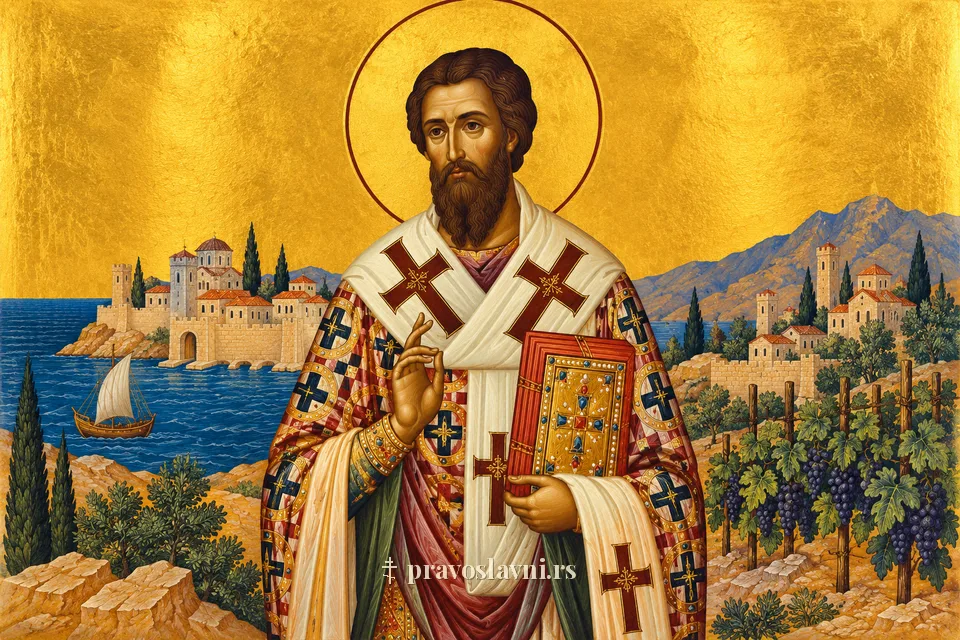
Mercy was his nature even in childhood. He gave away bread from his father's bakery to the poor, and when his father grew angry, Tikhon's prayer brought an abundance of grain into the house. Both sources also speak of the dry vines that he planted, which took root and bore fruit; according to the Life, that vineyard bore early fruit even after his death.
He bears the title Wonderworker because of the miracles he worked. According to tradition, he foretold the time of his death. He reposed in old age, according to the Prologue around the year 425.
His life teaches that God repays mercy towards the poor with abundance, and that zeal for the faith brings people to Christ.
St Tikhon was the bishop of Amathus, the city in Cyprus in which he was also born. His Life says that he grew up with devout parents, who taught him the sacred books, and that he first served in the Church as a reader. Bishop Memnonius ordained him a deacon because of the purity of his life. After the death of Memnonius the choice of a new bishop fell upon Tikhon, without a single voice against, and the Prologue and the Life record that he was consecrated by St Epiphanius, Archbishop of Cyprus.
In his time many of the inhabitants of the island still worshipped idols. Tikhon, as both sources say, preached to them with the zeal of an apostle and brought them to Christ. According to the Life, he pulled down the idols and the pagan sanctuaries in the country around Amathus.
Both the Prologue and the Life remember two stories about his mercy and God's answer to it. As a boy he used to carry bread from his father's bakery to the poor. His father was angry, but Tikhon turned to God, and after his prayer it was found that there was grain in abundance in the house.
The second story tells of vine branches which others had thrown away as dry. Tikhon, according to both sources, planted them all the same, and they took root and bore fruit. The Life adds that the fruit was early, rich and sweet, and that even after his death the vineyard gave grapes early, which were brought to the church on his feast day for the wine used in the divine services.
Tikhon bears the name Wonderworker, according to both sources because of miracles during his lifetime, and according to the Life after his death as well. According to tradition, he knew in advance when he would die. He reposed in old age, according to the Prologue around the year 425.
Why we do not know more about him is explained by the Life: the extensive records of his life were lost when the Hagarenes, in their raids, were destroying churches and books.
From his life there remains the lesson that God repays mercy to the poor with abundance, and that the zeal of one shepherd can lead many away from idols to Christ.


