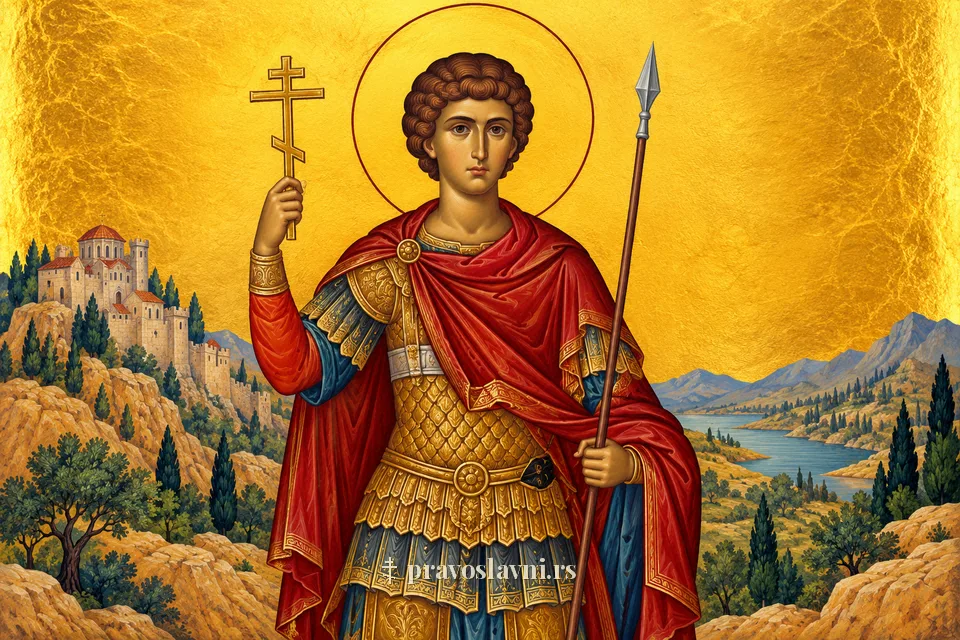
Saint of the day
Great Martyr Procopius
What happenedSt Procopius, a commander of the Emperor Diocletian, was converted on the road by a vision of the cross, brought his mother and many others to the faith, and was beheaded for Christ.
Read the LifeOrthodox Calendar · 8 July according to the Julian calendar
Tuesday, 21 July 20268 July (according to the Julian calendar)Save your slava — you'll get a reminder a week and a day before.
Send a greeting card →What happenedSt Procopius, a commander of the Emperor Diocletian, was converted on the road by a vision of the cross, brought his mother and many others to the faith, and was beheaded for Christ.
Read the Life
You may eat meat, eggs, milk and dairy products, as well as any other food — but try to be moderate.
More about the fast →
Many families celebrate their Krsna slava (family patron saint's day) today
More about the feast →
“Although I was formerly a blasphemer, a persecutor, and an insolent man; but I obtained mercy because I did it ignorantly in unbelief.”
— 1 Tim 1:13Sung at the Slava (family patron saint's feast) and on the saint's feast day.
Thy martyr, O Lord, Procopius, in his suffering received from Thee, our God, an incorruptible crown; for, having Thy strength, he cast down the tormentors and crushed the powerless audacity of the demons. By his prayers save our souls.
Translation: pravoslavni.rs
On this day the Church celebrates the Holy Great Martyr Procopius, and many families keep him as their Krsna slava (family patron saint's day). His name is also mentioned in the marriage service. In prison he instructed in the faith twelve women who confessed Christ.
St Procopius was a soldier who changed his master. As Neanias, the son of a Christian father and a pagan mother from Jerusalem, he served as a commander of the Emperor Diocletian and set out for Alexandria to persecute the Christians. According to his Life, his father Christopher, a Christian senator, died soon after the birth of his son, and so his mother Theodosia brought him up in paganism.
The turning point came on the road, at night, with a strong earthquake. The Prologue preserves the question which the Lord addressed to him: “Neanias, where are you going, and against whom are you rising up?” When Neanias said that he did not know who was speaking to him, he saw a cross shining like crystal and heard: “I am Jesus, the crucified Son of God.” According to the Prologue, that cross was given to him as a sign of victory. Both sources compare his conversion with that of Saul. He had a cross made according to what he had seen, and on it, says his Life, there appeared the names Emmanuel, Michael and Gabriel. He then turned his army against the Hagarenes, who were attacking Jerusalem, and defeated them. His Life adds that he set the captives free and that not one of his soldiers was killed.
His mother, when he confessed his faith to her, complained to the Emperor. Before the judge Neanias threw off his belt and sword, as a soldier of the heavenly King. When he had been tortured, the Lord visited him in prison: He healed him, baptised him and gave him the name Procopius.
He brought many to Christ. According to his Life, two companies of soldiers came to believe, and Bishop Leontius baptised them by night. Twelve women who sought him out at the prison window he prepared for martyrdom, and their courage converted his mother as well; all of them were put to death before him.
Turned towards the east, before his death he prayed for the poor, for widows, for orphans, for the suffering and for the Church. The Prologue says that a sign from heaven confirmed to him that he had been heard. He was beheaded on 8 July (according to the Julian calendar), according to the Prologue in Caesarea of Palestine, in the year 303. The Prologue records that his name is mentioned in the marriage service, together with Constantine and Helen.
Procopius was born in Jerusalem, of a Christian father and a pagan mother, and his name was Neanias. According to his Life, his father Christopher, a Christian senator of Jerusalem, died soon after he was born. His mother Theodosia brought him up as a pagan. His Life says that she took him to Antioch in Syria and placed him in the service of Emperor Diocletian. The Emperor grew fond of him and made him a commander, and then sent him with soldiers to Alexandria to wipe out the Christians.
On the way, at the third hour of the night — according to his Life, near Apamea — there was a strong earthquake. The Prologue says that the Lord spoke to him: “Neanias, where are you going, and against whom are you rising up?” Neanias asked who was speaking, for he could not recognise Him. Then a cross shone above him, transparent like crystal, and a voice was heard: “I am Jesus, the crucified Son of God.” According to the Prologue, the Lord told him to conquer his enemies by this sign and that His peace would be with him. The Prologue and his Life compare this conversion with the conversion of Saul.
Neanias had a cross made for him like the one he had seen; his Life says that it was made by a goldsmith in Scythopolis. According to his Life, figures appeared on the cross with the names Emmanuel, Michael and Gabriel, and when the goldsmith tried to rub them out, his hand grew stiff.
He did not lead the army against the Christians, but against the Hagarenes who were attacking Jerusalem, and he defeated them. His Life adds that he freed the captives and that not one of his soldiers was killed. When he entered Jerusalem, he told his mother that he was a Christian. According to his Life, he smashed her gold and silver idols and gave the metal away to the poor.
His mother complained to the Emperor. According to his Life, Diocletian ordered Justus, the governor of Palestine, to bring Neanias back by kindness or by force. Before the judge he cast off the marks of his military service, his belt and his sword, because, as he said, he was now a soldier of Christ, the heavenly King. His Life also records his words: “I am a Christian, and you do what you have been ordered to do.” He was tortured and thrown into prison. His Life adds that the gaoler Terentius, out of pity, put straw under him.
In prison the Lord appeared to him — according to his Life at midnight, in light, as the doors were opening — healed him, baptised him and gave him the name Procopius. When they showed him, healed, to the people, the governor, according to his Life, claimed that the gods had healed him; in the temple Procopius made the sign of the cross, and the idols fell and were shattered.
According to his Life, two companies of soldiers with the tribunes Nicostratus and Antiochus also came to believe; Bishop Leontius baptised them by night and they were beheaded. Twelve women came to the window of his prison, saying that they too were handmaids of Christ. They were shut up together with him, and he, instructing them in the faith, prepared them for martyrdom. The women were tortured and put to death. Seeing their courage, his mother Theodosia also came to believe and was put to death with them.
According to his Life, Justus died of a fever, and Procopius was further examined by the new governor, Flavian. The soldier Archelaus, who was ordered to behead him, lost the strength in his arms and died. Nor did fresh tortures do him any harm. His last prayer, which he said at the place of execution with his face turned to the east, was for others: for the poor, the suffering, orphans and widows, and for the Church and her true faith. The Prologue says that a sign from heaven showed that his prayer had been heard, and then he bowed his head beneath the sword. He was beheaded on 8 July (according to the Julian calendar), according to the Prologue in Caesarea in Palestine, in the year 303. The Prologue records that his name is mentioned in the marriage service, together with Constantine and Helen.


