Saint of the day
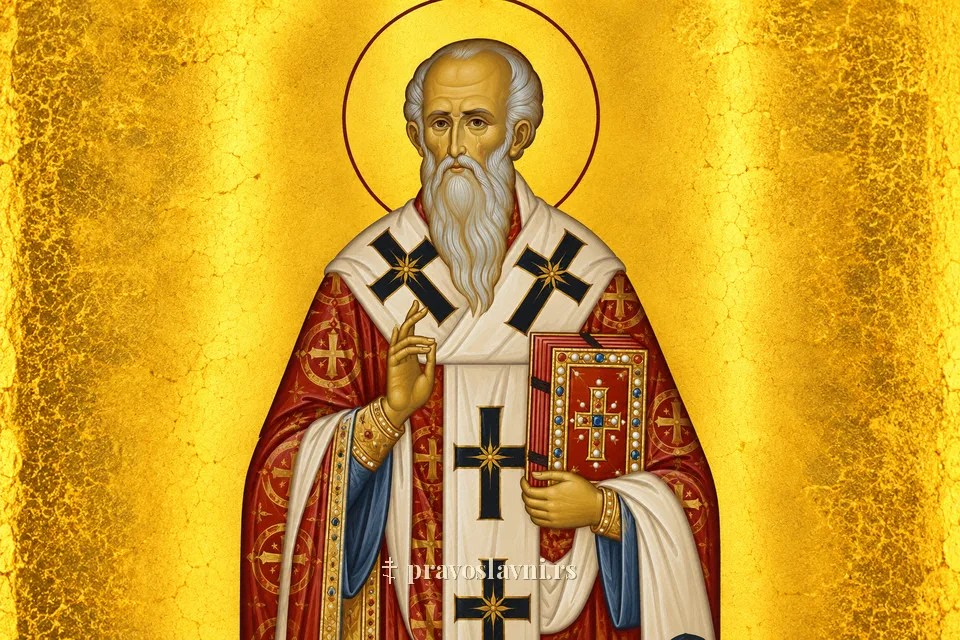
St Emilian the Confessor
What happenedSt Emilian, Bishop of Cyzicus, did not obey the iconoclast emperor, but for the veneration of the holy icons endured exile and reposed as a confessor.
Read the LifeOrthodox Calendar · 8 August according to the Julian calendar
Friday, 21 August 20268 August (according to the Julian calendar)What happenedSt Emilian, Bishop of Cyzicus, did not obey the iconoclast emperor, but for the veneration of the holy icons endured exile and reposed as a confessor.
Read the Life
No meat, dairy products, eggs, fish or oil — food cooked in water.
This is a recommendation — for your own fast, consult your priest or spiritual father.More about the fast →
Today the Church keeps the commemoration of a saint · not a Red Letter day.
More about the feast →
“But even if you should suffer for righteousness’ sake, you are blessed. ”And do not be afraid of their threats, nor be troubled.”“
— 1 Pet 3:14St Emilian was Bishop of Cyzicus, raised to that see, according to the Life, because of his ascetic life. When the iconoclast emperor demanded that the veneration of the holy icons be rejected, Emilian did not consent. The Prologue says that he refused the orders to have the icons taken out of the churches, and the Life that he stood firm in the teaching of the holy fathers.
According to the Prologue, he was exiled together with some other Orthodox bishops and spent five years in exile. For Christ he endured many torments, persecutions and humiliations. According to the Life, he was also in prison, and he bore all of this with joy, looking towards eternity.
He reposed in the Lord as a confessor, according to the Prologue in the year 820. The service to him, as the Life states, was written by St Theophanes the Branded.
Emilian was the bishop of the city of Cyzicus. The Life says that he was raised to the episcopal throne because of his ascetic life.
When the iconoclast Emperor demanded that the veneration of the holy icons be rejected, Emilian did not agree to the imperial demands. According to the Prologue, he refused the orders that the icons be carried out of the churches; the Life says that he stood firm in the teaching of the holy fathers. The Prologue records that, together with some other Orthodox bishops, he was exiled and that he spent five years in exile.
For Christ he endured many torments, persecutions and humiliations, and according to the Life imprisonment as well. The Life says that in all this he was sustained by the hope of an eternal reward, and so he accepted suffering with joy.
He reposed in the Lord as a confessor, according to the Prologue in the year 820. The Life states that the service to him was written by St Theophanes the Branded, and that Bishop Nicodemus of Cyzicus published it in Constantinople in the year 1876.
Emilian was not put to death, but he persevered in the faith under the pressure of the powerful. He chose to endure exile and humiliation rather than renounce the holy icons.
His Life calls Venerable Zosim a great man of prayer and a spiritual father. According to tradition, he was a monk from Sinai and a hermit, whose cave in the rock was not far from the present-day Tuman Monastery. Tradition says that Miloš Obilić, the governor of Braničevo in the days of Prince Lazar, accidentally wounded him with an arrow while hunting and carried him to his court at Dvorište. Feeling that death was near, Zosim, according to tradition, asked to be left on that spot with the words: “Tu mani (leave me here) and let me die here.” Tradition links the name of the Tuman Monastery with these words. When he reposed, Miloš, according to tradition, buried him and built a church dedicated to the holy Archangel Michael; Zosim's relics rest in the church at Tuman, and they were found in 1936 Venerable Jakov was born in 1894 in the village of Kušići near Ivanjica and at baptism received the name Radoje Arsović. In France he earned two doctorates, in philosophy at the Sorbonne and in law at Montpellier, and he worked in the diplomatic service of the Kingdom of Yugoslavia. In the nineteen-thirties, at a gathering of the Bogomoljci (God-worshipper) brotherhoods in Vrnjačka Banja, moved by the sermons of the holy Bishop Nikolaj and by the words of a simple peasant, he left his career and asked to be received as a novice. He was a man of few words, and he spent his night's rest in prayer. He had only two sets of worn-out clothes, his food was meagre, and although he was a doctor of learning, he gladly carried out the lowliest obediences. He edited the journal “Hrišćanski misionar” (The Christian Missionary) and was a fiery preacher, and he spent the war in the Ljubostinja Monastery; his Life calls him clairvoyant. He reposed as a confessor in February 1946 in the village of Rabrovo, after a beating, and at his own wish he was buried at Tuman, where his relics were found in 2014


