Saint of the day
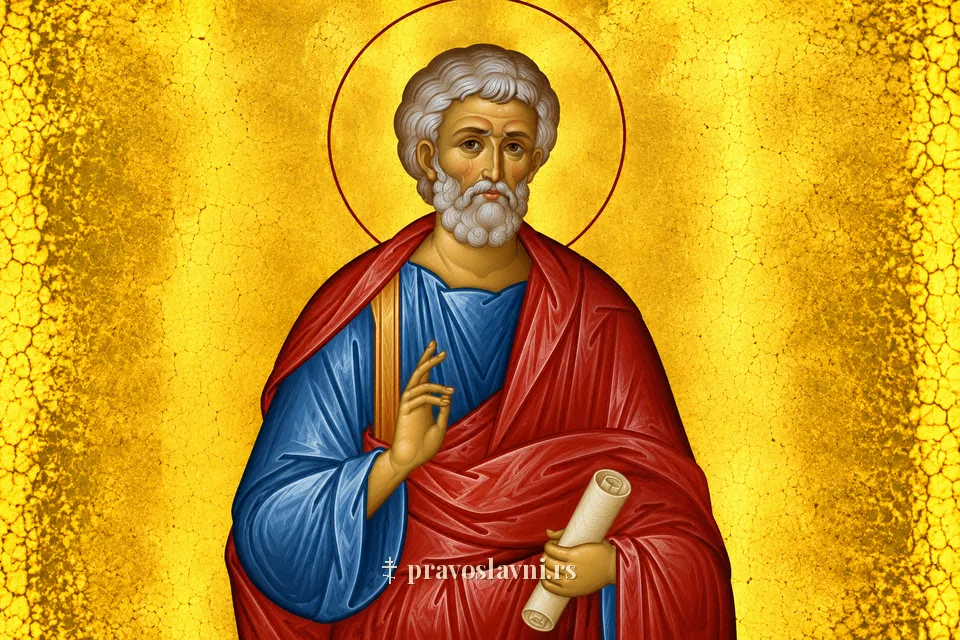
Holy Apostle Thaddeus
What happenedThe Apostle Thaddeus baptised and completely healed Abgar, the ruler of Edessa, and then refused his gold.
Read the LifeOrthodox Calendar · 21 August according to the Julian calendar
Thursday, 3 September 202621 August (according to the Julian calendar)What happenedThe Apostle Thaddeus baptised and completely healed Abgar, the ruler of Edessa, and then refused his gold.
Read the Life
You may eat meat, eggs, milk and dairy products, as well as any other food — but try to be moderate.
More about the fast →
Today the Church keeps the commemoration of a saint · not a Red Letter day.
More about the feast →
“Then the seventy returned with joy, saying, ”Lord, even the demons are subject to us in Your name.”“
— Lk 10:17“Since we have left what was our own, how could we accept what belongs to another?” — this is how the Apostle Thaddeus answered Abgar, the prince of Edessa, when he offered him a great deal of gold. Behind those words stood his entire life.
Thaddeus was one of the Seventy Apostles, and not the apostle of the same name from the circle of the Twelve. The Life says that he was a Jew from Edessa, with a good knowledge of the Old Testament. In Jerusalem he was baptised by John the Baptist, and then he followed Christ.
Prince Abgar was suffering from leprosy. After he had kissed the cloth with the image of the Lord, he recovered, except for a small trace on his face, and the Lord promised him His disciple. When Christ had risen and ascended, Thaddeus was sent to Edessa. The Life says that Abgar fell prostrate before the apostle, whose face shone wondrously. Abgar was instructed in the faith and baptised, and as soon as he came out of the water, even the last trace of the disease disappeared. The healthy prince was the best sermon: the people of Edessa, who also listened to the apostle, abandoned the idols and were baptised.
Thaddeus then preached throughout Syria and Phoenicia, baptised many and built churches, and he reposed in Berytus (Beirut), in Phoenicia.
He teaches us that one who has left his own for the sake of Christ does not reach out for what belongs to another, and that the most beautiful gift is the one that is given without reward.
The Thaddeus of this commemoration is not the apostle of the same name from the circle of the Twelve, but one of the Seventy, as the Prologue stresses. The Life says that he was a Jew from Edessa and that he knew the Old Testament well. In Jerusalem he listened to John the Baptist and was baptised by him; then he saw Jesus, followed Him and was numbered among the Seventy whom the Lord sent out two by two. So the Baptist's hearer became a disciple of Christ, and then His preacher as well.
Edessa had a prince, Abgar, who was suffering from leprosy. A towel with the face of the Lord reached him; when he kissed it, he recovered, except for a small trace on his face. The Lord had promised him His disciple, and that promise was fulfilled after Christ had risen and ascended: Thaddeus was sent to Edessa.
According to the Life, in Edessa he stayed in the house of Tobias and healed many sick people: he would lay his hands on them and pray in the name of the Lord. His Life records that Abgar fell on his face when, in the palace, he caught sight of the apostle, whose face was shining wondrously. The apostle told him that he had been sent because of his great faith. The prince admitted that he had wanted to punish those who crucified Christ, and Thaddeus answered him that Christ has no need of human defence and that He will judge all.
Abgar was instructed in the faith and baptised. In baptism even that small trace of leprosy on his face disappeared, so that the prince was completely healthy — the Life says, both in body and in soul. Then he gathered the inhabitants of Edessa. The apostle's preaching and the healthy prince before their eyes convinced them to leave the idols and receive baptism. According to the Life, churches were built in the city, and the apostle ordained presbyters.
Abgar wanted to reward him with a great quantity of gold, but Thaddeus did not accept it: “Since we have left what is our own, how shall we accept what belongs to another?”
From Edessa he set out to preach in Syria and Phoenicia, and the Life adds Mesopotamia as well. He baptised many and raised churches. He reposed in the Lord in Berytus (Beirut) in Phoenicia.
St Thaddeus brought healing to both body and soul, and he sought no reward. One who has left what is his own for the sake of Christ does not reach out for what belongs to another.
St Bassa was married to a pagan priest, but in her heart, secretly, she belonged to Christ; in that faith she also brought up her three sons, Theognius, Agapius and Pistus. Her husband could not bear her faith, and so in the time of the Emperor Maximian he himself brought her and the children before the judge. Her Life says that in Edessa she confessed that she was a Christian and was thrown into prison with her sons. She encouraged her sons to endure, and after being tortured they were beheaded before her eyes. The Prologue records that she rejoiced that her sons had completed their course and that she herself went to suffering of her own free will. According to her Life, an angel fed her in prison, and when she was brought to Macedonia she refused to offer sacrifice and smashed the idol of Zeus in the temple. Her Life also says that neither water, nor fire, nor wild beasts did her any harm. She was thrown into the sea, but she was saved: according to the Prologue, angels carried her away, and according to her Life, three radiant men lifted her into a boat. On a certain island she was finally beheaded. That is why the Prologue honours her on a twofold ground: because of her own suffering and because of the sons whom she gave to Christ. A mother who brought up her children for Christ and rejoiced at their crown bears witness that faith is the greatest inheritance.
Separate page: Holy Martyr Bassa with her children →
According to his Life, St Rafailo was born on 23 April 1875 in Deronje in Bačka, of his father Velimir and his mother Persida, and in the world he was called Georgije (Đorđe) Momčilović. At the age of ten he went to the Kovilj Monastery, and then to Bođani. He was tonsured a monk on 26 October 1896 at Manasija, where Abbot Miron (Đorđević) tonsured him; in the same year Metropolitan Mihailo ordained him a hierodeacon, and later he became a hieromonk. He studied painting in Belgrade, Moscow and Italy. He made iconostases for the church in Velika Krsna, for the Rakovica Monastery, for Pačir and Gornji Kovilj and for the Ružica church in Belgrade, he painted many icons and portraits, and he also painted landscapes with success. Later he was abbot of Šišatovac, with the rank of archimandrite. According to his Life, the Ustaše arrested him on 25 August 1941, and on 3 September of the same year he suffered a martyr's death in Slavonska Požega. The place of his grave is not known. The Holy Assembly of Bishops of the Serbian Orthodox Church entered him in 2000 into the Imenoslov (the list of saints) as a hieromartyr, with his commemoration on 3 September, the day of his suffering. He was a monk who served the Church with prayer and with his gift for icon painting, and for Christ he laid down his life as well.


