Saint of the day
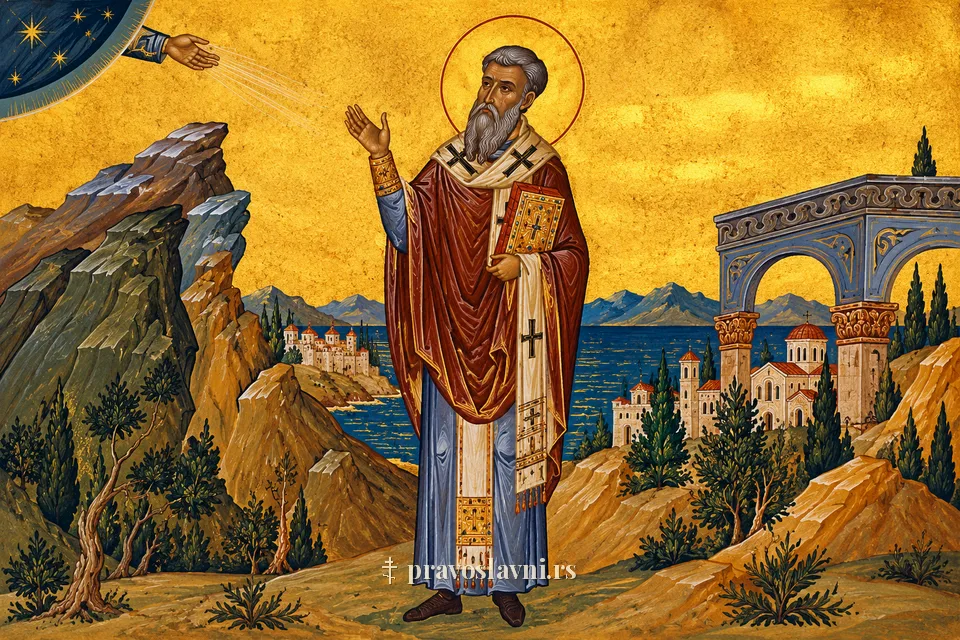
St Eumenius of Gortyna
What happenedThe commemoration of a bishop from Crete who gave away all his possessions to the poor and became the shepherd of Gortyna.
Read the LifeOrthodox Calendar · 18 September according to the Julian calendar
Thursday, 1 October 202618 September (according to the Julian calendar)What happenedThe commemoration of a bishop from Crete who gave away all his possessions to the poor and became the shepherd of Gortyna.
Read the Life
You may eat meat, eggs, milk and dairy products, as well as any other food — but try to be moderate.
More about the fast →
Today the Church keeps the commemoration of a saint · not a Red Letter day.
More about the feast →
“Blessed are the merciful, For they shall obtain mercy.”
— Mt 5:7St Eumenius, Bishop of Gortyna, lived in the seventh century, as the Prologue records. He did not suffer for Christ, but his whole life was one long, voluntary gift to God.
About his childhood we know nothing. We know that as a young man he had an estate and that, as his Life says, from his early days he lived by the word: “Strive to enter through the narrow gate.” He did not keep his possessions for himself. He gave them away to those who were hungry and had nothing to wear, and he kept nothing back. By this he did what the rich young man of the Gospel could not do, when Christ offered him the same path.
Then he set out on a harder struggle — against his own desires. He fasted strictly and spent many nights in prayer. No one drove him to this. He could have remained rich and honest and lived in peace. Yet he chose that Christ should be his only treasure.
He did not seek glory, but people could not fail to notice him. The Christians of Gortyna on Crete chose him as their bishop. Here the Prologue quotes the words of the Lord about the city on a hill, which cannot be hidden. His Life says that his name means “merciful”, and that is how he lived. The Prologue calls him “a father to orphans, riches to the poor, a comfort to the sorrowful, a healer to the sick”.
The Prologue records that through his prayer the sick recovered, and unclean spirits left people. His Life also remembers a snake which attacked him, and he defended himself by prayer alone. The power of God through him, says the Prologue, was seen both in Rome and in the Thebaid, in Egypt. There, according to the Prologue, in a time of drought he obtained rain by his prayers. It was in the Thebaid that he died, and his body was carried to Gortyna, among his own people.
Eumenius did not wait for misfortune to take something from him, but himself gave everything that he had. By this he teaches us that the narrow gate is not only for great ascetics. It is reached step by step — every time we share something of our own with another and say “no” to our own selfishness.
There are saints whom we remember for their martyr's blood, and there are also those whom we remember for a quiet struggle that lasts a whole lifetime. St Eumenius, Bishop of Gortyna, belongs to the latter. No one forced him to be left without his possessions. There was neither persecution nor threat. He could have lived out his days as a rich and honest man, and no one would have blamed him for it. He, nevertheless, chose the harder path.
We do not know where he was born, who his parents were, or how his childhood passed. We do know, however, which word of the Lord he carried in his heart. His Life says that from his young days he held to the words: “Strive to enter through the narrow gate.” Many people hear that sentence in church and forget it as soon as they go out. For Eumenius it became a guide for every day.
As a young man he had an estate. He did not keep it for a rainy day, nor did he give only as much as he would not miss. He gave away absolutely everything to those who had neither bread nor clothing. Anyone who knows the Gospel will remember the rich young man. Christ offered him the same path, and he went away sorrowful, because he could not part with his wealth. Eumenius, many centuries later, said “yes” where that young man had said “no”.
But giving away money was not enough. What came afterwards was harder — the struggle with himself. A full stomach, a warm bed, the desire to please oneself: all of this quietly pulls a person down to the earth. Eumenius resisted it with strict fasting, and he spent many nights in prayer instead of in sleep. In this way, little by little, he became a free man — free for God and for others.
He did not seek glory. Yet people quickly recognise the one who lives as he speaks. The Christians of Gortyna, a city on Crete, chose him as their bishop. Here the Prologue cites the Lord's words about the city that is set on a hill and cannot be hidden.
He was not a bishop who gives orders from a distance. He was there for everyone who knocked at his door. His Life notes that his name means “merciful”, and he bore that name rightly. To his flock he was everything that it needed. The Prologue says it briefly: he was “a father to orphans, riches to the poor, a comfort to the sorrowful, a healer to the sick”.
Eumenius had neither an army nor money. He had prayer, and through that prayer God worked great deeds. The Prologue records that the sick rose up healthy, and that unclean spirits left people in peace. His Life also remembers an incident with a snake. When it attacked him, the saint reached neither for a stone nor for a stick. He defended himself by prayer, and the snake was left dead.
The Prologue says that the power of God was made known through him both in Rome and in the Thebaid, in Egypt. There, in the Egyptian desert, the last miracle that we remember also took place. The land had long remained without rain and the people were in distress. Eumenius prayed to God, and the rain fell.
It was in the Thebaid, far from his own Crete, that he also died. His body was later carried to Gortyna, among the people whose shepherd he had been, and there it was buried. The Prologue says that he lived in the seventh century.
Eumenius did not shed his blood for Christ. His sacrifice did not last a single day, but a whole lifetime. He gave his possessions to the poor, he bridled his body by fasting, and he gave his strength and his prayers to his people. He did not wait for misfortune to snatch away what he had — he himself gave everything away.
The narrow gate is not closed today either. Eumenius reminds us that one does not reach it all at once, but step by step: every time we share what we have and every time we say “no” to our own selfishness. And when one arrives, one sees that it was worth it.
Ariadne had neither property nor a distinguished name — she served as a slave to Tertullus, a prominent man in Prymnessus in Phrygia, in the time of the Emperor Hadrian, as the Prologue records. She had only her faith in Christ, and that was exactly what her master wanted to take from her. While sacrifices were being offered to the idols and there was feasting in her master's house, she stayed apart, in prayer to Christ. For that disobedience she paid with beatings and prison, and according to her Life with long hunger too, but she did not give way. When he saw that he would get nothing from her, Tertullus drove her out, and so Ariadne left Prymnessus. Even that gave him no peace: he soon wished to bring her back, and so a pursuit set out after her, and her Life says that he himself went as well. God hid her where no one would look for her: while she was praying, a rock received her into itself, says the Prologue, and her Life mentions an angel of the Lord in connection with this miracle. The pursuers were left empty-handed, and the anger they carried they turned in the end against one another. Ariadne teaches us that faith is not measured by one's position: even the most insignificant person, when he leans upon God, is stronger than all who threaten him. Much can be taken from a person, but not that which he himself does not renounce.


