Saint of the day
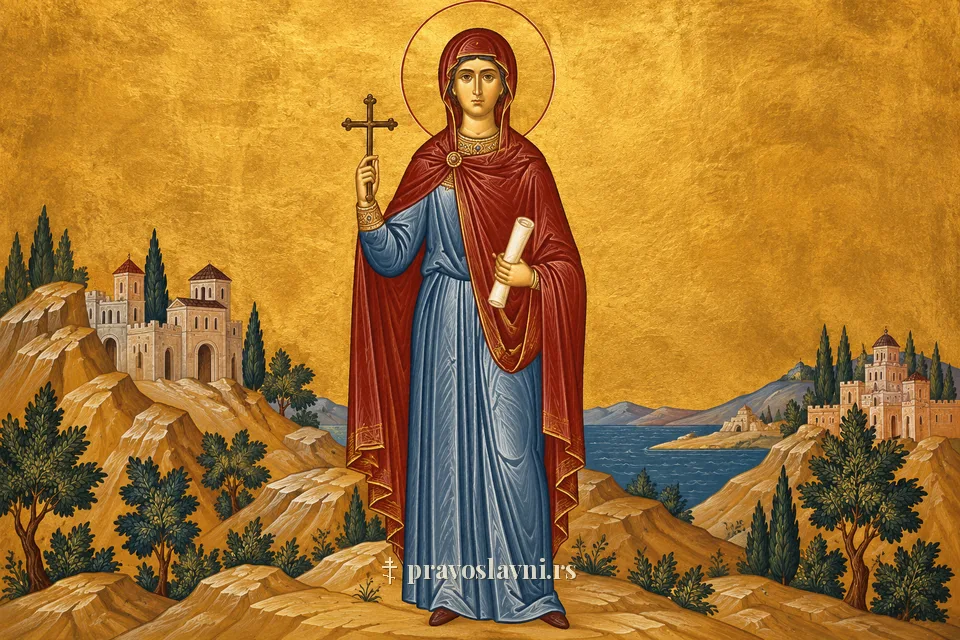
Holy Protomartyr Thecla
What happenedA maiden from Iconium who, on hearing the Apostle Paul, left her betrothed and her home; fire and wild beasts did not touch her.
Read the LifeOrthodox Calendar · 24 September according to the Julian calendar
Wednesday, 7 October 202624 September (according to the Julian calendar)What happenedA maiden from Iconium who, on hearing the Apostle Paul, left her betrothed and her home; fire and wild beasts did not touch her.
Read the Life
No meat, dairy products, eggs or fish — oil and wine are allowed.
This is a recommendation — for your own fast, consult your priest or spiritual father.More about the fast →
Today the Church keeps the commemoration of a saint · not a Red Letter day.
More about the feast →
“Therefore whoever confesses Me before men, him I will also confess before My Father who is in heaven.”
— Mt 10:32Thecla lived in Iconium, in Asia Minor. She was young, from a well-to-do house, and betrothed to Thamyris. Her life seemed to be settled in advance. One day the Apostle Paul, who had come there with Barnabas, was preaching in Iconium. Thecla listened to Paul's preaching about Christ and about a pure life, and she decided not to marry but to dedicate her life to Christ.
Her mother and her betrothed tried to dissuade her, but in vain. So Thamyris brought a charge against Paul, and the apostle ended up in prison. The girl bribed the gaoler so that she could go on listening to him. Both of them were brought before the court. Paul was banished, while Thecla, at the demand of her own mother, was to be burnt at the stake. According to her Life, at that moment the Lord appeared to her in the likeness of Paul and encouraged her. Then a sudden rain put out the fire.
After that she found herself with Paul in Antioch. There the prominent Alexander desired her, and when she refused him, he reported to the authorities that she confessed Christ. She was condemned to the arena, but not a single beast harmed her, and according to her Life a lioness fawned on her as if it were tame. Neither the snakes nor the bulls to which they tied her did her any harm, and the spectators began to praise Thecla's God aloud. When she was asked who she was, she gave the answer that the Prologue remembers: “I am a handmaid of the living God.” They let her go.
She spent her last years alone, on a mountain near Seleucia. She fasted, prayed and healed the sick without payment. Even in old age she had no peace: one day some young men rushed at her with the worst of intentions, and behind them, according to the Prologue, stood the envy of others. She prayed, and the Prologue says that she then vanished into the rock, so that the attackers could not touch her. Her Life says that she was ninety years old at the time.
In her life, in the words of John Chrysostom which the Prologue hands down, we see two gifts to God: “with one hand virginity, and with the other hand martyrdom”. Her life teaches us that love for Christ is stronger than every fear, and that whoever gives his life to Him is not forsaken by Him.
Thecla grew up in Iconium, in Asia Minor, in a wealthy and respected family. She was eighteen years old and was promised to a young man named Thamyris, of whom everyone said that he was a good match. Her life, one would say, was already settled.
Then the Apostles Paul and Barnabas came to Iconium. Thecla listened to Paul from her own house and could not tear herself away from his words about Christ and about purity. According to her Life, she listened to him for days and nights. When she stopped listening, she was a different person: she had decided not to marry and that her whole life would belong to Christ.
A storm broke out at home. Her mother tried everything, both pleas and punishments, and Thamyris did not manage to win her back either. Thecla kept silent and stood her ground. Thamyris then blamed Paul for everything and accused him before the governor, and so the Apostle was thrown into prison. Not even the prison walls stopped her. She bribed the guard and made her way to the Apostle, because she wanted to go on listening to him.
When they were found together, both were brought to trial. There too Thecla did not defend herself. The hardest thing was that her own mother demanded that she be punished with death. Paul was driven out of the city, and Thecla was sentenced to be burned.
She did not draw back even before the fire. According to her Life, the Lord Himself then brought her comfort, appearing to her in the form of Paul. And the fire had no time to harm her: a storm with hail and a downpour put out the pyre, and Thecla remained alive.
Her road then took her to Antioch, where she arrived together with Paul. There a prominent man of Antioch, Alexander, noticed her. Rejected and put to shame before everyone, he took his revenge: he reported to the authorities that she confessed Christ, and the governor condemned her to the beasts. She spent the night before the trial under the protection of a woman named Tryphaena.
In the arena something happened that no one expected. The beasts, even the starving ones, did not touch her. According to her Life, one lioness fawned on her like a tame animal. They also tried snakes, and bulls to which they tied her, but nothing harmed her. The spectators began to praise Thecla's God aloud.
The governor wanted to know who this girl was. Her answer, as the Prologue records it, was: “I am a handmaid of the living God.” He set her free.
She stayed for some time in Antioch, and many came to believe because of her. The years that were left to her she spent in solitude, on a mountain near Seleucia, and Paul himself blessed her on that path. There she fasted and prayed, healed the sick without any reward, and taught them to believe in Christ.
The good she did was a nuisance to some. Those who made their living from healing watched their patients leaving them. One day some young men attacked the old woman with the worst of intentions, and the Prologue reveals that it was precisely the envy of those people that drove them to it. To Thecla purity was a holy thing, and so she took to flight. The last thing the Prologue records about her is that, after praying, she disappeared into the rock. It was not the hands of her attackers that received her — it was God who received her. According to her Life, she was ninety years old at the time.
St John Chrysostom, whom the Prologue quotes, summed up her life in a single image: “in one hand virginity and in the other hand martyrdom” — these are the two gifts that Thecla offered to the Lord. Thecla left her home, her mother, her betrothed and her wealth, passed through fire and the arena, and remained faithful to Christ into deep old age. She was not strong of herself. Her strength was given to her by the One to whom, while still a girl, she had promised her life. Her example teaches us that love for Christ is stronger than every fear, and that whoever gives his life to Him, He does not abandon.
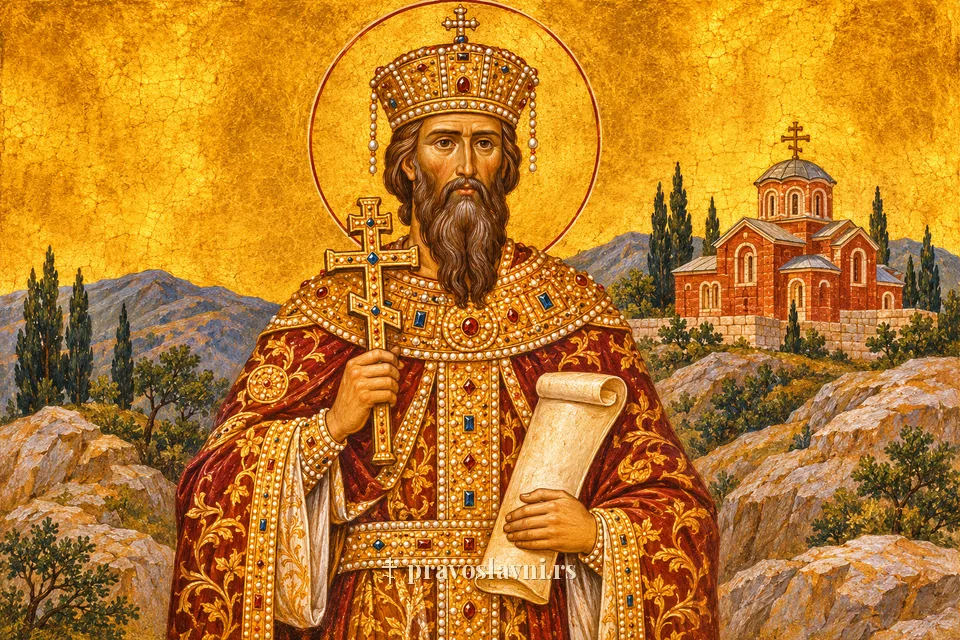
St Stefan was the son of Stefan Nemanja, the Grand Župan, and St Sava was his brother. According to his Life, at the assembly in Ras in 1196 Nemanja handed the throne over to him and charged him to take care of the people, of the churches and of the monks. When his father and brother were building Hilandar on the Holy Mountain (Mount Athos), Stefan sent them from the homeland everything that was needed. His brother Vukan rose against him with the help of the Hungarians and for a time ruled in his place. When he returned to the throne, he did not think of revenge but of peace with his brother, and the way to it led across their father's grave: Sava brought the relics of their father to Studenica, and there he restored concord to the estranged brothers. According to the Prologue, Sava crowned him king at Žiča, hence the name First-Crowned, and his Life remembers that he wept much at his coronation. The Prologue praises his piety and the fact that, as a ruler, he loved peace more than war. As he had wished, he ended his life in the monastic habit, with the name Simon; his relics rest today in Studenica, and he departed to God in the year 1224. Reconciliation with a brother is greater than any victory.
Separate page: Holy King Stefan the First-Crowned →
St Vladislav, the son of Stefan the First-Crowned, was Sava's nephew. According to his Life, he came to the throne in 1234, in difficult times. St Sava reposed in Tarnovo in Bulgaria, and Vladislav wished to bury his uncle in his own land. The Bulgarian Tsar was his father-in-law, yet his Life says that his consent did not come easily. Nevertheless he returned with Sava's relics, which, according to the Prologue, he laid in his endowment (zadužbina) of Mileševa, and the same source also mentions his mercy towards the poor. The title on his coins, “Vladislav, servant of Christ”, tells us more about him than many words of praise. According to his Life, in 1243 the nobles deposed him from the throne. The holy King Milutin, his nephew, was at his side when he peacefully gave up his soul to God; he was buried at Mileševa, and according to his Life the grave was discovered only when the monastery was being restored, in 1990 The greatest honour for every person, whoever he may be, is to be a servant of Christ.
Separate page: Holy King Vladislav →
The Venerable David was known in the world as Prince Dimitrije. He was the son of Vukan, Nemanja's son, and the youngest among his brothers, born into the ruling house of the Nemanjić family. His father, as we have seen in the story of King Stefan, fought for power even against his own brother. The son chose another path: he exchanged princely honour for a monastic cell. He received the monastic tonsure, with the name David, in the monastery which he himself had built at Brodarevo on the river Lim, and he also went as a pilgrim to the Holy City of Jerusalem. According to his Life, God glorified His saint with miracles. He reminds us that even in princely rank a person should not forget that the greatest calling is to serve God.


