Feast of the day
Protection of the Most Holy Theotokos
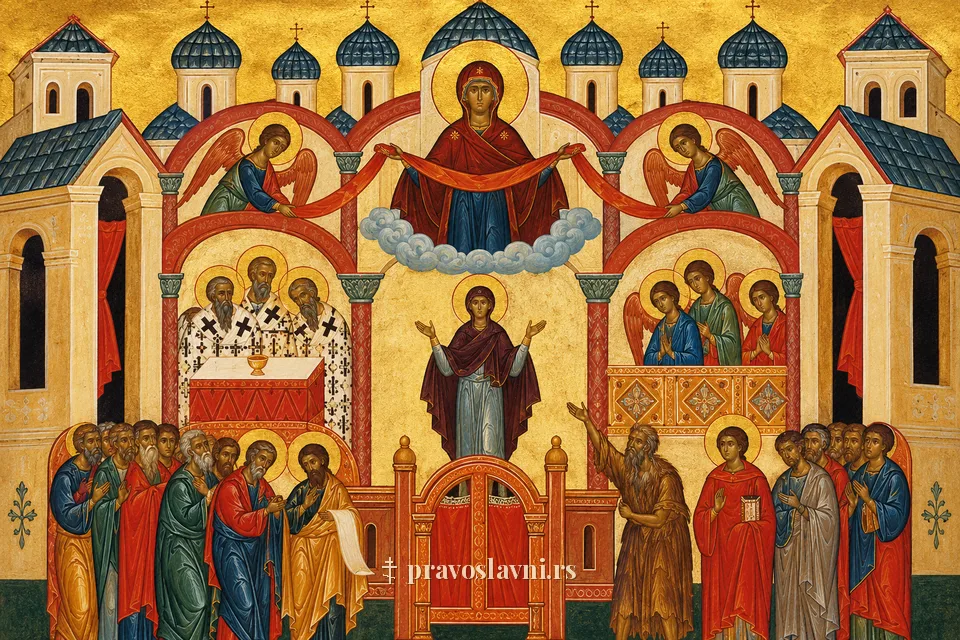
What happenedIn the Church of Blachernae in Constantinople the Theotokos appeared to the people at prayer and spread out her veil as a protection over them all.
Read the LifeOrthodox Calendar · 1 October according to the Julian calendar
Wednesday, 14 October 20261 October (according to the Julian calendar)Save your slava — you'll get a reminder a week and a day before.
Send a greeting card →What happenedIn the Church of Blachernae in Constantinople the Theotokos appeared to the people at prayer and spread out her veil as a protection over them all.
Read the Life
No meat, dairy products, eggs or fish — oil and wine are allowed.
This is a recommendation — for your own fast, consult your priest or spiritual father.More about the fast →
Many families celebrate their Krsna slava (family patron saint's day) today
More about the feast →
“Whatever He says to you, do it.”
— Jn 2:5Sung at the Slava (family patron saint's feast) and on the feast day.
Today we, the faithful people, celebrate radiantly, overshadowed by thy coming, O Mother of God; and gazing upon thy most pure image, we say with compunction: Cover us with thy precious Veil, and deliver us from all evil, entreating thy Son, Christ our God, to save our souls.
Translation: pravoslavni.rs
The feast of the Protection recalls one night in Constantinople in the year 911, in the time of the Emperor Leo the Wise. At Blachernae, in the church of the Theotokos, the people had gathered for the all-night vigil.
Among the last in the church was Andrew, a Slav and a former slave, whom the city took for a madman. He had once been a scribe in the house of the nobleman Theognostus, who loved him and had him educated. According to his Life, after a certain dream he decided to live as a fool for the sake of Christ. He left a secure home and went out onto the street. Whatever people gave him he did not keep for himself; according to the Prologue, he looked only to what God thought of it, and not to what people thought. Folly was his mask, and prayer was his real life. That night Epiphanius was with him, a young man who knew his secret.
In the middle of the vigil the Most Holy Theotokos was revealed to Andrew, present in the church with her people. That sight gave the feast its name: with her omophorion she sheltered the people. According to his Life, she prayed for a long time to her Son for everyone who calls upon Him and for those who call on her for help, and she was accompanied by the two Johns, the Baptist and the Theologian. The Prologue records that Andrew asked Epiphanius whether he too could see “the Queen and Lady of all, how she prays for the whole world”. The young man saw her and was afraid. And so a man whom everyone took for a fool saw what the wise of this world were not able to see.
From this, according to the Prologue, comes the feast itself. It was not a new discovery. Even before Blachernae Christians knew that they have an intercessor before God, and the night at Blachernae only confirmed it. His Life underlines that her help arrives precisely when a person thinks there is no way out. That is why the feast of the Protection is a feast of hope: whoever calls on her in trouble is not forsaken.
Andrew went on living despised, and Epiphanius later became Archbishop of Constantinople.
The Most Holy Theotokos watches over everyone who prays to her, and those who see most clearly into heaven are the ones who have left every earthly glory for the sake of Christ.
The feast of the Protection is tied to a single night in Constantinople. It was 1 October in the year 911, Emperor Leo the Wise sat on the throne, and at Blachernae, in the church dedicated to the Theotokos, the All-Night Vigil was being served. The Life says that it was the night before Sunday, and so a great many people had gathered.
Among those at the back was a man whom nobody took seriously — Andrew, a stranger of Slavic stock, of whom Constantinople thought that he was not in his right mind. Beside him stood the young Epiphanius, Andrew's spiritual son, who did not believe in his madness.
Andrew had come to Constantinople as a slave. The nobleman Theognostus, who bought him, was unusually kind to him: he gave him schooling and entrusted him with the work of a scribe. The young man had everything that a person of his position could wish for, and most of all he loved the church and the stories of the saints.
According to the Life, the decision came after a certain dream: Andrew understood that God was asking him to live as a madman, for the sake of Christ. Andrew obeyed. His master was convinced that the servant had truly fallen ill. Since the treatment bore no fruit, Theognostus let him go wherever he wished.
From then on Andrew lived in the street, without a roof and almost without clothing. The Life does not hide how many humiliations he bore, and to each one he answered with a prayer for those who insulted him. The Prologue says that he gave away to others even the alms that he himself received, in secret, like a man to whom human gratitude means nothing. People saw in him only a lunatic, but God saw a man of prayer.
That night, in the middle of the service, there was revealed to Andrew what remained hidden from the others: the Most Holy Theotokos was there, in the church, with her people. The Prologue mentions that a multitude of saints was with her. The feast received its name from what Andrew saw then: the Theotokos sheltered the people with her omophorion.
The Life says that she prayed for a long time to her Son for all who call upon Him and for those who call on her for help. With her were also the two Johns, the Baptist and the Theologian, who accompanied her.
Andrew turned to Epiphanius and, as the Prologue records, asked him whether he saw “the Queen and Lady of all, praying for the whole world”. The vision was given to Epiphanius just as it was to his teacher, and he trembled at it.
So it was that the one whom the city considered a madman was the first to behold heaven opened above Constantinople. And he did not look upon it alone: beside him was a disciple whom he trusted.
The Prologue reminds us that Christians did not discover only on that night who the Theotokos is for them: they had turned to her from the beginning, convinced that her intercession before God can do much. Blachernae brought nothing new. It only showed what the faithful had believed even before that.
The Prologue sees in this the reason why the Church celebrates the Protection. Every autumn the Church brings us back to that night, so that we may not forget: whoever calls upon the Theotokos in trouble is not left alone. That is why the Protection is not only a memory from far-off Constantinople, but a promise given to us as well. The Life, in its teaching on the feast, underlines that her help comes precisely in those hours when a person thinks that everything is lost. And her prayer, as Andrew saw, had no limits: it embraced the whole world, not only those in the church.
After that Andrew went on with the same life, despised by people. According to the Life, the end found him at prayer for those who suffer and for the whole world. His disciple Epiphanius later became Archbishop of Constantinople.
The Most Holy Theotokos keeps everyone who prays to her. And those who see most clearly into heaven are the ones who for the sake of Christ have left behind all earthly glory.
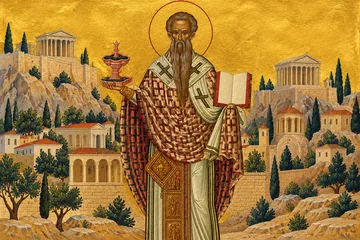
Ananias, Bishop of Damascus, is numbered among the Seventy Apostles. Saul of Tarsus arrived in Damascus with authority to arrest the followers of Christ and take them to Jerusalem. The Lord, in a vision, sent Ananias to him. The Acts of the Apostles, and his Life after them, say that at first Ananias hesitated: word of Saul's persecutions had reached him too. When the Lord revealed to him that Saul was His chosen vessel, he went. He laid his hands on the blinded persecutor, called him brother, and Saul received his sight and accepted baptism at his hands. According to his Life, when they were later plotting Paul's death, Ananias together with the other disciples helped him to slip out of the city in secret. Afterwards he preached in Damascus and in Eleutheropolis and healed the sick. When the governor Lucian ordered a persecution of the Christians, Ananias told him before the court that he himself had seen Christ and that he would not bow down to idols. After torture they stoned him outside the city; the Christians carried his body to Damascus, and the Prologue records that his relics later came to Constantinople. Sometimes obedience to God leads us to stretch out our hand to the very one we fear the most.
Separate page: Holy Apostle Ananias →
Romanus, whom the Church calls the Melodist, was a native of Emesa in Syria. After Beirut, where he had been a sexton, he came to Constantinople; there, according to his Life, he worked in the church by day and prayed at Blachernae by night. He could neither read nor sing, and yet the patriarch, valuing his zeal, gave him the same pay as the others — which the clerics held bitterly against him. One Badnji dan (Christmas Eve), before the emperor and a full church, they decided to shame him publicly and forced him to sing. In tears, Romanus sought comfort from the Theotokos, and then lay down hungry. In a dream the Theotokos fed him with a scroll. He woke up full of joy, and at the Christmas vigil the whole church heard him: his new hymn, “Today the Virgin”, was so beautiful that everyone fell silent. His Life says that those same clerics begged his forgiveness. He became a deacon and, according to the Prologue, wrote more than a thousand kontakia; he died in Constantinople around the year 510. God raises up the humiliated, and a gift is not obtained through pride, but through tears and prayer.