Saint of the day
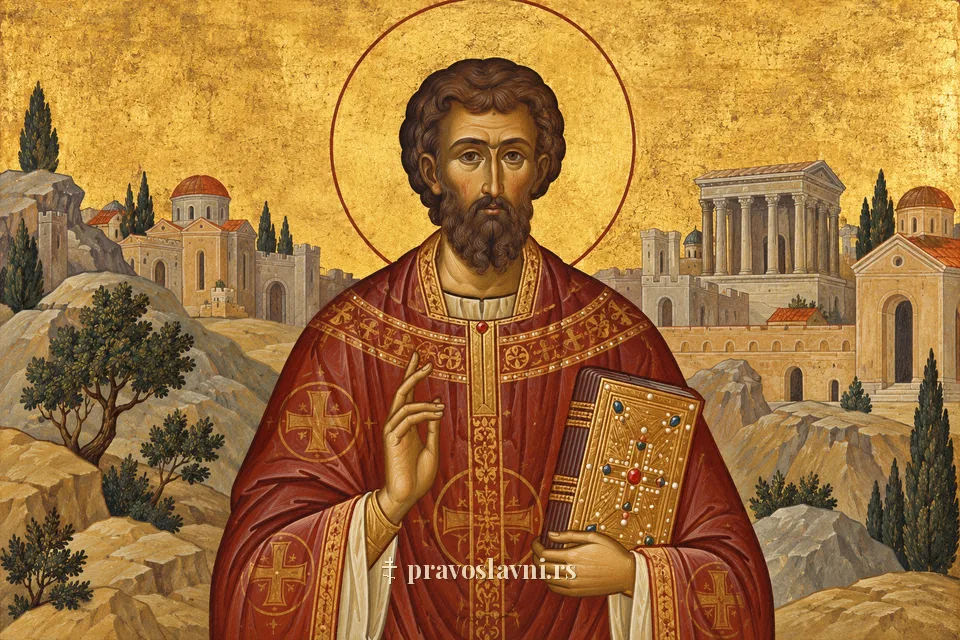
Hieromartyr Lucian
What happenedA learned presbyter of Antioch who, on his way to martyrdom, converted forty soldiers.
Read the LifeOrthodox Calendar · 15 October according to the Julian calendar
Wednesday, 28 October 202615 October (according to the Julian calendar)What happenedA learned presbyter of Antioch who, on his way to martyrdom, converted forty soldiers.
Read the Life
No meat, dairy products, eggs, fish or oil — food cooked in water.
This is a recommendation — for your own fast, consult your priest or spiritual father.More about the fast →
Today the Church keeps the commemoration of a saint · not a Red Letter day.
More about the feast →
“I have fought the good fight, I have finished the race, I have kept the faith.”
— 2 Tim 4:7St Lucian was a learned man and a strict ascetic, but also someone who was afraid for himself. That is exactly why his story is close to every one of us.
He came from a noble house in Samosata, in Syria. His father and mother died, according to his Life, when he was twenty years old, and what fell to him he did not keep for himself: the poor received it all. He studied Holy Scripture in Edessa, under the confessor Macarius. The Prologue records that he became a presbyter in Antioch. There, according to his Life, he ran a school, because he wanted Scripture to become for his pupils both knowledge and a way of life. The Prologue also mentions his scholarly labour: he checked the sacred books against the Hebrew original and cleansed them of heretical alterations.
When the Emperor Maximian Galerius moved against the Christians, Lucian went into hiding. According to his Life, he was afraid of his own weakness. According to the Prologue, he was betrayed out of envy by Pancratius, a heretical priest. While they were taking him to Nicomedia, in Cappadocia he came upon soldiers who had abandoned the faith out of fear. His Life says that he put them to shame, and the Prologue that forty of them returned to Christ and later suffered as martyrs.
The emperor, according to his Life, spoke with him only from a distance, because he feared the power of his word. Neither offers nor threats were of any use. Prison followed, and in it fetters and long starvation. On the eve of Theophany the faithful somehow got in to him in order to receive Holy Communion. There was nothing on which the Gifts could be laid, and he was lying in chains. His Life tells that he then offered his own chest, and so the Divine Liturgy was served upon him himself.
The next day, as his Life says, he died with the confession of faith on his lips. According to the Prologue, that was on 7 January 311. They threw his body into the sea, tied to a stone. His Life says that the sea gave it back all the same: a month later dolphins brought it to the shore, unharmed, and his disciples joyfully buried it.
Fear is no disgrace. The only disgrace is to let it decide in our place — and Lucian did not let it.
Few Liturgies in the history of the Church have been as unusual as the one that was served at the beginning of the fourth century in a prison in Nicomedia. We shall speak of it towards the end. First it must be said who the priest Lucian was and how a learned man came to be in chains.
Lucian was a Syrian from Samosata, from a noble house. The Life says that he lost his parents in his twentieth year. He did not keep his inheritance: all of it went to those who have nothing. Then in Edessa, beside the confessor Macarius, he entered into the depths of Holy Scripture. He lived, according to the Life, as a true ascetic — in a fast such as few can endure, in prayer and tears. A book was his dearest company.
To a man of such knowledge and such a life Antioch, according to the Prologue, entrusted the priesthood. There, as the Life tells, he gathered disciples. It was not enough for him that they should understand Scripture; he wanted them to live by it as well. He earned his bread with his pen, and he gave a part of his earnings to the poor. The Prologue also credits him with one quiet, scholarly feat: he checked the holy books against the Hebrew original and cleansed them of heretical alterations.
Under Emperor Maximian Galerius the persecution became fierce. According to the Life, the authorities struck first at those whom the people followed — at the learned and respected teachers of the faith. Peter of Alexandria and Anthimus of Nicomedia had already suffered. Lucian hid himself. The Life honestly admits the reason: he was afraid of his own weakness, lest pain should break him.
It was not the authorities who found him, but betrayal. According to the Prologue, he was betrayed by Pancratius, a priest of heretical convictions, out of envy; the Life adds that this envy had been smouldering for a long time. Bound, he was led to the emperor, to Nicomedia.
On the way, in Cappadocia, he came upon Christian soldiers who had not withstood the threats and had renounced the faith. The Life says that he did not comfort them with gentle words, but put them to shame. He asked them: if in battle they do not spare themselves for the sake of the emperor, why do they deny the same to Christ? The Prologue records the fruit of those words: forty soldiers returned to the faith and later suffered as martyrs. And in Nicomedia the one who had once been hiding was now encouraging others. He reminded his frightened disciples of Christ's word that one should not fear those who can kill only the body.
The emperor, according to the Life, knew how well Lucian was able to win people over, and he was not sure even of his own steadfastness. For that reason he did not want to meet him face to face. The honours that were offered did not interest Lucian, and the threats remained without effect. What was left was prison, with chains, long hunger and thirst. Here the Prologue refers to St John Chrysostom, according to whom Lucian despised hunger.
It was the eve of Theophany. Lucian and his brethren in chains, according to the Life, were longing for Holy Communion. God brought it about that the guards relaxed their watch, and the faithful brought in everything that was needed for the service. There was nothing on which to place the Gifts, and Lucian could no longer even raise himself. Then he offered himself. “Place them on my chest, and it will be a living altar to the living God,” the Life records. That night the prison became a church, and all received Communion.
The next morning the emperor wanted to know whether the martyr had survived the night. The Life says that Lucian with his last breath confessed once more who he was — a Christian — and so ended his earthly journey. According to the Prologue, it was 7 January 311.
By the emperor's order the body, tied to a stone, was sunk in the sea. But, as the Life relates, after a month Lucian appeared to his disciple Glycerius and showed him where to wait for him. The body did indeed reach the shore, and it was dolphins that brought it. Decay had not touched it. His disciples, full of joy, laid it in a tomb, and over it much later, according to the Life, the holy Empress Helen built a church.
Lucian was not a man without fear. But fear did not have the last word. Whoever hands his weakness over to God is able to raise up others as well.
St Euthymius was called Nicetas in the world and came from the region around Ancyra. According to his Life, he lost his father as a seven-year-old, and so while still a boy he became the support of his mother and sisters. The Prologue records that he served in the army, entered into marriage and had a daughter, Anastasia. Yet his heart drew him to God, and one day after Krstovdan (the Exaltation of the Cross), according to his Life, he secretly left home and never returned. On Olympus the renowned elder Ioannicius tested him with a grave insult, and Nicetas accepted it silently and humbly, so that the elder recognised in him a great monk to be. Olympus, the Holy Mountain (Mount Athos), then a pillar near Thessalonica — these, according to the Prologue, are the stages of his long and strict ascetic struggle. His Life also knows of years spent shut up in a cave, of Saracen captivity from which God miraculously delivered him, and of the restored church of St Andrew at Peristera. Near Thessalonica he founded two monasteries, one for men and one for women, and according to his Life he brought some of his relatives into monasticism forty-two years after he had left home. He ended his earthly path on the islet of Hiera (the Holy Island) near the Holy Mountain. Thessalonica, according to the Prologue, keeps his wonderworking relics to this day. Those whom he left for the sake of Christ, Christ gave back to him in the end — as brothers and sisters in the faith.


