Saint of the day
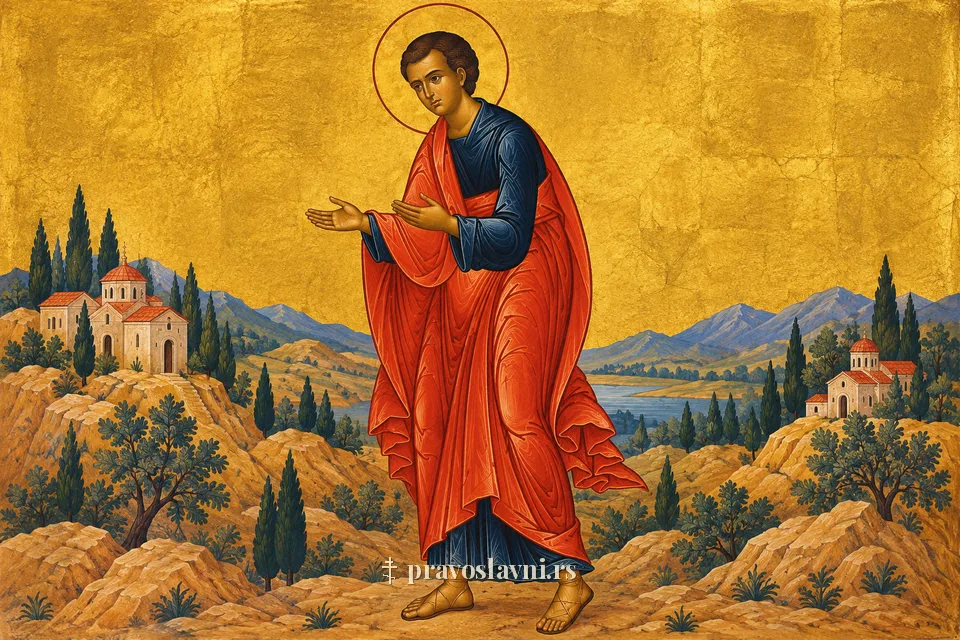
Holy Apostle Philip
What happenedCrucified upside down in Hierapolis, the Apostle Philip prayed from the cross for his tormentors, and the earth, according to his Life, gave back alive most of those it had swallowed.
Read the LifeOrthodox Calendar · 14 November according to the Julian calendar
Friday, 27 November 202614 November (according to the Julian calendar)Save your slava — you'll get a reminder a week and a day before.
Send a greeting card →What happenedCrucified upside down in Hierapolis, the Apostle Philip prayed from the cross for his tormentors, and the earth, according to his Life, gave back alive most of those it had swallowed.
Read the Life
No meat, dairy products, eggs or fish — oil and wine are allowed.
This is a recommendation — for your own fast, consult your priest or spiritual father.More about the fast →
Many families celebrate their Krsna slava (family patron saint's day) today
More about the feast →
“Come and see.”
— Jn 1:46Bethsaida on the Lake of Galilee, the homeland of Peter and Andrew, was also the native town of the Apostle Philip. But while they lived by fishing, Philip was an educated man, who knew the Scriptures and the prophecies about the Messiah. When Jesus said to him in Galilee, “Follow Me”, he set off at once, without hesitating.
He passed this news on to Nathanael: as is written in the Gospel according to John, he told him that they had found the One of whom Moses and the prophets wrote. To his doubt he answered only: “Come and see.”
Philip too had his moments of little faith. When five thousand people had to be fed, he reckoned that not even two hundred denarii would be enough. And after the Mystical Supper he asked: “Lord, show us the Father, and it is sufficient for us.” Christ answered him that whoever has seen the Son has seen the Father also.
Philip saw the risen Christ, was a witness of the Ascension and received the Holy Spirit. Then he preached in Galilee, in Greece and through the cities of Asia Minor. His Life tells that he raised the dead, healed the sick, and that the earth swallowed up a high priest who had rushed at him and blasphemed Christ.
With the Apostle Bartholomew and his sister Mariamne he came to Hierapolis in Phrygia, where the people worshipped a serpent. The apostles killed it by prayer, and the blind Stachys received his sight. By the sentence of the governor, Philip was crucified in front of the temple, with his head towards the ground, and pelted with stones. Then, according to the Prologue and his Life, there came an earthquake, in which the governor, the pagan priests and many unbelievers went down into the depths. Even then Philip did not seek revenge: the prayer which he offered for his torturers, according to his Life, saved most of those who had been swallowed up, and only the governor and the pagan priests remained in the earth. So the apostle gave up his soul to God on the cross. Bartholomew then performed the baptism, and Stachys, the former blind man, became a bishop.
The Prologue records that he suffered in the year 86, in the time of Emperor Domitian. His Life also mentions a vine which sprang up on the spot where his blood had been shed.
The Apostle Philip teaches that faithful witness and the forgiving of enemies bear a fruit which outlives even death.
Philip was born in Bethsaida, by the Sea of Galilee, in the town from which Peter and Andrew also came. They were fishermen, but Philip's parents gave him schooling. He studied the Scriptures and knew the prophecies about the Messiah. When Jesus found him in Galilee and said to him, “Follow Me,” Philip went at once.
He passed this news on to Nathanael. The Gospel according to John says that he told him they had found the One of whom Moses and the prophets wrote — Jesus of Nazareth. Nathanael doubted whether anything good could come out of Nazareth, and Philip simply answered him: “Come and see.” Jesus called Nathanael a true Israelite in whom there is no deceit.
Philip was not perfect from the beginning, and the Gospel does not hide it. When five thousand people had to be fed, Jesus tested him with the question of where they should buy bread. Philip reckoned that not even two hundred denarii would be enough; his Life says that afterwards he was ashamed of his little faith. In Jerusalem some Greeks asked Philip that they might see Jesus, and he went with Andrew to tell the Teacher.
After the Mystical Supper Philip asked: “Lord, show us the Father, and it is sufficient for us.” Jesus answered him that whoever has seen Him has seen the Father also. His Life sees in these words the teaching that the Son is of one essence with the Father, against the error of Arius.
According to his Life, Philip saw the risen Christ, was a witness of the Ascension, and at Pentecost received the Holy Spirit.
His Life says that Asia Minor fell to Philip by lot. Before he set out for it, in Galilee he brought back to life, in the name of Christ, the dead child of a widow. In Greece he healed the sick and raised one dead man. The high priest from Jerusalem also came there and accused him of fraud, claiming that the disciples had stolen the body of Jesus. Philip's answer pointed to the sealed and guarded tomb, which is proof of the Resurrection and not of a theft. When the high priest rushed at him, he went blind, and the other attackers went blind too. Philip prayed and they were healed, and many believed. Only the high priest would not stop blaspheming — and the same punishment overtook him as Dathan and Abiram: he vanished into the earth.
His Life goes on to tell of Azotus, where, calling upon Christ, he healed the eyes of the maiden Charitina, and of Hierapolis in Syria. Punishment overtook the old man Aristarchus, who seized the apostle by the hair, at once: he lost his sight, his hearing and the strength of his hand. The mockers demanded the raising of a dead man as proof — and Philip raised up Theophilus. Once Aristarchus too had been healed, Hierapolis in Syria accepted the faith and destroyed its idols, and Irus, Philip's host, became bishop.
With Philip in his preaching went the Apostle Bartholomew and Philip's sister, the virgin Mariamne. In Lydia they met John the Theologian and went together to Hierapolis in Phrygia. In that city, according to the Prologue and his Life, the deity was an enormous serpent: kept in a temple and showered with sacrifices, it was called by the people their goddess. By the prayer of the apostles it was killed. Stachys, blind for forty years, received his sight and was baptised.
When Nicanora, the wife of the governor of the city, was also healed of a snake-bite and came to believe, the governor, on his return, sent men for the apostles. In front of the temple they hung Philip on a cross with his feet upwards and pelted him with stones; Bartholomew was crucified beside the temple wall. Punishment did not wait: according to the Prologue and his Life, in a great earthquake the ground split open beneath the governor, the serpent's priests and a multitude of unbelievers, and they vanished into it. Those who survived then implored the apostles for their prayers. Even then the crucified apostle did not ask for vengeance, but prayed for his enemies. According to his Life, Philip's prayer changed the outcome: those who had been swallowed came back to the surface alive, and only the governor and the priests remained in the depths. Philip gave up his soul to God on the cross. The baptism of the new believers was carried out by Bartholomew, who gave them Stachys as their bishop.
His Life records that in Hierapolis, where he was buried with honour, on the third day a vine sprang up on the spot where his blood had fallen. According to the Prologue, his martyrdom took place in the year 86, in the time of Domitian, and in the course of time Rome became the guardian of his relics.
The Apostle Philip teaches that even little faith is not the end: corrected by Christ Himself, he became a fearless preacher, who answered persecution with miracles and with prayer for his enemies, even from the cross. Such faithfulness and forgiveness bear fruit.
St Gregory Palamas came from a distinguished and devout house of Constantinople: his father Constantine served Emperor Andronicus the Second and was the tutor of the future Andronicus the Third. As a boy, says his Life, he would bow three times before the icon of the Theotokos before his lessons, and he advanced so far in his studies that he was praised before the emperor. Instead of service at court he chose the Holy Mountain (Mount Athos): in his twentieth year he gave away his estate to the poor, and his mother and sisters entered a convent. For three years he lived at Vatopedi under the elder Nicodemus, and then in the Lavra and in the hermitage of Glossia. According to the Prologue and his Life, a vision in which the milk in a vessel became wine, as a sign that one should pass from simple teaching to deeper theology, was accompanied by the words of a young man: “Or perhaps you do not know that this is a gift of God's grace?” When Barlaam taught that the light of Tabor was created and mocked the hesychasts, Gregory answered him with nine treatises on the uncreated light, and Barlaam was condemned at a council in Constantinople. His Life says that because of that struggle, by order of the Patriarch of Constantinople, he spent four years in prison. He was appointed Archbishop of Thessalonica by Patriarch Isidore and Emperor John Cantacuzene, and the Prologue gives the year 1347. The Serbian Tsar Stefan Dušan, according to his Life, offered him estates and treasure, but Gregory refused them, explaining that his measure was small and that he could not accept more than that. He spent a year as a slave in Asia, where he had been taken by the Hagarenes, who captured him on the way to Constantinople, and there he taught the faith, until Serbian merchants ransomed him. For thirteen years he was the shepherd of Thessalonica; he foretold the day of his death in advance, and he departed with the words: “To the heavens! To the heavens!” — according to the Prologue, in the year 1360. Thessalonica keeps his relics to this day, and healings are received from them, and his life teaches that quiet prayer prepares a person to defend the truth about God's grace.


