Saint of the day
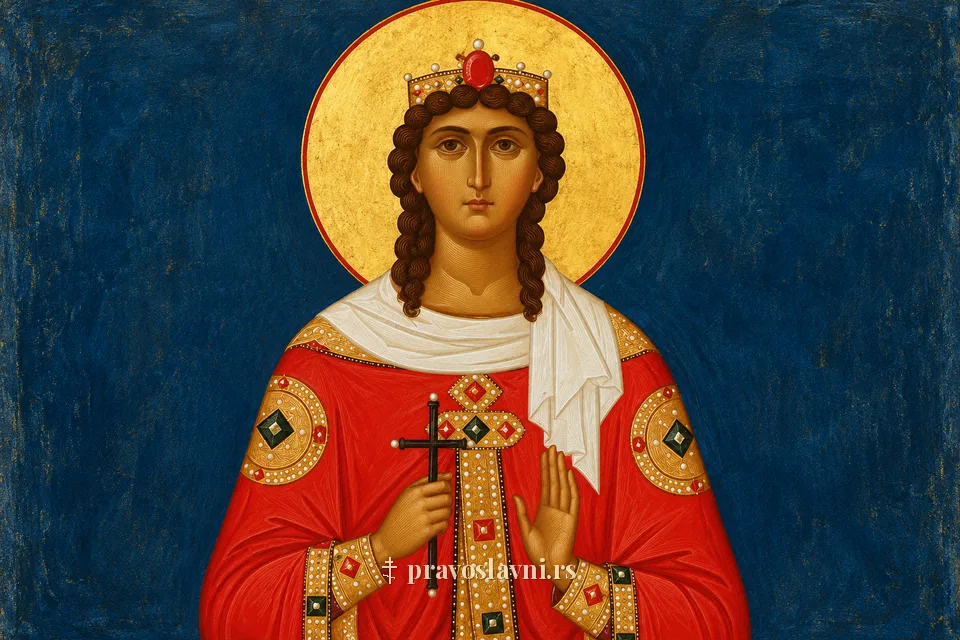
Great Martyr Barbara
What happenedShut up in a tower, Barbara came to know the one Creator by gazing at the heavens, and for her faith in Christ she was beheaded by her own father.
Read the LifeOrthodox Calendar · 4 December according to the Julian calendar
Thursday, 17 December 20264 December (according to the Julian calendar)Save your slava — you'll get a reminder a week and a day before.
Send a greeting card →What happenedShut up in a tower, Barbara came to know the one Creator by gazing at the heavens, and for her faith in Christ she was beheaded by her own father.
Read the Life
No meat, dairy products, eggs or fish — oil and wine are allowed.
This is a recommendation — for your own fast, consult your priest or spiritual father.More about the fast →
Many families celebrate their Krsna slava (family patron saint's day) today
More about the feast →
“If God is for us, who can be against us?”
— Rom 8:31St Barbara is a great martyr who was put to death by her own father. Dioscorus, a rich and distinguished pagan from Heliopolis, was left a widower, and she was his only child. The Prologue places that city in Egypt, while her Life says that it all took place in the time of Emperor Maximian.
Her path to God began in solitude. Her father shut her away in a high tower, with teachers, maidservants and idols, so that not everyone might gaze upon her beauty. There, as she pondered, she understood that the world around her could not have been made by any statue fashioned by someone's hand. In this way, without anyone's instruction, she came to the one Creator. Later, while her father was away on a journey, she went out among Christian women and heard from them about Christ; her Life adds that she was baptised by a priest disguised as a merchant. She inscribed her faith in her father's bathhouse as well: instead of two windows, as many as Dioscorus had ordered, the builders at her wish made three, in honour of the Holy Trinity. In the bathhouse, according to both sources, two more testimonies of her faith remained: the sign of the cross in the stone, traced with her finger alone, and a healing spring on the spot where she had stood.
Her greatest trial came to her from her own home. Not even the sword in her father's hand reached her at once — both sources speak of a rock that hid her — but Dioscorus found her all the same, beat her, left her without food and handed her over to the governor Martian. Her Life preserves his words: “I renounce her, since she has renounced my gods.” The wounds from her tortures were healed by the Lord Himself, when He visited her in prison at midnight. According to her Life, He said to her: “Be of good courage, My bride, and do not be afraid!” Juliana saw this and went with her to death. At the place of execution Barbara was put to death by her father himself. On the same day lightning killed both him and Martian, and nothing was left of them but ashes. The Prologue records that this was in the year 306.
Her trace did not vanish. Her Life relates that in 1108 her relics were translated from Constantinople to Kiev, where they rest to this day and work miracles. The Prologue also knows of her frequent appearances, sometimes together with the Theotokos.
Barbara teaches us that God can be known from His creation too. Whoever loves Christ above all else is not left alone even in the hardest hour.
In the time of Emperor Maximian, as her Life relates, in Heliopolis — the Prologue adds that this was an Egyptian city — there lived Dioscorus, a wealthy and respected pagan. His wife had died, and his only child, his daughter Barbara, he kept shut up in a high tower. He did not want ordinary people to look upon her beauty, and so he provided her there with teachers, servants and statues of the gods.
The Prologue and her Life agree that the maiden came to faith by herself, without human instruction. Pondering what surrounded her, the earth and the heavens, she concluded that statues which someone had carved could not be the makers of such a world — there must be one Creator. Her Life adds that she refused every mention of marriage: she told her father that she would rather lose her life than consent to a forced marriage, and she resolved to remain a virgin.
As he was preparing for a long journey, Dioscorus ordered that a bath-house be built for him and that it should have two windows. As soon as he had set off, Barbara left the tower and came to know some Christian women, from whom she heard about Christ. According to her Life, she was secretly baptised in the name of the Holy Trinity by a priest who passed himself off as a merchant.
She then persuaded the builders of the bath-house to pierce the wall in a third place as well, because God is one in three Persons. The bath-house also preserved the traces of her presence: where she had stood, water sprang forth, which later brought healing to many, and the cross which she traced with her finger upon the stone remained in it — so say both the Prologue and her Life. According to her Life, she spat upon her father's idols.
When Dioscorus learned that his daughter was a Christian, he drew his sword. Barbara fled, and both sources say that she was hidden from her father by a rock which split open before her. In her Life there is also the story of a punishment for betrayal: of the two shepherds who saw her, the one who gave her away turned to stone, and his sheep to locusts.
Her father beat her, dragged her to the house, kept her hungry and locked up in the dark, and then handed her over to the governor Martianus. Her Life hands down the sentence with which he renounced his daughter before the governor: “I renounce her, since she has renounced my gods.”
Cruel tortures followed. Consolation came to the prison at midnight: Christ, with angels according to the Prologue, healed her wounds, promised her an eternal reward and, as her Life records, said: “Be of good courage, My bride, and do not be afraid!”
The miracle was seen by Juliana, a woman who happened to be there, and so she confessed Christ and asked to share Barbara's fate. The torture was continued upon them both, and then they were led in procession through the city; her Life says that angels wrapped a covering around Barbara, who was being led naked. The sentence was: death by the sword. The sword above Barbara's neck was raised by her own father; Juliana was put to death by a soldier. Before the day was out, lightning struck Dioscorus and Martianus and left nothing of them but ashes. The Prologue places this martyrdom in the year 306. According to her Life, the relics were buried by a certain Galentian, who built a church over them, where the sick found healing.
Her Life follows the relics further still. Barbara, the daughter of the Byzantine Emperor Alexius Comnenus, who was married to the Grand Prince of Kiev Michael (Sviatopolk Iziaslavich), translated them in 1108 from Constantinople to Kiev, and a stone church of the Archangel Michael was built for them. When Batu Khan was laying the land waste, the relics were hidden beneath the stairway of the church, and later returned. From the 17th century her Life records healings by water in which the saint's hand had been immersed, as well as the punishment of two thieves who in 1666 laid hands on her reliquary: after they were struck by thunder, one was left deaf and the other out of his mind, and on the seventh day they confessed. The left hand too, which was kept in Lutsk, survived theft, fire and breaking; Bishop Gedeon placed its fragments in the altar of St Sophia in Kiev. Kiev preserves her wonderworking relics to this day, and the Prologue adds that the saint appeared many times after her death as well, not infrequently together with the Mother of God.
Barbara came to the Creator by contemplating His creation, and she chose Christ instead of her father, riches and life; God stood by her in her torments, punished her persecutors, and through her relics He still heals those who believe.
St John of Damascus was born in Damascus, into a wealthy Christian family, at the time when the Saracens ruled the city. His Life says that his father, a judge and a high dignitary, bought a learned captive monk, Cosmas from Italy, to teach John and an adopted orphan, who was also called Cosmas. John mastered many branches of learning, from philosophy and music to theology, and the more he knew, the humbler he was. He became the first minister of the caliph, whom the Prologue calls Abd al-Malik. When the Emperor Leo the Isaurian rose up against the icons, John defended them powerfully with his writings. The emperor then had a letter forged, supposedly written in John's own hand, in which Damascus is offered to Byzantium, and sent it to the caliph, and the caliph ordered that John's right hand be cut off. Healing came from the Theotokos, who, after his prayer before her icon, appeared to him in a dream: the hand was miraculously joined on again and healed. Neither the caliph's remorse nor his offer that John should return to the court held him back: he set his slaves free, gave away his property to the poor and became a monk in the Lavra of St Sabbas. His Life tells that his elder tested him with hard obediences, and when John, contrary to the elder's rule, wrote a funeral hymn for a grieving monk, the Theotokos appeared to the elder and told him to let John write. The hymns of the funeral service come from him, and the Church also sings from his Octoechos, Irmologion, Paschal canon and the hymns of the Menaia; he also wrote theological treatises, especially in defence of the icons. The Prologue, which numbers him among the great Fathers of the Church, also records that he died in peace around the year 776, in his one hundred and fourth year. St John teaches us that true knowledge leads to humility, and that God richly rewards humble obedience and faithfulness in persecution.


