Saint of the day
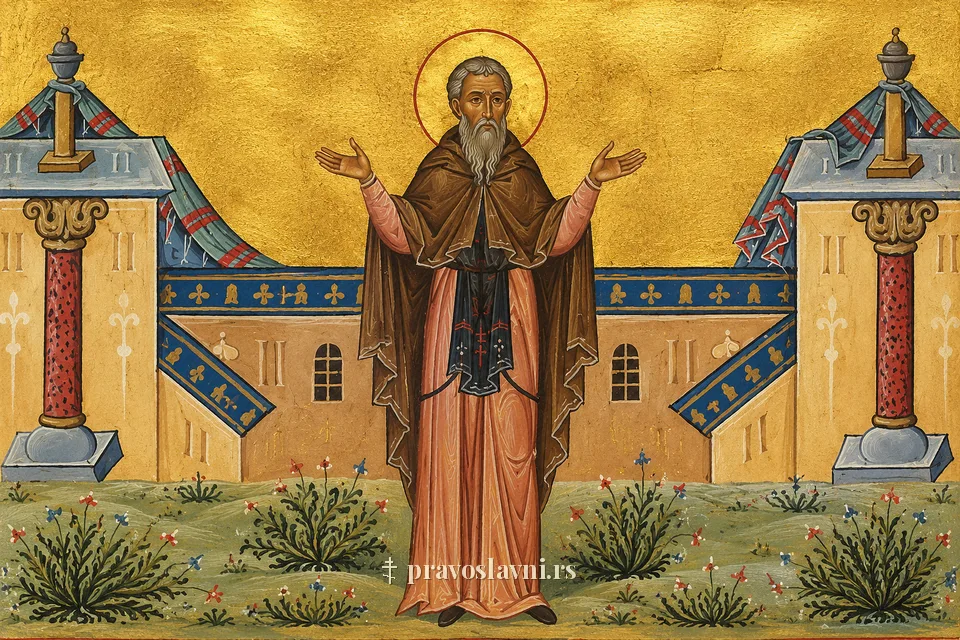
Venerable Patapius
What happenedVenerable Patapius fled from the praise of men from the Egyptian desert to Constantinople, but there his miracles of healing made him known to the whole city.
Read the LifeOrthodox Calendar · 8 December according to the Julian calendar
Monday, 21 December 20268 December (according to the Julian calendar)What happenedVenerable Patapius fled from the praise of men from the Egyptian desert to Constantinople, but there his miracles of healing made him known to the whole city.
Read the Life
No meat, dairy products, eggs, fish or oil — food cooked in water.
This is a recommendation — for your own fast, consult your priest or spiritual father.More about the fast →
Today the Church keeps the commemoration of a saint · not a Red Letter day.
More about the feast →
“The effective, fervent prayer of a righteous man avails much.”
— Jas 5:16A desert-dweller from Egypt, Venerable Patapius lived in Constantinople as a recluse, in a cell not far from the Church of Blachernae. A native of Thebes, born of devout Christian parents, he became a monk when he grew up and withdrew into the Egyptian desert, but there he became too well known: people were constantly coming to him. For that reason he took refuge in the capital, hoping that amid the multitude he would remain unnoticed.
Even so, he did not stay hidden for long. The Prologue and his Life remember a young man blind from birth, a Christian, who longed to see and to glorify the Creator, and whom Patapius, in the name of Christ, commanded to receive his sight — and at once he saw. The healed man told everyone what had happened to him, and so many began to come to Patapius, asking for his prayers.
Both sources mention other healings too: the deliverance of a young man from a demon, the recovery of a woman whose wound the physicians had been unable to heal, and of a rich man who suffered from dropsy. He worked them all by calling upon Christ and by the sign of the cross.
He died in deep old age — the Prologue places him in the seventh century — and his Life records that he was buried with honour in the Church of St John the Forerunner. His life bears witness that holiness cannot be hidden: God reveals the grace of those who serve Him, and the power of the name of Christ and of the cross is stronger than every illness and every evil.
Thebes, an Egyptian city on the Nile, was the homeland of Patapius, and his pious Christian parents taught him from his earliest years to fear God. When he grew up he became a monk, breaking off everything that tied him to the world, and went into the Egyptian desert, there to cleanse his heart, in fasting, prayer and toil, out of love for God.
But people found him there too: they came for help and praised him, and this troubled him, for it disturbed his solitude. And so the desert-dweller became an inhabitant of Constantinople — in the crowds of the great city he hoped to remain unseen.
His prayer without ceasing continued in Constantinople as well, behind the closed door of the cell which he built beside the walls, in the neighbourhood of the Church of Blachernae — and no one knew of him except God.
The silence, according to the Prologue and his Life, was broken by a young man blind from birth, a Christian, who begged for his sight so that he might glorify the Creator. Patapius prayed and in the name of Christ commanded him to see, and his sight was opened at once. The man who had been healed did not keep silent, and soon the whole capital knew of the hidden ascetic and was asking for his prayers.
The Prologue and his Life remember other miracles as well. A distinguished rich man of the capital had lost his fortune to physicians because of dropsy, but not the illness itself; he recovered only after the prayer of Patapius, the sign of the cross and an anointing with oil.
Going towards the sea, the saint also met a young man whom a demon was tormenting and whose death it sought. His Life records that the demon then cried out: “Truly You are terrible, O Nazarene,” lamenting that the name of Christ and the cross were overcoming it once again. With the sign of the cross and the words “Come out, unclean spirit, come out, and go far away into the desert,” Patapius drove it out, and with a shriek it left the young man. The young man who had been set free, weeping for joy, gave thanks to God and to the saint.
A woman with a grievous wound on her breast could no longer be helped by physicians; the sign of the cross made by Patapius healed her in an instant. There were many more such miracles; in all of them the saint called upon Christ and made use of the cross.
His Life explains, in the words of the Gospel, why his holiness could not remain hidden: a city that is set on a hill cannot be hidden, and a treasure hidden in a field is found all the same. Patapius died in deep old age. The Prologue says that he lived in the 7th century, and his Life records that he was buried with honour in the Church of St John the Forerunner.
His life bears witness that God does not leave in the shadows those who serve Him, but reveals the grace that is in them. The name of Christ and the sign of the cross are stronger than demons and illnesses, and for every healing thanks belongs first of all to God.
Seven apostles of the Seventy — Sosthenes, Apollos, Tychicus, Epaphroditus, Onesiphorus, Cephas and Caesar — are celebrated together on this day. Their commemoration is repeated on 4 January, when all the apostles of the Seventy are celebrated, and Apollos (10 September), Onesiphorus (7 September) and Cephas and Caesar (30 March) have separate days of their own as well. The sources say little about their sees, and they do not always agree. The Prologue places Sosthenes in Caesarea, and his Life in Colophon in Lydia; wherever it was that he was bishop, Tychicus held that see after him. Caesar served in Corone in the Peloponnese, Cephas in Iconium, while Epaphroditus was bishop of Adriania in Pamphylia. For Apollos and Onesiphorus the sources do not state where they served. All of them suffered for Christ, and before that, inspired by God, they zealously preached Him; now they rejoice in His Kingdom. Their example teaches that the faithful preaching of the Gospel and patient endurance for Christ lead into eternal joy.
Separate page: Holy Apostles Sosthenes, Apollos and those with them →


