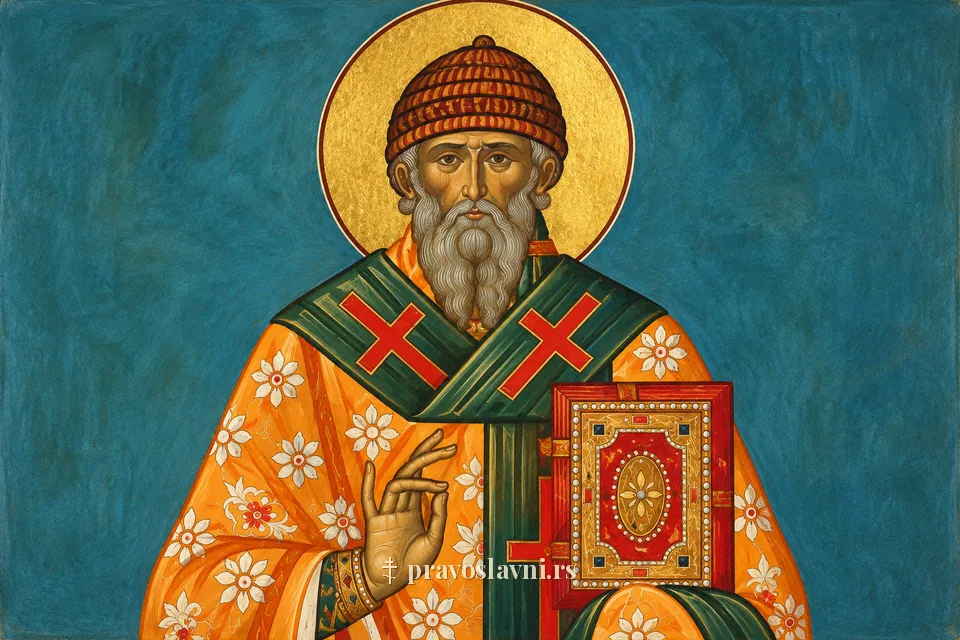
Saint of the day
St Spyridon the Wonderworker
What happenedWhen, on his way to the imperial palace, a guard struck him, taking him for a beggar, Spyridon turned the other cheek, and then healed the sick emperor.
Read the LifeOrthodox Calendar · 12 December according to the Julian calendar
Friday, 25 December 202612 December (according to the Julian calendar)Save your slava — you'll get a reminder a week and a day before.
Send a greeting card →What happenedWhen, on his way to the imperial palace, a guard struck him, taking him for a beggar, Spyridon turned the other cheek, and then healed the sick emperor.
Read the Life
No meat, dairy products, eggs or fish — oil and wine are allowed.
This is a recommendation — for your own fast, consult your priest or spiritual father.More about the fast →
Many families celebrate their Krsna slava (family patron saint's day) today
More about the feast →
“I thank You, Father, Lord of heaven and earth, that You have hidden these things from the wise and prudent and have revealed them to babes.”
— Mt 11:25St Spyridon was born on Cyprus, into a simple village family. His Life says that from his earliest years he tended flocks. He married young and had children, and as a widower, as his Life adds, he gave his property to travellers and the poor and gave his life over to God. The Prologue records that the poor received the greater part of the yield from the field which he tilled himself, alongside the livestock which he tended himself, even when, on account of his piety, he had already been chosen as Bishop of Trimythous.
God worked great deeds through him. Both sources speak of a great drought and famine on Cyprus, which ceased when he obtained rain by prayer, so that the land once more gave an abundant harvest. A swollen stream, according to his Life, stood still at his command when he was hurrying to rescue a slandered friend. At the First Ecumenical Council in Nicaea in the year 325 he defended the faith against the teaching of Arius. His Life tells that he brought a certain pagan philosopher to baptism, without any subtle reasoning, by simple words about the Holy Trinity. Many who had been wandering in heresy, according to the Prologue, returned to the Church on seeing his miracles and hearing his simple confession.
Among the hierarchs whom the ailing Emperor Constantius summoned to Antioch, as his Life says, was Spyridon too. A guard, on account of his humble clothing, struck him as though he were a beggar, and he, faithful to Christ's commandment (Mt 5:39), offered the other cheek as well. The emperor recovered at a single touch of his hand upon his head; the gold he was given the bishop, according to his Life, distributed to the poor, and from the emperor he obtained that the clergy be freed from taxes.
The Prologue also says that he saw and heard angels, and that the future and the thoughts of others were revealed to him. His Life says that he knew of his death beforehand and that he fell asleep at prayer, while the Prologue gives the year, 348, and adds that even now miracles take place at his relics on Corfu.
Spyridon remained a shepherd even when he became a bishop. His life bears witness that heavenly treasure is the only lasting one and that God rewards the merciful, the humble and the honest. Simplicity of faith was stronger than all learning.
Spyridon was born on Cyprus, in a simple village family, as the Prologue and his Life record. His Life states that from childhood he tended flocks. He married early and had children, and after the death of his wife he devoted his whole life to God. His Life says that he lived purely and that his property went to travellers and to the poor.
According to his Life, God endowed him with the gift of working wonders, so that even those whom no one could help found a cure with him, and the demons fled at a single word of his. The devout widower then became Bishop of Trimythous; his Life places that election in the time of Constantine the Great and his son Constantius. The Prologue notes that the greater part of the harvest from the bishop's field went to the poor, while he kept little for himself; even then he himself tilled the field and tended the livestock.
Cyprus, which was tormented by drought, famine and plague, received rain after Spyridon's prayer, as the Prologue and his Life record; it did not cease for several days, right up until his new prayer, and the harvest that year was abundant.
In a later famine, as his Life relates, a rich grain merchant in Trimythous would not give grain to a poor man without payment. Spyridon foretold that the poor man would have grain the very next day and that the rich man would come begging, and so it was: a storm tore down the barns, the grain that the water carried away was gathered up by the poor, and the merchant began to offer it for nothing.
His Life also preserves the story of a farmer who received gold from Spyridon. Since that same merchant would not lend to him without a pledge, he left that piece of gold with the merchant as a pledge. When the debt had been settled with interest, the gold, after Spyridon's prayer in the garden, returned to what it had been at the beginning — a snake.
His Life also tells of a friend whom envious men slandered, so that he ended up in prison under sentence of death. Spyridon set out to defend him, and when a swollen stream cut across his path, he commanded it to stand still and crossed to the other side; the friend was then released.
Spyridon took part in the First Ecumenical Council at Nicaea in the year 325, convened in the time of the Emperor Constantine in order to condemn the teaching of Arius. His Life relates that a certain pagan philosopher disputed with him. Spyridon said to him: “Philosopher, in the name of Jesus Christ, listen to what I shall say to you.” He spoke briefly and simply about the Holy Trinity and the Incarnation. The philosopher fell silent, was converted and was baptised.
A supplement to his Life also speaks of the brick from which, in his hand, fire and water came forth while the clay remained: three elements in one thing were for him an image of the Holy Trinity. The Prologue adds to this that Orthodoxy in this way, through his miracles and his unadorned faith, won back many who had been wandering in heresy.
Constantius, the son of Constantine the Great — in the Prologue, Constans — fell gravely ill in Antioch, at a time when the empire had already been divided after his father's death. According to his Life, an angel showed him in a vision two bishops who would be able to heal him, and so the Emperor summoned hierarchs from every region. Spyridon set out for Antioch with his disciple Triphyllius. When a guard in front of the palace, taking him for a beggar because of his clothing, struck him, Spyridon did exactly what Christ commands in the Sermon on the Mount (Mt 5:39) and did not strike back, but offered the other cheek as well. He healed the Emperor by touching his head. Of the imperial gold, as his Life adds, he kept nothing, but gave it to the poor, and he advised the Emperor to free the priests from taxes, which the Emperor did. A certain pagan woman, according to his Life, brought her dead son to him on his way home; the child came back to life after his prayer, and that joy cost the mother her life. The Prologue records in general terms that he raised the dead.
According to his Life, when Triphyllius, as a bishop, came to desire a piece of land near Pentadaktylos, Spyridon showed him that the true inheritance is gained not on earth but in heaven. According to the Prologue, angels appeared to him in such a way that he both saw and heard them, and neither the future nor the hearts of men remained hidden from him.
He knew, according to his Life, when he would die; his last teachings were about love for God and for people, and he fell asleep while praying. The year of his death, 348, is known from the Prologue, which adds that Spyridon's relics are kept today on Corfu, where miracles take place even now.
Spyridon teaches us that true riches are not in barns but in heaven. God rewards mercy, humility and honesty, and what has been gained by injustice brings nothing good. Spiritual strength is worth more than eloquence and rank.


