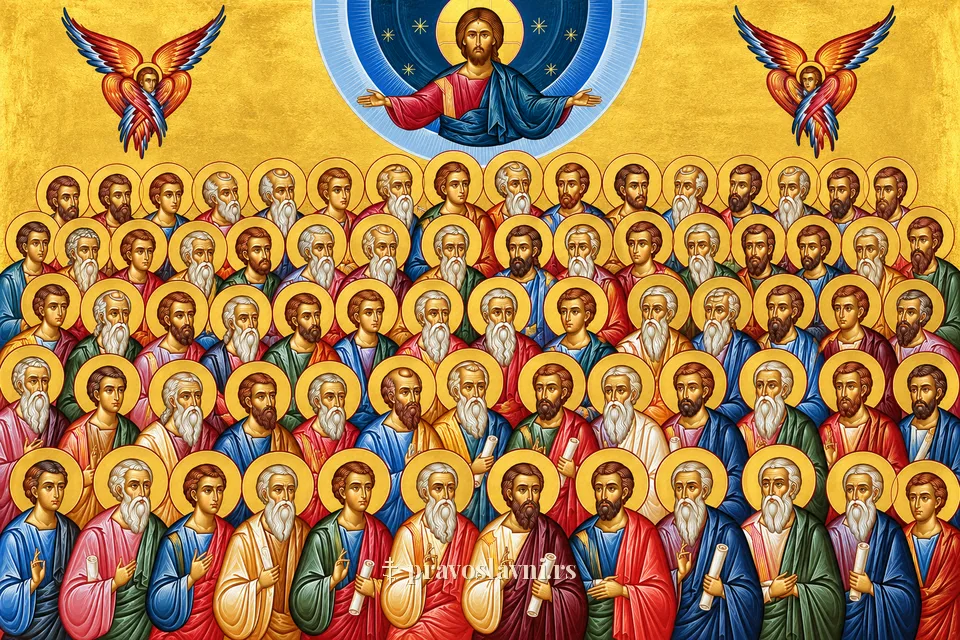
Feast of the day
Synaxis of the Seventy Holy Apostles
What happenedBesides the Twelve, the Lord chose seventy more apostles and sent them out two by two to go before Him into every town and place.
Read the LifeOrthodox Calendar · 4 January according to the Julian calendar
Sunday, 17 January 20274 January (according to the Julian calendar)What happenedBesides the Twelve, the Lord chose seventy more apostles and sent them out two by two to go before Him into every town and place.
Read the Life
You may eat meat, eggs, milk and dairy products, as well as any other food — but try to be moderate.
More about the fast →
Sunday — a festive day · 33rd Sunday after Pentecost – Sunday before Theophany
More about the feast →
“He who hears you hears Me, he who rejects you rejects Me, and he who rejects Me rejects Him who sent Me.”
— Lk 10:16The Twelve were not the only messengers of Christ: besides them He chose and sent out seventy more disciples. The Gospel according to Luke says: “After these things the Lord appointed seventy others also, and sent them two by two” (Lk 10:1). They went before Him into every city and place where He Himself was about to go. The Lord told them then that the harvest is great, but the labourers are few (Lk 10:2).
They returned with joy, because even the demons were subject to them in His name (Lk 10:17). The Lord gave them authority over all the power of the enemy, but He taught them to rejoice rather that their names are written in heaven (Lk 10:19–20).
According to the Prologue, the Seventy were at the side of the Twelve while the Church was spreading and being established, and for this they suffered much — both from men and from demons.
Not even among them was it without a fall. The Gospel according to John mentions disciples who went back (Jn 6:66), and the Prologue applies those words to some of the Seventy as well; from among the Twelve, after all, Judas fell away. The Prologue nevertheless does not class them as traitors: they turned away because they were weak and wavering in the faith. Other chosen men later entered into their number.
Those who remained were sustained, as the Prologue says, by a faith that did not waver and by love for the risen Lord. By this they overcame the world, and the Kingdom of Heaven became their inheritance.
That is why the Church celebrates them together on this day, as one synaxis. Their example teaches that strength is not in man, but in faith and in love for the risen Christ.
The Lord did not have only the Twelve closest disciples. The Gospel according to Luke records: “After these things the Lord appointed seventy others also, and sent them two by two” (Lk 10:1). They went before Him into every city and every place to which He Himself intended to come. The Church celebrates them together, at the Synaxis of the Seventy Holy Apostles.
Before He sent them, the Lord told them that the harvest is great, but the labourers are few, and that they should pray the Lord of the harvest to send out workers (Lk 10:2). The Seventy became just such workers.
They came back full of joy. They told how even the demons were subject to them in His name (Lk 10:17). The Lord answered them that He had seen Satan fall from heaven like lightning (Lk 10:18) and that He was giving them authority over serpents, scorpions and over all the power of the enemy (Lk 10:19).
But He at once directed them to a greater joy. They should not rejoice that the spirits are subject to them, but that their names are written in heaven (Lk 10:20). The miracles, then, were not the most important thing.
When the Church began to spread, the Seventy did not stand aside. The Prologue sees them beside the Twelve, as fellow workers in every task of spreading and strengthening her. They paid for this with many tribulations, and among their enemies the Prologue mentions not only men but demons as well.
The Gospel according to John bears witness that many of the disciples went back and walked with Him no more (Jn 6:66). The Prologue cites these words also when speaking of some of the Seventy, who drew away from the Lord. Not even the circle of the Twelve was spared: Judas fell away from it.
Nevertheless, the Prologue makes a clear distinction and does not count these men from the Seventy among the traitors. They fell away because they were weak and wavering in faith, as people can be. And into their number there afterwards entered others, who were also chosen.
What sustained those who remained? The Prologue answers briefly: a faith that did not waver and a love for the risen Lord that was never quenched in them. By this, according to the Prologue, they overcame the world, and the Kingdom of heaven became their inheritance. That is why the Church celebrates them together on this day, as one synaxis of Christ's envoys.
The Seventy were not men without fault. But what held them firm did not come from themselves — and that same faith and love for Christ leads a person towards the Kingdom of heaven today as well.
St Eustathius came from the župa (district) of Budimlja, from a devout family, and from his earliest years, according to his Life, he was drawn more to the church than to children's games, and he begged his parents: “I greatly desire to learn; send me to learn my letters.” He received the monastic tonsure while still a young man, in Zeta; his Life states that he was tonsured by Bishop Neofit in the monastery of the Holy Archangel Michael. Prayer, fasting and vigil were his daily life, and what he received for food and clothing went to the poor. His Life says that he begged God with tears that he might venerate the Tomb of the Lord, and so he set out for Jerusalem with two monks who were on their way there. There he venerated the holy places and was instructed by the desert-dwellers, and on his return, by way of the Holy Mountain of Athos, he settled in Hilandar. After several years he became abbot of Hilandar, and then also Bishop of Zeta. The throne of St Sava fell to him after the death of Archbishop Joanikije: his Life says that the nobles of Church and state unanimously chose him for that place at an assembly held by King Milutin, although he resisted. As Archbishop of Serbia he cared tirelessly for the faithful people, and he gave the funds of the Church to the poorer churches. When he fell ill at Žiča, his Life records that he said to those grieving around him: “Leave such sorrow; magnify the Lord with me.” He raised his hands with the words “Into Your hands, O Lord, I commit my spirit” and reposed in peace, as an old man — according to the Prologue in the year 1279, and according to his Life in 1286. His Life says that God glorified his tomb at Žiča with signs, that his body was found incorrupt, and that his relics were later translated to Peć, when enemies threatened.


