Saint of the day
Venerable Paul of Thebes
What happenedVenerable Paul of Thebes left his estate and fled into the desert, where he lived the ascetic life in hiding until deep old age, until Anthony the Great found him.
Read the LifeOrthodox Calendar · 15 January according to the Julian calendar
Thursday, 28 January 202715 January (according to the Julian calendar)What happenedVenerable Paul of Thebes left his estate and fled into the desert, where he lived the ascetic life in hiding until deep old age, until Anthony the Great found him.
Read the Life
You may eat meat, eggs, milk and dairy products, as well as any other food — but try to be moderate.
More about the fast →
Today the Church keeps the commemoration of a saint · not a Red Letter day.
More about the feast →
“Of whom the world was not worthy. They wandered in deserts and mountains, in dens and caves of the earth.”
— Heb 11:38St Anthony, the father of monks in the Egyptian desert, once asked himself, according to the Life, whether there was anyone more perfect than he. In a vision he learned that in the depths of the desert there lived such a servant of God. That is how the world came to know of St Paul of Thebes.
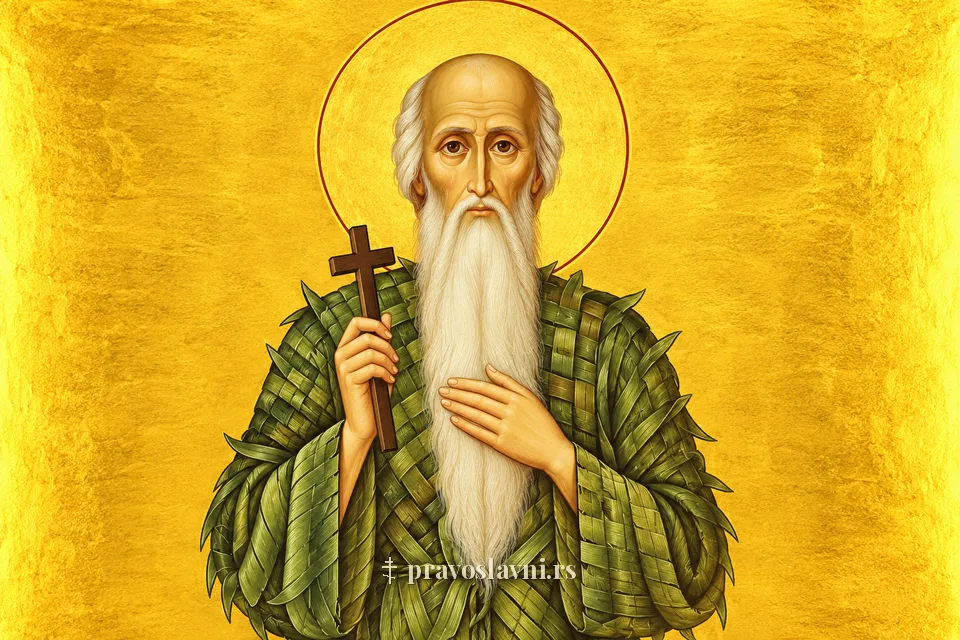
He was an Egyptian from a well-to-do house, a contemporary of the Emperor Decius. When his parents died, he was to divide the property with his sister. The inheritance brought Paul danger. The threat that he would be reported to the authorities as a Christian came from his sister's husband, and behind it stood greed: Paul's share of the property too was meant to fall to him. That man, moreover, bowed down to idols. The Prologue records that Paul, shaken by the suffering of the martyrs, renounced the inheritance in his sister's favour. With nothing at all, led by God, he went away into the desert. His Life says that for sixty years a raven brought him half a loaf of bread every day; the rest was given by the desert: water from the spring in the cave, dates, and palm leaves for clothing.
Anthony, according to the Life, searched for him for three days, and only on his knees before the cave did he prevail on him to open to him. They had no need to introduce themselves: according to the Life, God revealed to them who each was. From his guest Paul learned that the persecution was no more. On that day the raven brought a double portion, and Paul said that this was Christ's gift to the guest. They spent the night in conversation.
In the morning Paul said that his end was drawing near and wished to be buried in Anthony's mantle, a gift from Bishop Athanasius. Having come to his own monastery to fetch it, Anthony said to his disciples of himself that he was a monk only in name, and of Paul: “I have seen Elijah, I have seen John in the desert, and truly I have seen Paul – in Paradise!” On the way back, as the Life records, he saw Paul's soul among the angels, and found his body on its knees, as though he were still praying. According to the Life, two lions dug the grave, and Anthony buried Paul in the mantle. Paul lived to the age of one hundred and thirteen, and he died in the year 342.
His life teaches humility. The great Anthony found in the desert a hidden saint greater than himself. And Paul chose God instead of an inheritance, and God fed him.
St Anthony was already the father of many monks in the Egyptian desert when, according to the Life, he was seized by the thought that he was perhaps the most perfect among them. The answer came in a vision: deeper in the desert there lives a servant of God who surpasses him, and he must make haste while that man is still alive. So begins the story of a hidden ascetic — St Paul of Thebes.
Paul was an Egyptian; the Prologue traces him from Lower Thebes, and the Life from the Thebaid. He lived under the Emperor Decius, and the Life adds Valerian as well. He came from a wealthy house; the Life adds that he was educated and brought up in the Orthodox faith.
The death of their parents left a great estate to Paul and his sister. His sister's husband, to whom their parents had given her in marriage while they were still alive, bowed down to idols and was greedy for money. In order to get hold of Paul's share as well, he threatened that he would accuse his brother-in-law before the authorities as a Christian. It was a time of persecution. The Life records that Paul later described to Anthony the sufferings that he had watched at that time: how young men endured both torture and temptations, and yet did not deny Christ. The Prologue says that it was precisely their sacrifice that moved him to give up the inheritance in favour of his sister. With nothing at all, yet under God's guidance, he went away into the desert.
In a cave beside which there was a spring, according to the Life, he remained until his death. He clothed himself in palm leaves and ate dates. Bread, according to the Life, was brought to him for sixty years by a raven, half a loaf every day.
Anthony, as the Life tells, reached that cave only on the third day, having set out on the journey at random, in the midday heat, with a staff in his hand. The way, according to the Life, was shown to him by two creatures: first one that resembled a horse, and then a she-wolf. Even there his way was not easy: the door stayed shut until Anthony, kneeling, declared that without a meeting he would not go away even alive. According to the Life, they did not have to introduce themselves to each other — God had already revealed to them who was who. Anthony greeted his host: “Rejoice, Paul, chosen vessel and pillar of fire.”
From his guest Paul learned that the times had changed and that there was no longer any persecution. The Life records that on that day the raven brought a whole loaf, which Paul interpreted as Christ's gift to the guest. Neither the one nor the other wished to set himself above the other, and so the breaking of the bread was settled jointly: the loaf parted in two in their hands. They spent the night in conversation, beside the spring, giving thanks to God.
In the morning Paul revealed that his end was drawing near and that Anthony had been sent to bury him. He wished to be buried in Anthony's mantle, the one that he had from Bishop Athanasius. Anthony went to fetch it from his monastery, three days' walk away, and there he told his disciples that he no longer considered himself a true monk, but a monk in name only. Of Paul he said: “I have seen Elijah, I have seen John in the desert, and truly I have seen Paul – in Paradise!” To their further questions he answered briefly: “There is a time for everything.”
While still on the road, according to the Life, he saw Paul's soul, accompanied by angels, departing to heaven. He found him dead, on his knees, as though he were still praying. Having no tool for digging, he thought of staying and dying there, but, as the Life says, two lions came. They dug the grave, and then, having received Anthony's blessing, went away. In the Prologue there are no lions; there Anthony is an eyewitness of how the creatures of the desert and of the sky obey Paul. Of Paul's things he kept the garment of palm leaves; Anthony used to put it on at Pascha and at Pentecost. Paul lived to the age of one hundred and thirteen; both sources place his peaceful end in the year 342.
The story of Paul teaches humility. Anthony, who wondered whether there was anyone more perfect than he, found him in the desert and called himself a monk in name only. And Paul exchanged his inheritance for God and lived on what God sent him.
The Prologue records that Venerable Gabriel of Lesnovo was a Slav, a companion of Sts Prohor of Pčinja and John of Rila, and that he lived in the tenth century. His Life says that he was born in the region of Osečko Polje, near Kriva Palanka, as the son of wealthy and devout people who, having no children, obtained a son from God by their prayers and tears. He quickly learned to read, and he loved the Gospel most of all. The marriage that his parents arranged for him was not his own choice: he begged God that he might remain a virgin, and his Life records that this prayer was heard when the Archangel Michael called his wife from this life. Pointing to the example of St Alexis the Man of God, he received from his parents the freedom to leave. According to his Life, an angel told him in a dream to build a church of the Nativity of the Theotokos in Osečko Polje, and he built it with his parents' money. He became a monk in the monastery of Lesnovo. After that he lived in a skete in the direction of Zletovo, in a small wood at Lukovo, and finally on Obli Vrh, where he spent some thirty years in fasting and vigil. His Life says that people were healed and freed from demons when they came to him in the skete. When he reposed, the brethren did not know where his body lay, but according to his Life he appeared to the monk Joseph, and so the myrrh-streaming relics were translated to Lesnovo. The Prologue ascribes to him the church of the Archangel Michael on the mountain of Lesnovo and the gift of working miracles, which was shown while he was alive and did not cease even after his repose. The great church at Lesnovo was later built by Jovan Oliver, and the relics, according to his Life, were translated because of the Turkish wars to Trapezir, where, as his Life says, they still grant healings.


