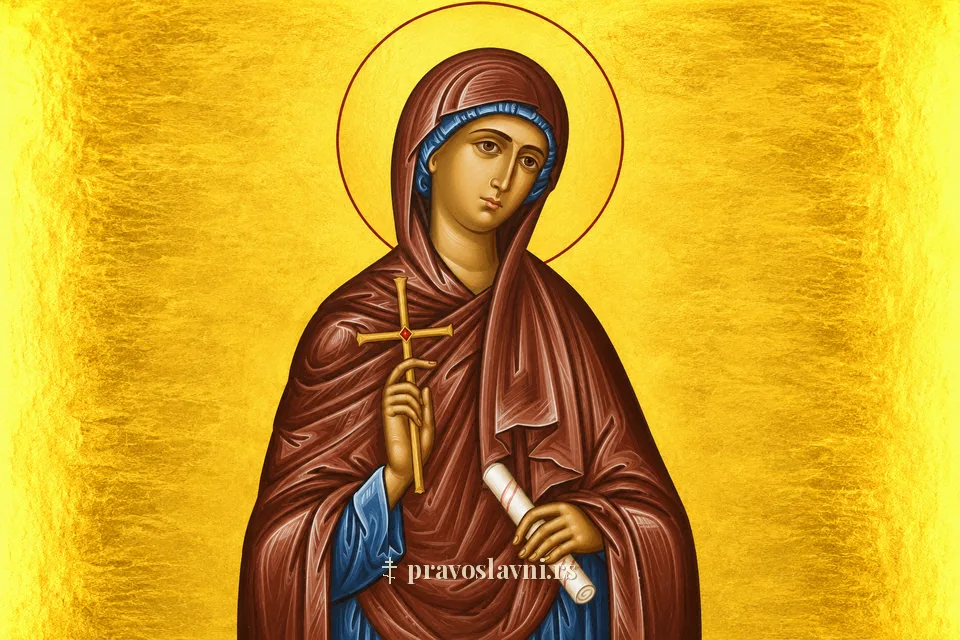
Saint of the day
Venerable Xenia of Rome
What happenedOn the eve of her wedding a Roman senator's daughter secretly left her home, her wealth and her name, to live as Xenia for God alone.
Read the LifeOrthodox Calendar · 24 January according to the Julian calendar
Saturday, 6 February 202724 January (according to the Julian calendar)What happenedOn the eve of her wedding a Roman senator's daughter secretly left her home, her wealth and her name, to live as Xenia for God alone.
Read the Life
You may eat meat, eggs, milk and dairy products, as well as any other food — but try to be moderate.
More about the fast →
Today the Church keeps the commemoration of a saint · not a Red Letter day.
More about the feast →
“But one thing is needed, and Mary has chosen that good part, which will not be taken away from her.”
— Lk 10:42The name Xenia means a stranger, and she chose it herself. Her true origin, according to her Life, was known to no one during her lifetime: that she was the daughter of a Roman senator was learned only from the last of her companions who was still alive.
Her father was rich and devout, and she was his only child. When her parents chose a bridegroom for her from a senatorial family, she chose a different life. Two maidservants promised that they would keep silent and that they would live with her in purity. According to her Life, they gave everything they had to the poor, and then one night, disguised as men, they went away in secret.
Their road, by way of Alexandria and the island of Kos, brought them to Mylasa. There, where the old priest Paul had led them, she bought a house, and her Life states that she also built a small church of St Stephen the Protomartyr, beside which a convent for maidens came into being. Paul tonsured her a nun together with her companions, and when he became a bishop, he made her a deaconess, although she did not want this.
The sisters remembered her for her ascetic struggle. The Prologue says that she did not spare herself in anything and that not one sister was more poorly dressed than she was. She ate seldom and of the humblest food, and her nights were spent standing in prayer, before which the demons could not hold their ground.
Her departure, according to her Life, she announced to the sisters in advance, asking them to remember her to Paul. She reposed in the year 450, and both sources remember the heavenly sign which then shone over the convent. Paul, who in those days was with his clergy in the village of Leukin, announced: “The Lady Xenia has fallen asleep.” She was buried, according to her Life, by the southern gate of the city, at a place which she herself had appointed. Many of the sick found healing with her, and her two companions were later buried beside her as well.
Xenia left behind wealth, marriage and even her own name, in order to live hidden, in humility and prayer. Her example calls us to watchfulness and to prayer.
Her father was a Roman senator, a wealthy and devout man, and she was his only child. The Life records that she was then called Eusebia. Her parents chose a bridegroom for her, the son of another senator, and set the day of the wedding. She, however, carried a different desire in her heart: to remain a virgin all her life and to belong to God alone, of which her parents knew nothing.
Her two maidservants did not leave her on her own. They swore that they would keep the secret and agreed to live with her in purity. Before the wedding, according to the Life, they gave away all their wealth to the poor. Then they disguised themselves as men and one night left in secret. She chose uncertainty, only so as to remain faithful to her desire to belong to God.
The Life tells that they arrived by ship first in Alexandria, and then on the island of Kos. She took the name Xenia, which means stranger, and asked her companions not to reveal to anyone who she was and where she came from. A meeting in the harbour decided her further path: there she came to know the old priest Paul, who was in charge of a small brotherhood in the Monastery of St Andrew, and who was at that time returning home after venerating the holy places. Xenia begged him to be their guide, with the words: “Man of God, do not despise one who is a stranger in a foreign land.” The elder admitted that he himself was not from there either, but from Mylasa, and he took them with him.
So Mylasa became her home. The Life says that she bought a house there near a church, and then herself built a church of St Stephen the Protomartyr, beside which a small convent for women grew up. Paul tonsured her and her two companions as nuns. The convent was given the name Kos, after the island from which they had come. When, after the death of Bishop Cyril, Paul took over the episcopal see of Mylasa, he made Xenia a deaconess, although she was opposed to it.
During her lifetime no one learned where she came from. The Prologue stresses that she did not spare herself in anything — neither in abstaining from food, nor in her prayers at night — and that not one sister was more poorly dressed than she was. According to the Life, she took food at intervals of two or three days, and sometimes not for a whole week. Her nights passed in prayer on her feet — the Life remembers her hands raised towards heaven — and the demons could not hold their ground before her.
Prayer became her wealth, and humility her honour.
When Paul went with the clergy to the village of Leukin for the feast of St Ephraim, Xenia, as the Life states, told the sisters that she would soon die and asked them to remember her to Paul. Her companions, according to the same Life, saw two things at that hour: her, prostrate in prayer, and a light with a sweet fragrance that suddenly filled the church. She reposed at noon, in the year 450.
The Prologue and the Life also remember the heavenly sign by which the hour of her death was marked; according to the Life, it accompanied the funeral procession through the city and disappeared only when her body had been buried. Paul announced: “The Lady Xenia has fallen asleep.” The healings at her bier and her grave were many, and people divided the cloth from the bier among themselves and kept it as a holy thing. She was buried, according to the Life, at Sikinia, by the southern gate, as she herself had commanded. Later both her companions were buried beside her as well. Only the last of them, as the Life records, told the nuns where Xenia came from and how she had fled from Rome.
Xenia renounced wealth, marriage and even her own name, and God glorified her more than any earthly honour. Her life calls us too to watchfulness and prayer.
According to his Life, St Babylas was from the east, from Theoupolis; his parents were distinguished and devout people, and he was taught the Holy Scriptures. He did not keep the property he inherited, but divided it among the poor, the widows and the children without parents. Then, with two disciples, Agapius and Timothy, he withdrew into the mountains. He was a priest. When the pagans in Rome wanted to hand him over, he went with his disciples to Sicily. There he brought many pagans to God. The prince of Sicily seized him and both of his disciples, and they confessed Christ before him. In order to frighten the people, the prince had them led, tortured as they were, from town to town across the island. In the end all three were beheaded, in the third century. The Christians, according to his Life, buried them in Sicily. Babylas and his disciples did not waver, because eternal life was more important to them than this earthly one.
Separate page: Holy Martyr Babylas →
Blessed Xenia was born between the years 1719 and 1721; her husband was Andrei Fyodorovich Petrov, a singer in the court choir. Her Life records that he died suddenly and without repentance, and she was twenty-six years old at the time. In order to pray for his soul, she took upon herself the ascetic struggle of foolishness for Christ's sake. She took her husband's name and began to wear his clothes, saying: “Andrei Fyodorovich has not died.” She gave her house to Paraskeva Antonova, and her belongings she gave away to the poor. Her relatives asked the authorities to stop her, but it was established that she was of sound mind and was entitled to dispose of her own property. She endured mockery for decades, wandering through St Petersburg in men's clothing in every kind of bad weather, and she spent her nights in a field, at prayer, turning with prostrations to all sides. When a stone church was being built at the Smolensk Cemetery, at night she secretly carried bricks up onto the scaffolding. People noticed that after her request help came against trouble, and after her gift came joy, and so mothers sought her blessing for their sick children. She died at the beginning of the nineteenth century, after about forty-five years of that struggle, and she was buried at the Smolensk Cemetery, beside the church which she had helped to build. The Russian Orthodox Church numbered her among the saints in the year 1988 Her self-sacrificing love still leads many today to ask for her intercession.


