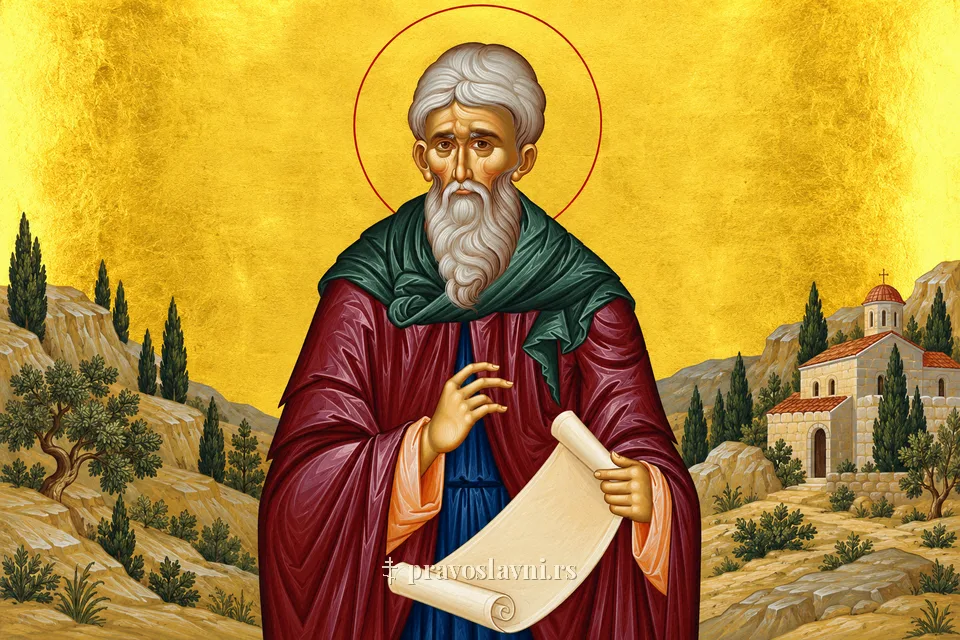
Saint of the day
Venerable Isidore of Pelusium
What happenedSt Isidore of Pelusium renounced wealth and standing, and left the Church thousands of letters full of counsel, comfort and instruction.
Read the LifeOrthodox Calendar · 4 February according to the Julian calendar
Wednesday, 17 February 20274 February (according to the Julian calendar)What happenedSt Isidore of Pelusium renounced wealth and standing, and left the Church thousands of letters full of counsel, comfort and instruction.
Read the Life
No meat, dairy products, eggs, fish or oil — food cooked in water.
This is a recommendation — for your own fast, consult your priest or spiritual father.More about the fast →
Today the Church keeps the commemoration of a saint · not a Red Letter day.
More about the feast →
“But be doers of the word, and not hearers only, deceiving yourselves.”
— Jas 1:22With St Isidore of Pelusium, teaching never ran ahead of deeds; in this, as the Prologue and his Life testify, he took the Lord Jesus as his example. That is why his word carried weight.
That weight was seen best when St John Chrysostom was unjustly banished. Isidore did not hesitate to defend the exile, even though the persecutor was his own kinsman, Patriarch Theophilus. The Prologue records that he admonished Theophilus by letter for his enmity towards Chrysostom, and the Life that he also appealed to Emperor Arcadius. He did not stop the persecution, but the persecutors were left exposed. Later Cyril, the new Patriarch of Alexandria, at Isidore's request acknowledged Chrysostom as a holy confessor. According to the Life, Isidore also urged the calling of the council in Ephesus and cared for peace in the Church.
Most of all, however, he spoke through letters. Their number, according to the historian Nicephorus, reaches as many as ten thousand, and the Prologue says even more than that. To each person he wrote what that person needed, to one a word of comfort, to another a rebuke. He reminded philosophers that fine speech is not worth much without a good life. To Bishop Apollonius he wrote that the faith should not be imposed, but that people should be led to it by counsel and example. He praised the humble, and the Life also preserves his saying: “He who practises virtue has a radiant crown.” He warned Bishop Palladius of Helenopolis to keep away from frequent conversations with women. He set virginity in the first place, without belittling honourable marriage.
Theophilus and Cyril, Patriarchs of Alexandria, were his relatives, and he came from Egypt, from a distinguished house. The world would have seen in him a man who had everything: property, and standing, and learning, both worldly and spiritual. He, however, chose a life for Christ. The Life says that he became a monk on the Mount of Pelusium, in the days of Emperor Theodosius the Younger, and became a presbyter, and people revered him as an abba. The historian Evagrius testifies that he enjoyed great esteem. He reposed in deep old age, around the year 436.
From him we learn that a word is worth as much as the life that stands behind it, and that purity of soul is no lesser a concern than purity of body.
Who were all those who received his messages? Bishops and monks, philosophers, and even emperors. To Bishop Apollonius, as his Life relates, he wrote that the faith is not forced upon anyone: a man draws near to it when he sees a good life and hears wise counsel. To the monk Patrimus he recommended that he should strive for good deeds, and not for fine speaking. The same thought stands in the message to the philosophers which the Prologue preserves: “It is more important to be instructed in a virtuous life than in eloquent preaching.”
Humility was for him the measure of everything. According to his Life, he taught that in a humble man the virtues shine most brightly, and that the greatest reward is received by the one who thinks little of his own good deeds. One short saying of his sums this up: “He who practises virtue has a radiant crown.”
He valued virginity above all the virtues, but he did not look down on honourable marriage. His Life relates that in a letter to Antony the Scholastic, relying on the words of the Apostle, he explained that each of these states has its own glory, just as the heavenly lights do not all shine alike.
Peace in the Church was his concern in later times as well. According to his Life, he reminded Emperor Theodosius of that duty by letter, and he also supported the calling of the Third Ecumenical Council in Ephesus against the heretics. To the blasphemer Therasius he made it clearly known that, in opposition to the teaching of Arius, he was ready even to suffer for the true faith.
The Prologue remembers him as a great defender and interpreter of the Orthodox faith. And the secret of his word lay in this: that, following the example of the Lord Jesus, he always first fulfilled himself what he taught to others. He lived to a great old age and around the year 436 peacefully departed into the Kingdom of Christ.
Venerable Nicholas was born in the village of Kydonia on Crete, into a Christian family. He went to Constantinople and became a disciple of the abbot Theodore the Studite; his Life says that he came there to his uncle, the monk Theophanes, while the Prologue records that Theodore was a kinsman of his. In the Studion Monastery he became a monk, and later he was ordained a priest. His Life records that his parents were taken captive by the Saracens when they conquered Crete, and that he comforted his weeping brother Titus with the words: “So God has willed”. Under the iconoclast Emperor Leo the Armenian he and Theodore were severely tortured for the sake of the holy icons and spent three years in prison. The Emperor Michael brought them their freedom, and after Theodore's death the governance of the Studion Monastery passed to Nicholas. When Patriarch Ignatius was deposed and Photius was brought in to take his place, Nicholas left the monastery, and after his arrest he lay in prison for two years. The Emperor Basil the Macedonian set him free and asked him to lead the monastery once again. The Prologue and his Life also remember his healings — among those healed were the Empress Eudocia and Helen, the wife of the patrician Manuel — as well as his prophecy about the newborn daughter of the patrician Theophilus Melissenus, whose children had not been surviving, a prophecy which came true. When on his deathbed he learned that the brethren were short of grain, he called on them to trust in God and foretold wheat within three days. The Prologue and his Life record that the promise was fulfilled in exactly that time — the grain was sent by ship by the Emperor Basil. He reposed in the year 868, at the age of seventy-five.


