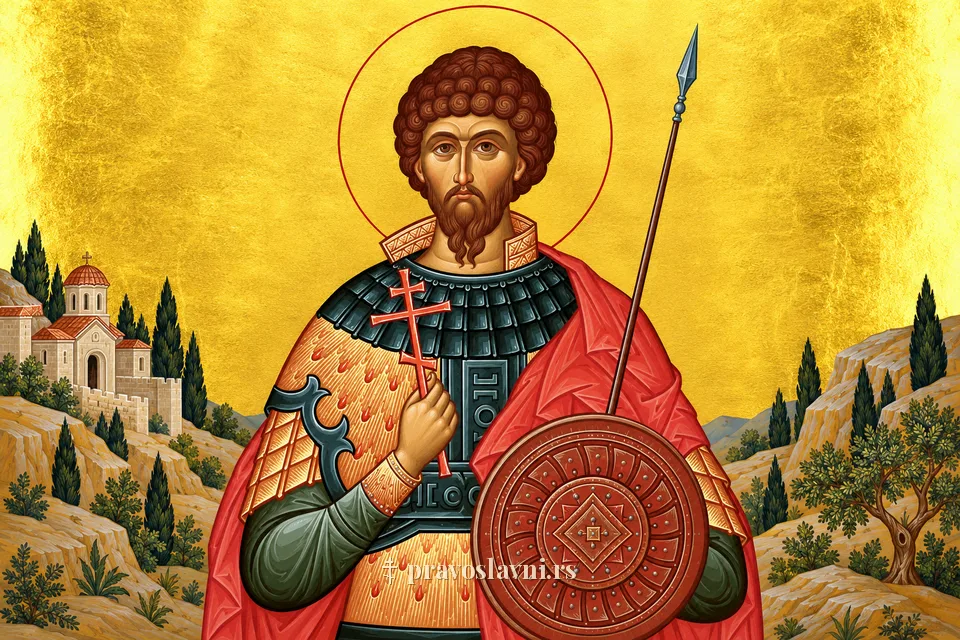
Saint of the day
Great Martyr Theodore Stratelates
What happenedThe general Theodore smashed the gold and silver idols of Emperor Licinius and shared out the pieces among the poor, and for this he suffered for Christ.
Read the LifeOrthodox Calendar · 8 February according to the Julian calendar
Sunday, 21 February 20278 February (according to the Julian calendar)What happenedThe general Theodore smashed the gold and silver idols of Emperor Licinius and shared out the pieces among the poor, and for this he suffered for Christ.
Read the Life
You may eat meat, eggs, milk and dairy products, as well as any other food — but try to be moderate.
More about the fast →
Today the Church keeps the commemoration of a saint · Sunday — a festive day · Sunday of the Publican and the Pharisee (Lenten Triodion).
More about the feast →
“Therefore take up the whole armor of God, that you may be able to withstand in the evil day, and having done all, to stand.”
— Eph 6:13The Prologue teaches that the greatness of a martyrdom is seen by what a man left behind and how much he endured for Christ. Great Martyr Theodore Stratelates had much to leave behind: he was young, handsome, brave and eloquent, he held command in the army of Emperor Licinius and governed Heraclea, and the Emperor, according to his Life, was even hinting at the throne for him. All of that he gave up for Christ.
He was a native of Euchaita. The Life remembers that there, calling on the name of Christ, he overcame a huge serpent that was ravaging the countryside, while the old woman Eusebia, who had tried in vain to dissuade him, prayed for him. After that many received the faith, and in Heraclea, according to the Life, almost the whole city.
Licinius persecuted the Christians. On the night before the Emperor's arrival, according to the Life, God encouraged him in a vision not to be afraid. When the Emperor came to Heraclea with his statues of gold and silver, Theodore, as the Prologue and the Life record, took them to his own house, broke them into pieces by night and gave them away to the poor. Everything, according to the Life, came to light when the captain Maxentius recognised the golden head of Artemis among the poor. Theodore denied nothing.
Grievous suffering followed: scourging, and then the cross. The Prologue records that even in his torments he glorified God. According to the Life, an angel restored him to health, encouraging him to persevere to the end and win the immortal crown, and the captains who came for his body, finding him alive, themselves came to believe. When the people wanted to attack the executioner, Theodore, according to the Life, stopped them. He was beheaded with the sword in the year 319. To the scribe Uarus he entrusted his wish to rest in Euchaita, on the land of his forefathers.
His relics were translated to Euchaita, and the Prologue says that they were later placed in the Church of Blachernae in Constantinople. Soldiers, according to the Prologue, have in him a protector to whom they can turn for help. His life reminds us that idols, however much gold they are made of, have no power at all, while Christ gives victory to those who persevere to the end.
Theodore Stratelates had what many people chase after all their lives. He was a commander in the army of Emperor Licinius and the governor of the city of Heraclea, and his Life remembers him as a brave and handsome man and a gifted orator. He came from Euchaita, where his family had an estate. The Emperor, according to his Life, even gave him hope that one day he might take over the throne.
The Prologue says that martyrdom is measured by two measures: what a man has left behind for Christ, and how much he has endured for Him. By those measures Theodore's sacrifice is great. The Emperor's favour, an officer's rank, beauty and the days of youth — all this he set aside for the sake of Christ.
And the emperor whom he served was a persecutor. Although the devout Constantine was his brother-in-law, Licinius, according to the Life, held to the example of the godless Maximian, from whom he had also taken over power. Among the Christians whom he put to death the Life also names the Forty Martyrs of Sebaste.
His Life tells that in a desolate region near Euchaita there lived a huge serpent, from which both people and cattle perished every day. Theodore set out there alone, without an escort and without announcing it, with a sword and a cross. While he was resting on the grass, the old woman Eusebia found him and implored him to get away, because many had perished there. He sent her away, and she, according to his Life, prayed for him. Calling upon the name of Christ, Theodore challenged the beast, overcame it with the help of his horse and his sword, and then gave thanks to Christ for the victory.
That event opened many hearts, and his Life says that both soldiers and ordinary people received baptism. When he later preached in Heraclea, almost the whole city, according to his Life, came to the faith. The Prologue adds that he did not keep the truth from the Emperor either, but called him too to conversion, from statues to the living God.
Licinius, enraged, sent men to bring Theodore. According to his Life, Theodore kept them with him as guests, and sent word to the Emperor by letter that the city was in unrest and that it would be best for him to come to Heraclea himself, with his idols of gold and silver. The Emperor arrived from Nicomedia with eight thousand soldiers and a great retinue. According to his Life, on the night before that meeting God comforted him with a vision and a voice: he had no need of fear.
Licinius showered his commander with praises. When the time came for the public sacrifice, Theodore asked that he might first take the statues to his own house. That night, as the Prologue and his Life record, he broke them into pieces, and distributed the gold and silver to the needy. According to his Life, everything was revealed to the Emperor by the captain Maxentius, who recognised the golden head of Artemis among the poor. Theodore did not make excuses. Before the Emperor he mocked the powerless statues and bore witness to the God who is alive.
Harsh tortures followed. The Prologue and his Life mention scourging, and his Life also five days in chains without food. At last he was crucified, and the Prologue says that his body was pierced with arrows on the cross. His Life here draws a parallel with Golgotha: there the sentence was pronounced by Pilate, here by Licinius. The Prologue preserves his words from those hours: “Glory to You, my God, glory to You!”
When Theodore fell silent on the cross, having entrusted his spirit to God, the Emperor thought that he was dead and went away. But his Life does not end the story there. That night, according to it, Theodore received from an angel new health and freedom from the cross, with the message that he should persevere to the end and gain the immortal crown. In the morning the captains Antiochus and Patricius came to throw his body into the sea, and they found him alive, singing to God. According to his Life, they too were baptised.
Afterwards, according to his Life, the prisoners were released from the prison, the citizens abandoned the idols, and the sick recovered by touching him or his clothing. When a clash flared up among the soldiers, Theodore calmed the crowd with the words: “Stop, my dear ones!” Licinius then ordered his execution. The people wanted to settle accounts with the executioner, but Theodore did not allow it. To the scribe Varus he left, according to his Life, instructions: to write down the day of his suffering, and that his body should rest in Euchaita, on his ancestral estate. He was beheaded in the year 319, at three o'clock in the afternoon.
The Christians, according to his Life, escorted his body with candles and incense, and afterwards many miracles followed. His relics, according to his Life, were translated to Euchaita, and the Prologue adds that they later came to Constantinople, to the church at Blachernae. The Prologue sees him as the protector of the army: a soldier who turns to him has a helper in him.
Theodore's life shows that statues, however costly they may be, are powerless, and that Christ gives victory to those who persevere.
St Zechariah is the eleventh among the minor prophets. Of his origin his Life says that he came from the tribe of Levi and was born in Gilead; his name means the remembrance of God. When the temple in Jerusalem had to be rebuilt, he and the prophet Haggai encouraged the prince Zerubbabel in that work. He prophesied about Christ: the Life quotes his words that Christ would solemnly enter Jerusalem “on a donkey, a colt, the foal of a donkey”. He also foretold the betrayal of Judas: “So they weighed out for my wages thirty pieces of silver”. And he foretold that the apostles would scatter when Christ suffered: “Strike the Shepherd, and the sheep will be scattered”. He is called the Sickle-seer because in a vision he saw a sickle falling from heaven upon evildoers, above all upon those who steal and those who blaspheme the name of God. He died in the last year of the reign of King Darius Hystaspes, about the year 520 before Christ. According to the Life, he was buried near the tomb of the prophet Haggai. Through Zechariah God revealed centuries in advance the humble King on a donkey and the price of His betrayal, so that the faithful might recognise in Christ the One whom the prophets had announced.
Separate page: Holy Prophet Zechariah →
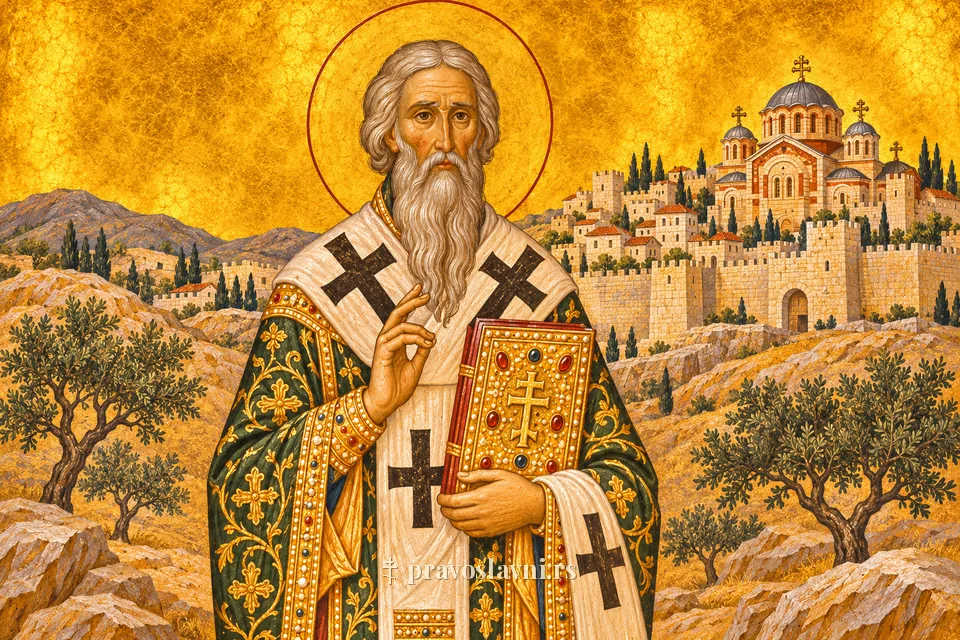
St Sava II was born, according to his Life, around the year 1200 as Predislav, a son of King Stefan the First-Crowned. St Sava was his uncle and his model, and so Predislav too chose the monastic path and the ascetic life. His Life mentions that, while he was a monk of Hilandar, he went on pilgrimage to the Holy Land, to the tomb of Christ and the places of the Lord's Passion. His first service as a bishop was in Hum. He succeeded St Arsenije on the throne of the Serbian archbishops and took the name Sava II — according to the Life, in the year 1266. Of his work as archpastor the Prologue and his Life say the same: he served with devotion, out of love for his flock. The holy Archbishop Danilo, who wrote an account of his life, testifies that he cared for the people entrusted to him without respite, aware of the responsibility that he bore before God. He reposed in Peć — the Prologue gives 1268 as the year of his death, and the Life 1271. His relics are kept in the Monastery of Peć. The example of St Sava II teaches that a shepherd serves the flock of God faithfully and without tiring.


