Saint of the day
Zadušnice (winter) — Memorial Saturday
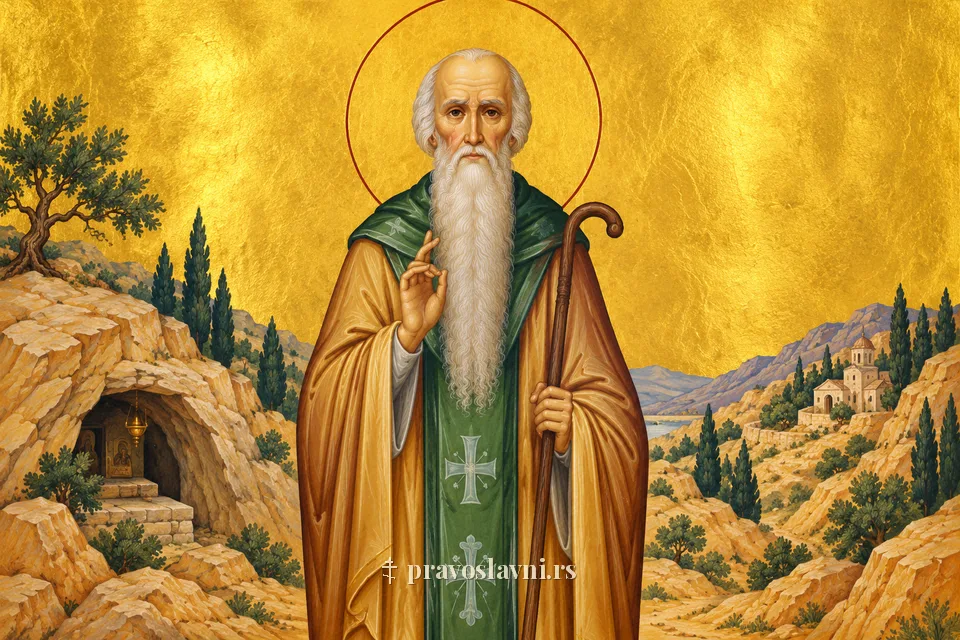
Venerable Timothy
What happenedVenerable Timothy lived in fasting and prayer on Olympus in Asia from childhood to deep old age, and received from God the gift of healing.
Read the LifeOrthodox Calendar · 21 February according to the Julian calendar
Saturday, 6 March 202721 February (according to the Julian calendar)What happenedVenerable Timothy lived in fasting and prayer on Olympus in Asia from childhood to deep old age, and received from God the gift of healing.
Read the Life
You may eat meat, eggs, milk and dairy products, as well as any other food — but try to be moderate.
More about the fast →
Zadušnice (winter) — Memorial Saturday (Lenten Triodion)
Prayer for the departed →More about the feast →
“Blessed are the pure in heart, For they shall see God.”
— Mt 5:8The winter Zadušnice (Memorial Saturday) are also called the Meatfare, the Poklade and the Great Zadušnice, and they are “winter” after the season in which they usually fall. Zadušnice are Saturdays devoted to prayer for the departed and to their commemoration, and the Church keeps them four times a year: the winter, the summer, the Miholjske and the Mitrovske. They have no fixed date, because they depend on the beginning of the Paschal fast, and as a rule they fall on the Saturday before Mesne poklade (Meatfare Sunday); if the Meeting of the Lord or the patronal feast of the church falls on it, the commemoration is moved earlier. The commemoration is very old: it is already recorded in the typikon of the Great Church of Constantinople from the ninth or tenth century.
A special place in the prayers of that day belongs to those who, because of particular circumstances, were not buried according to the Christian rite. The prayer rests on love for one's neighbours and on the hope that God will forgive the departed at the Last Judgement, which is commemorated on Mesne poklade. The canon of that day prays for all the dead, and for those who perished in water, in war, in an earthquake, a fire or an accident. The day usually begins in church: at the Liturgy the priest pours wine over the koljivo (boiled sweetened wheat), and after the dismissal there follows a memorial service (parastos) for all the departed. Whoever cannot reach the cemetery because of the distance holds the commemoration in the nearest church, while at the cemetery the faithful light candles as the priests go from grave to grave censing them.
The candle, the wine and the koljivo each have their meaning: the candle means faith in Christ, the light of the world, the wine Christ's Blood and God's mercy, and the koljivo the resurrection, according to Christ's word about the seed which bears fruit only when it goes down into the earth. By folk custom, the graves are tidied and decorated with flowers, and a pogača (a round flat loaf), koljivo, wine and other food are taken to the cemetery. It is also the custom on that day to give alms and a share of the food brought to every poor person one meets. In some regions, as in Herzegovina and Popovo polje, people do not go to the cemetery, but Zadušnice are kept at home, with candles lit before sunrise.
We remember Venerable Timothy as a monk to whom God granted to heal the sick and to have power over demons. The Prologue explains why: God gives such power to those who are pure and chaste — and Timothy was such all his life. The Life also mentions a vow from his youth: that he would never raise his eyes to the face of a woman.
He lived at Symbola, on Olympus in Asia, and the Prologue remembers him as a desert-dweller. The Life records that in that deserted region there was a monastery, governed by the virtuous Archimandrite Theoctistus. There Timothy became a monk while still a child; he was a disciple of Theoctistus, as was Plato the Confessor.
Fasting, abstinence and prayer filled his days, and the Life also remembers the nights which he spent on his feet in prayer. The Prologue says that he did not slacken in that labour until deep old age. According to the Life, he overcame the passions completely, and he spent long years going through mountains and deserts, in prayer with tears, devoted to God alone. Both sources say that the Holy Spirit dwelt in him; according to the Prologue, this was the fruit of long labour over his own soul. The Life states that by his prayer those sick with every illness recovered and were set free from evil spirits.
He reposed in deep old age, in the year 795.
Timothy's life teaches that God gives His gifts to those who guard their purity and do not abandon prayer.
Venerable Timothy lived on Olympus in Asia, in a place that was called Symbola, and he walked the monastic path from childhood to great old age. Both sources say that he became a monk while he was still a boy. The Prologue remembers him as a hermit, while his Life records that in that desolate region there stood a monastery, which was governed by the virtuous Archimandrite Theoctistus. Timothy was his disciple; under the same teacher, according to his Life, Plato the Confessor also learned the monastic life.
Both sources speak expressly about his purity: he remained pure throughout his whole life, and his Life calls him a virgin in both soul and body. According to his Life, while still a young man he made a vow that he would never look upon the face of a woman.
That purity was served by daily ascetic struggle. His Life mentions fasting, abstinence and standing in prayer all night long, as well as long years in which, living for God alone, he walked through mountains and deserts and prayed with tears. The Prologue adds vigil and work without rest, right up to old age. His Life says that in this way every movement of passion was quenched in him and that he attained dispassion and perfection.
The Prologue explains the link between purity and the gifts of God: to those who are pure and chaste God gives authority over evil spirits, and so He gave it to Timothy too. Both sources record that the Holy Spirit dwelt in him, and according to the Prologue, he himself prepared that dwelling place in his soul by his labour. He received the gift of healing and authority over the demons. His Life states that at his prayer the sick recovered from every illness, and people were set free from evil spirits.
He lived to a great old age and reposed in the year 795.
The example of Venerable Timothy teaches that a soul which guards its purity and does not give up fasting and prayer becomes a place where the Holy Spirit dwells, and that to such people God gives the gift of healing.
The body of St Eustathius, according to his Life, was brought back to Antioch only around the year 482, in the time of the Emperor Zeno, and the people came out to meet it far outside the city, with candles and chanting. So honour came to a man who had died as an exile. Eustathius was Archbishop of Antioch, the successor of Philogonius, and the Life praises him as a holy man, worthy of that ministry. Both sources stress his zeal for the Orthodox faith. At the First Ecumenical Council he rose up against the teaching of Arius and, with the other Fathers, confessed that the Son is of the same essence as the Father. By this, according to the Life, he made enemies of Eusebius of Nicomedia, Theognis of Nicaea and Eusebius of Caesarea. The Prologue says that the supporters of Arius grew stronger after the death of the Emperor Constantine and began to persecute the Orthodox, while the Life places the council earlier: it says that Eusebius and Theognis, around the year 330, while passing through Antioch, convened an unjust council and with money induced a woman to slander him. On the basis of that lie Eustathius was deposed and sent into exile, where he suffered for a long time and died; the Prologue gives the year 345. The truth, according to the Life, came to light all the same: the woman fell gravely ill and admitted that she had taken a bribe and sworn falsely. The life of Eustathius teaches that confessing the full divinity of the Son is sometimes paid for with slander and exile, but in the end God reveals the truth and glorifies His faithful ones.


