Great feast
Great and Holy Friday
What happenedOn Great and Holy Friday the Church remembers the holy, saving and awesome sufferings of the Lord Jesus Christ, His crucifixion, death on the cross and burial.
Read the LifeOrthodox Calendar · 17 April according to the Julian calendar
Friday, 30 April 202717 April (according to the Julian calendar)What happenedOn Great and Holy Friday the Church remembers the holy, saving and awesome sufferings of the Lord Jesus Christ, His crucifixion, death on the cross and burial.
Read the Life
Great Friday: according to the Typikon, no food until the bringing out of the Epitaphios — as each is able, with the advice of a priest.
This is a recommendation — for your own fast, consult your priest or spiritual father.Prayer of St Ephraim the Syrian →More about the fast →
Red Letter day — great feast; by custom, no work is done
More about the feast →
“Who Himself bore our sins in His own body on the tree, that we, having died to sins, might live for righteousness—by whose stripes you were healed.”
— 1 Pet 2:24By custom, on Great and Holy Friday the lady of the house dyes the Paschal eggs. Into the water in which the eggs are dyed she pours a little holy water, from Theophany or from Pascha. The red colour is a sign of Christ's Blood, which He, the innocent one, shed on Golgotha, and at the same time a sign of the Resurrection. The egg that comes out of the dye first is called the čuvarkuća (“guardian of the house”): it is put aside and kept until the following Pascha.
Before dyeing, the eggs are, by custom, decorated with wax and a pen: the letters and patterns drawn in wax remain white. Most often “H. V.” and “V. V.” are written (for “Hristos Vaskrse”, “Christ is risen”, and “Vaistinu Vaskrse”, “Truly He is risen”), little crosses and flowers are drawn, while stickers are a newer custom.
From the afternoon, when the Epitaphios (plaštanica, the burial shroud of Christ) is brought out in church, right up to Pascha the faithful come up to it and kiss it. In some regions the faithful pass under the table on which the Epitaphios lies, with a prayer and a good wish; among the people it is believed that such a wish will come true, but that is a folk belief and not the teaching of the Church. For the whole of Holy Week the Church prescribes the strictest fast, without oil and fish, and for Great and Holy Friday the church handbooks say that it is desirable to eat nothing on that day.
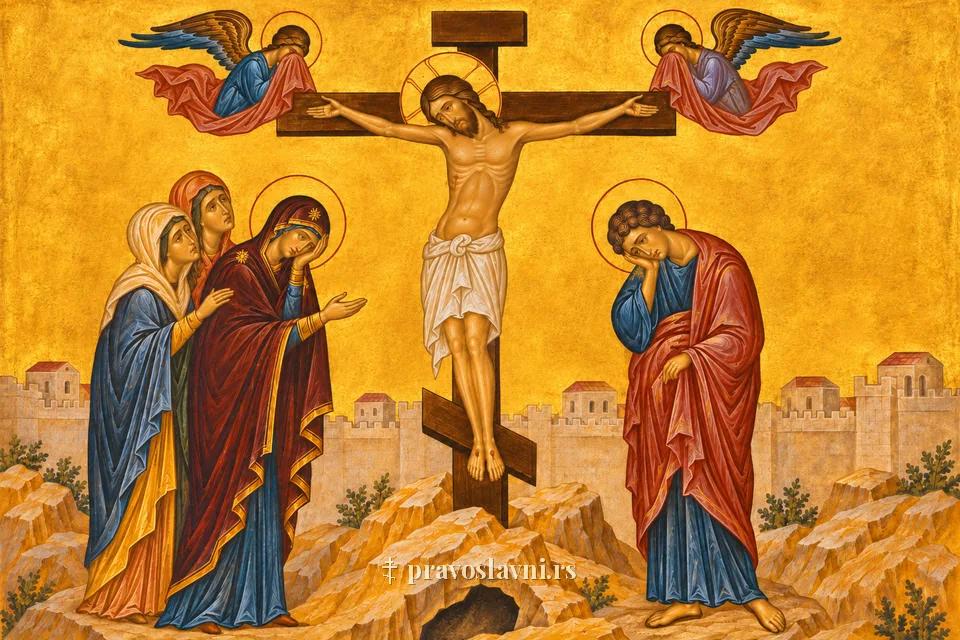
On Great and Holy Friday the Church remembers the holy, saving and dread Passion of the Lord Jesus Christ. Christ was tried before Annas and Caiaphas, spat upon and struck, and false witnesses accused Him. Pilate found no guilt in Him, but the people chose Barabbas and demanded crucifixion. Pilate's wife, because of a dream, sent word to him to have nothing to do with that Just Man, and Pilate washed his hands. Scourged, in a scarlet robe and with a crown of thorns, the Lord was led out to the Place of a Skull; the cross was carried by Simon of Cyrene. He was crucified between two robbers, under the inscription “Jesus of Nazareth, the King of the Jews”. One robber blasphemed Him, and the other confessed Him, and the Saviour promised him Paradise. By the cross stood His Mother, Mary the wife of Clopas, and the Apostle John.
Having said “It is finished!”, Christ gave up His spirit; the sun was darkened, the earth quaked, and the veil of the Temple was torn. The centurion Longinus confessed: “Truly this was the Son of God!”, and then His side was pierced with a spear, and blood and water flowed out. The Synaxarion connects the crucifixion at the sixth hour with Adam. Joseph of Arimathea took the body down from the cross and laid it in a tomb, and Nicodemus brought myrrh and aloes.
On that day the Liturgy is not served. The Royal Hours are served, and at Vespers the epitaphios (plaštanica) is carried out into the middle of the church, where the faithful venerate it until Vaskrs (Pascha). For the whole of Holy Week the Church prescribes the strictest fast, and on Great and Holy Friday it is desirable to eat nothing at all. The Apostle Paul writes that Christ was “obedient to the point of death, even the death of the cross”, and St Justin of Ćelije teaches that the robber who believed is our hope. St Justin, in a homily on Great and Holy Friday, says: “Not even the Dread Judgement, brethren, will be more dreadful than Great and Holy Friday.” Great and Holy Friday shows how far the love of God goes.
The Synaxarion of Holy Week says that on Great and Holy Friday the Church remembers the holy, saving and dread Passion of our Lord and God Jesus Christ. Christ was first led to be judged before Annas, and then before Caiaphas. They spat on Him and struck Him, false witnesses accused Him, and the mockers demanded that He prophesy to them who it was that had struck Him.
Pilate found no fault in Him. According to the custom he offered to release one prisoner, but the people chose Barabbas and demanded the crucifixion. Pilate's wife, because of a dream, sent word to him to have nothing to do with that Righteous Man. Pilate washed his hands, and the people answered that His blood should be on them and on their children. After He had been scourged, the soldiers mocked Him: a reed in His right hand, a crown of thorns on His head, a scarlet robe on His shoulders. Judas returned the thirty pieces of silver and hanged himself.
The soldiers compelled Simon of Cyrene to carry the cross. They crucified Christ at the third hour at the Place of a Skull, between two thieves, and Pilate's inscription read: “Jesus of Nazareth, the King of the Jews”. The passers-by and the chief priests mocked Him: if He is the King of Israel, let Him come down from the cross, and they will believe in Him. One thief blasphemed Him, while the other defended and confessed Him, and the Saviour promised him that he would dwell with Him in Paradise. By the cross stood His Mother, Mary the wife of Clopas, and the Apostle John.
Of the words from the cross, the Synaxarion records that the Lord said He was thirsty, and then: “It is finished”. Then He gave up His spirit. The sun was darkened from the sixth to the ninth hour, the earth quaked, the rocks were split, and the veil of the temple was torn. The centurion Longinus confessed: “Truly this was the Son of God”. They broke the legs of the thieves, but not those of Christ, for He had already died; Longinus pierced His side with a spear, and blood and water flowed out. The Synaxarion links the crucifixion on the sixth day and at the sixth hour with Adam, and according to tradition Adam's skull lies at the Place of a Skull.
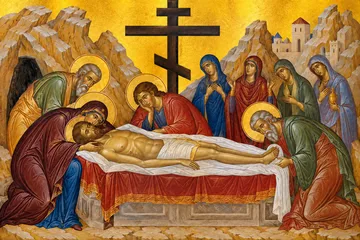
Joseph of Arimathea begged the body from Pilate, took it down from the cross and laid it in a tomb, and Nicodemus brought a mixture of myrrh and aloes.
The Church's handbooks say that Christ sheds His blood so that no one should ever again have to be killed as a sacrifice; on Great and Holy Friday the devil is defeated and sin is destroyed. In the thought of St Justin of Ćelije, our hope is the thief, who confessed the crucified Christ as Lord. St Justin says in his homily on Great and Holy Friday: “Not even the Dread Judgement, brethren, will be more dreadful than Great Friday.” The Apostle Paul writes: “For the message of the cross is foolishness to those who are perishing, but to us who are being saved it is the power of God.” (1 Cor 1:18)
At Matins the twelve Gospels of the Passion are read, and the faithful listen to them holding lighted candles. In the morning the Royal Hours are served, with readings from all four Gospels. Because of the strictest fast and out of awe before the sacrifice of Golgotha, the Liturgy is not served on that day. At the hour when Christ died, Vespers is served. Then the Epitaphios (the Holy Shroud) is carried out into the middle of the church, and the table on which it is laid signifies the Lord's tomb. The faithful come up to it and venerate it with a kiss right up until Pascha.
When, at the place of execution, the turn came of the old presbyter Ananias, he began to tremble. Then Phusik, who served the king but was a Christian in his heart, spoke to him in words which the Prologue preserves: “Do not be afraid, old man; close your eyes and be courageous, that you may behold the divine light!” Phusik was denounced at once, openly confessed Christ and was tortured to death, and the virgin Askitrea, his daughter according to the Prologue, was killed as well. Bishop Simeon watched all this, for he was to be put to death last.
Simeon was a bishop in Persia in the time of King Sapor. His Life says that he was falsely accused of being a friend of the Greek Emperor and an enemy of Persia, and that Sapor first burdened the Christians with a tax and then began to kill the clergy and pull down the churches. He was arrested together with the presbyters Abdelas and Ananias. According to the Life, he did not bow before the king, because formerly he had bowed out of respect for the royal dignity, but now he was being asked to renounce his God. He was shaken neither by promises nor by threats, nor by the demand that he bow down to the sun.
According to the Life, in prison he also lived to see a joy. Simeon's rebuke brought back to the faith Ustazan, a royal eunuch who had fallen away from Christ, and he confessed the true faith before the king. He was put to death before Simeon, and the Life records that he asked for it to be proclaimed that he was not dying as an enemy of the king, but only as a Christian.
Many of the faithful were led out to the place of execution with Simeon — a thousand according to the Prologue, a hundred according to the Life. To the last he encouraged the others not to be afraid, while he himself stayed to wait for his turn, and only then was he beheaded. A year later Azat, the king's favourite among the eunuchs, also suffered for Christ, together with about a thousand other Christians, so that the king grieved over that loss and put a stop to the mass killings. They all suffered in the year 341 or 344.
Simeon teaches that a true shepherd does not bow his head before the enemy of his God and that he goes to his death last, so that none of his own may lose courage.