Great feast
Ilindan — Holy Prophet Elijah
Holy Prophet Elijah
What happenedThe Holy Prophet Elijah was zealous for the one God against idolatry, and he was taken up from earth to heaven in a fiery chariot.
Read the LifeOrthodox Calendar · 20 July according to the Julian calendar
Monday, 2 August 202720 July (according to the Julian calendar)Save your slava — you'll get a reminder a week and a day before.
Send a greeting card →What happenedThe Holy Prophet Elijah was zealous for the one God against idolatry, and he was taken up from earth to heaven in a fiery chariot.
Read the Life
You may eat meat, eggs, milk and dairy products, as well as any other food — but try to be moderate.
More about the fast →
Red Letter day — great feast; by custom, no work is done
More about the feast →
“Elijah was a man with a nature like ours, and he prayed earnestly that it would not rain; and it did not rain on the land for three years and six months.”
— Jas 5:17Sung at the Slava (family patron saint's feast) and on the saint's feast day.
An angel in the flesh, the foundation of the prophets, the second forerunner of the coming of Christ, the glorious Elijah, who sent down from on high grace unto Elisha to drive away sicknesses and to cleanse lepers; wherefore he also poureth forth healings upon them that honour him.
Translation: pravoslavni.rs
Ilindan is the feast of the Holy Prophet Elijah. Along with St Nicholas, he is among the saints whom the Serbian people honour most, and many families celebrate this day as their Krsna slava (family patron saint's day).
By folk custom, many craftsmen take St Elijah as their patron, from furriers, tailors and potters to silversmiths (kujundžije) and millers, and in more recent times car body repairers and taxi drivers as well. Ilindan, by folk custom, is considered the turning point of summer, so after it there is no bathing in rivers, and on the feast itself people do not work in the fields or go into the vineyards.
On Mount Carmel Elijah called on the priests of Baal to call upon their god. From morning until noon they cried out in vain. Then Elijah, according to his Life, ordered that his sacrifice be drenched with water three times and prayed, and fire from the Lord consumed the sacrifice, the wood, the stones and the water. According to his Life, the people then fell on their faces and confessed God.
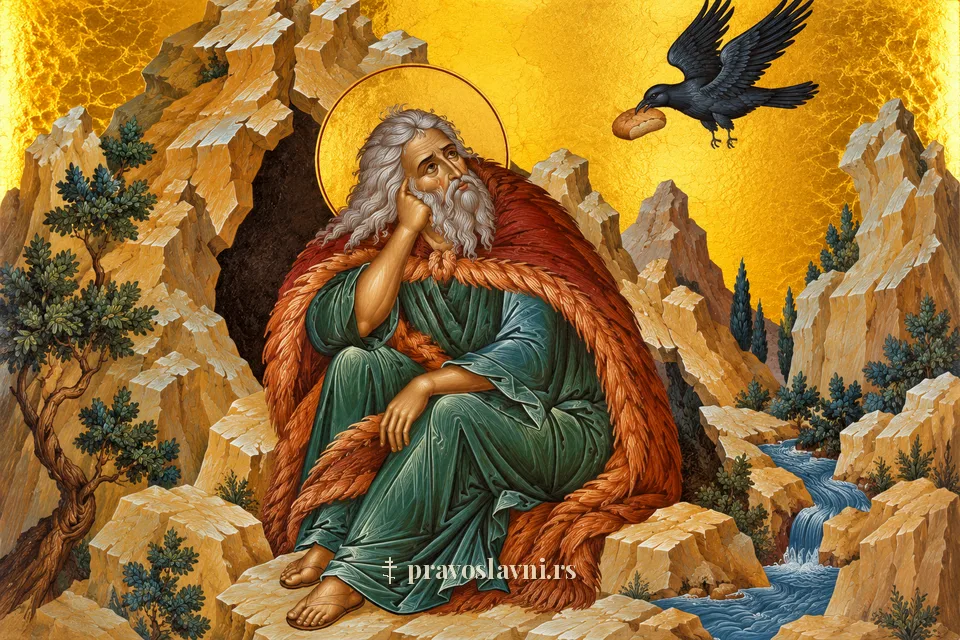
The Prophet Elijah was of the tribe of Aaron, from Thesbe, and so he is called the Tishbite. Already at his birth his father recognised, in a vision of angels and fire, a sign of the zeal with which the prophet would burn. He lived at the time when Ahab, the King of Israel, and his wife Jezebel served idols, and Jezebel built a temple to Baal. Elijah rebuked them. At his prayer the heavens were shut and for a long time there was no rain. According to his Life, ravens fed him by a brook, and in Zarephath of Sidon, in the house of a certain widow, the flour and the oil did not run out; Elijah raised her dead son to life. After the fire on Carmel, rain fell again through his prayer.
Jezebel swore that she would kill him. He fled into the wilderness, where, according to his Life, an angel twice strengthened him with bread and water, and after walking for forty days he reached Horeb. There God appeared to him, not in the storm, nor in the earthquake, nor in the fire, but in a still and gentle breeze. He chose Elisha as his successor, casting his mantle upon him. The word that he had spoken about Ahab and Jezebel was fulfilled to the end: both the blood of the king and the body of the queen fell to the dogs.
Towards the end of his earthly path Elijah parted the waters of the Jordan with his mantle, and then he was taken up into heaven in a chariot of fire with horses of fire. Elisha picked up his mantle and became the heir of his grace. Together with Moses he appeared to Christ on Tabor, and before the end of the world he will come again to stand against the Antichrist. The Prologue calls his appearance on Tabor the strongest proof of life after death.
Elijah was of the tribe of Aaron, a native of the town of Tishbe, after which he is called the Tishbite; his Life says that this town lies on the far side of the Jordan. The zeal that would later mark him was foreshadowed, according to both sources, already at his birth: his father Sobach saw angels beside the child. While still a young man, according to the Prologue, he often went off into the wilderness, where he prayed and meditated on God.
The kingdom was then divided into Judah, with Jerusalem, and Israel of the ten tribes, with Samaria. According to his Life, Jeroboam set up golden calves in Bethel and in Dan, so that the people would not go to Jerusalem. The king of Israel, Ahab, and his wife Jezebel, a Syrian woman, worshipped idols. Jezebel built a temple to Baal and appointed many priests, and Elijah rebuked them.
At Elijah's prayer the heavens were closed and for a long time there was no rain. According to his Life, God hid him by the brook Cherith, towards the Jordan, and ravens brought him bread in the morning and meat in the evening. Then he stayed with a widow in Zarephath of Sidon. In her house the flour and the oil did not run out, and when her son died, Elijah raised him to life; his Life says that he prayed and breathed three times upon the child, who according to tradition was called Jonah.
Ahab's courtier Obadiah, according to his Life, was during that time hiding a hundred prophets, fifty to a cave, and feeding them.
On Mount Carmel Elijah called the priests of Baal to a trial; his Life says that there were four hundred and fifty of them, and as many again prophets of other idols. From morning until noon they called upon Baal, but there was no answer. When his turn came, Elijah, according to his Life, built an altar of twelve stones, as many as there were tribes, dug a trench around it and three times drenched the sacrifice with four buckets of water each time. At his prayer fire fell from the Lord and consumed the sacrifice, the wood, the stones and the water. The people, according to his Life, fell on their faces confessing God, and the prophets of Baal were put to death by the brook Kishon. By Elijah's prayer rain fell once more.
Jezebel swore that she would kill him. According to his Life, he fled to Beersheba and went alone into the wilderness, where under a certain tree he begged God to take his life. An angel twice brought him baked bread and water, and he walked for forty days and forty nights to Horeb. There God appeared to him, yet not in the storm, nor in the earthquake, nor in the fire, but in a still and gentle breeze. According to his Life, God told him that there were seven thousand who had not bowed down to Baal, and commanded him to anoint Jehu as king and Elisha as prophet. He found Elisha while he was ploughing with twelve yoke of oxen and threw his mantle over him; Elisha took leave of his parents and went after him.
Elijah foretold that dogs would lick Ahab's blood and devour Jezebel, and both were fulfilled. His Life links this with Naboth, whom Jezebel had put to death on a false charge, so that Ahab might get his vineyard. Ahab repented, and so the punishment was put off to his sons.
According to his Life, Elijah went with Elisha from Gilgal to Bethel, to Jericho and on to the Jordan, and Elisha asked for a double portion of his spirit. Elijah parted the waters of the Jordan with his mantle and they crossed over on dry ground. Then he was taken up into heaven in a chariot of fire with horses of fire; his Life says that this was in a whirlwind. Elisha picked up his mantle, struck the Jordan with it and became the heir of his grace.
Together with Moses, Elijah appeared to the Lord Jesus Christ on Tabor. Before the end of the world he will come again to stand against the power of the Antichrist (cf. Rev 11). The Prologue says that the faithful receive Elijah's miracles as works of God's power, and it calls his appearing on Tabor the strongest proof of life after death.
St Ilia of Georgia is Ilia Chavchavadze, born in 1837 into the noble family of Chavchavadze. His first teacher was his mother: from her he learned to read, to write and to pray, and came to know the law of God. He was left without his parents early, and the children were then brought up by their aunt Macrina. Later he studied in Tbilisi and at the school of law in St Petersburg, which he left without a degree. He worked for the autocephaly of the Georgian Church and for the Georgian language in schools, and he founded a society for the spreading of literacy among the Georgians and a collection of Georgian manuscripts. In the poem “Prayer” he forgave his enemies. He was killed in 1907, while travelling with his wife Olga, who afterwards asked that the murderers be forgiven. The Holy Synod of the Georgian Orthodox Church numbered him among the saints in 1987 as the Righteous; he is commemorated on 20 July (according to the Julian calendar).


