Saints of the day
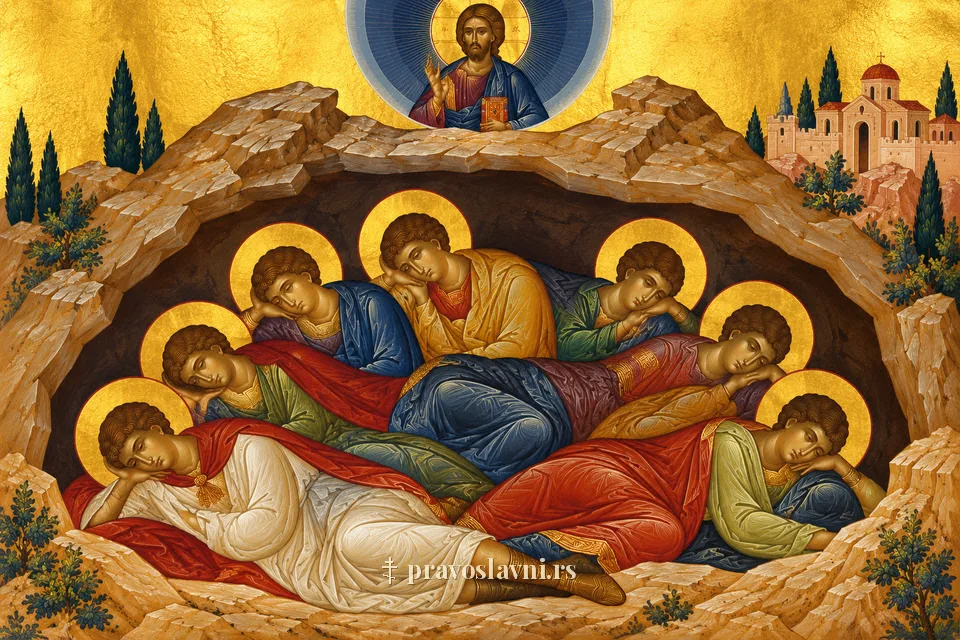
Holy Seven Youths of Ephesus
What happenedSeven youths of Ephesus, who had hidden in a cave from the persecutor Decius, awoke after a long sleep as witnesses to the resurrection of the dead.
Read the LifeOrthodox Calendar · 4 August according to the Julian calendar
Tuesday, 17 August 20274 August (according to the Julian calendar)What happenedSeven youths of Ephesus, who had hidden in a cave from the persecutor Decius, awoke after a long sleep as witnesses to the resurrection of the dead.
Read the Life
No meat, dairy products, eggs, fish or oil — food cooked in water.
This is a recommendation — for your own fast, consult your priest or spiritual father.More about the fast →
Today the Church keeps the commemoration of a saint · not a Red Letter day.
More about the feast →
“Most assuredly, I say to you, the hour is coming, and now is, when the dead will hear the voice of the Son of God; and those who hear will live.”
— Jn 5:25When workmen began to take stones out of a cave on Mount Ochlon near Ephesus, seven young men woke up inside, convinced that they had slept for only a single night. Yet, according to the Prologue, more than two hundred years had passed.
Their names were Maximilian, Iamblichus, Martinian, John, Dionysius, Exacustodianus and Antoninus. They were soldiers and the sons of distinguished Ephesians. When Emperor Decius gave the order in Ephesus that sacrifices be offered to the idols, they refused and hid themselves in a cave. God sent them a long sleep, and the emperor ordered the cave to be walled up. Two secret Christians from the court, Theodore and Rufinus, wrote down their names and their confession on tablets of lead.
In the time of Emperor Theodosius the Younger some people denied the resurrection of the dead, and the emperor prayed that God would reveal the truth. The awakening of the seven was the answer. According to the Life, Iamblichus tried to pay in the city with money from the days of Decius, and in this way the miracle came to light. The emperor came to Ephesus and spoke with them. After about seven days the young men fell asleep again, this time in the sleep of death, to await the general resurrection, and in a dream they asked the emperor to leave them in the earth in which they had been lying.
The seven martyrs of Ephesus bear witness that the dead will rise, just as they too rose from their long sleep.
Emperor Decius came to Ephesus and ordered that sacrifices be offered to the idols and that the Christians be seized. Seven young men, soldiers and sons of distinguished Ephesians, refused to offer sacrifice. Their names were Maximilian, Iamblichus, Martinian, John, Dionysius, Exacustodianus and Antoninus; the Life says that Maximilian was the son of the city governor. According to the Life, Maximilian said before the Emperor: “We confess the One God and King of Heaven, of whose glory heaven and earth are full.”
The Life says that the Emperor took away their soldiers' belts and gave them time to change their minds, and that they gave away their gold and silver to the poor.
The young men hid in a cave on Mount Ochlon near Ephesus. According to the Life, the youngest, Iamblichus, used to go into the city in disguise to buy bread. God sent them a long and wondrous sleep, and Decius ordered that the cave be walled up.
The names of the young men and their confession were preserved all the same: they were written on lead tablets by Theodore and Rufinus, men of the court who were secretly Christians, and they shut the tablets in a sealed copper casket. According to the Prologue, more than two hundred years went by; the Life says only — many years.
In the time of Emperor Theodosius the Younger some began to deny the resurrection of the dead. The Emperor prayed that God would reveal the truth. It happened that the workmen of Adolius, the owner of the hill, were taking stones out of the cave to build a sheepfold. The young men awoke young and healthy, thinking that a single night had passed.
The Life tells that Iamblichus went into the city, saw crosses on the gates and tried to pay with old silver money from the time of Decius. He was brought before Bishop Stephen and the governor, and the miracle came to light.
Emperor Theodosius came to Ephesus and, deeply moved, spoke with the young men; according to the Life, he knelt before them and wept. The Life records Maximilian's words to the Emperor: “Believe, for your sake the Lord has raised us before the general resurrection.” After about seven days the young men fell asleep again, this time in the sleep of death, to await the general resurrection. Theodosius intended golden coffins for them, but the young men, appearing to him in a dream, asked to remain in the earth in which they had lain.
The Life connects this account with the words of Scripture about the resurrection (Jn 5:25; Dan 12:2; Ezek 37:12). God awakened the seven as a living testimony that the dead will rise, at the very time when this was being doubted.
St Cosmas was born in the village of Mega Dendron in Aetolia. As a young man, according to his Life in his twentieth year, he went to the Holy Mountain and became a monk in the Monastery of Philotheou. As a monk he had, according to the Prologue, two requests before God: the preaching of the Gospel and suffering for the faith. Burning with the desire to preach, he went to Constantinople and received the blessing of Patriarch Seraphim II. He preached in many regions, longest of all in Albania; his Life also mentions Macedonia, Epirus, Aetolia and the Ionian Islands. According to his Life, he encouraged the founding of schools in which children learned to read and learned the faith, and wherever he preached he set up large wooden crosses. He taught love for God and for one's neighbour, humility, prayer and almsgiving; his Life records his words: “If you wish to be saved, seek nothing else in this world except love.” He was put to death by order of Kurt Pasha in 1779, at the age of sixty-five. According to the Prologue, he rejoiced when he learned that he had to die. His wonderworking relics rest in the church of the Most Holy Theotokos near Fier.


