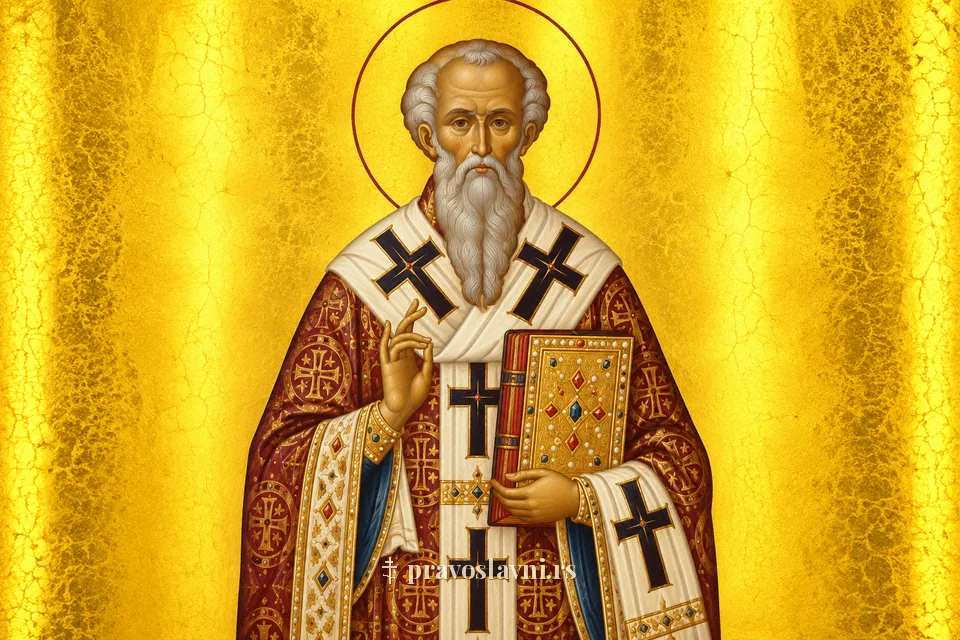
Saint of the day
Hieromartyr Babylas
What happenedSt Babylas, Bishop of Antioch, stood at the doors of the church and did not let in the Emperor Numerian, who was defiled by the murder of a boy.
Read the LifeOrthodox Calendar · 4 September according to the Julian calendar
Friday, 17 September 20274 September (according to the Julian calendar)What happenedSt Babylas, Bishop of Antioch, stood at the doors of the church and did not let in the Emperor Numerian, who was defiled by the murder of a boy.
Read the Life
No meat, dairy products, eggs, fish or oil — food cooked in water.
This is a recommendation — for your own fast, consult your priest or spiritual father.More about the fast →
Today the Church keeps the commemoration of a saint · not a Red Letter day.
More about the feast →
“You will be brought before governors and kings for My sake, as a testimony to them and to the Gentiles.”
— Mt 10:18The relics of St Babylas silenced the idol at Daphne: when the Caesar Gallus, the brother of Julian the Apostate, translated them to a place beside the temple of Apollo and built a church there, the idol no longer gave prophecies. And when Julian the Apostate ordered that the relics be returned to Antioch, fire from heaven burned the temple down.
Babylas was Bishop of Antioch in the time of the Emperor Numerian. The emperor killed a boy whom he was holding as a hostage of peace and offered him to the idols, and then came to enter the church during the service. Babylas stopped him at the doors and said that an idolater could not enter. St John Chrysostom, according to the Prologue, marvelled at that boldness.
At his examination he said that he feared the Heavenly King, and not an earthly one, and so he was thrown into chains, which, according to his Life, he wore as an honour. Three boys, his spiritual children, aged twelve, nine and seven, were seized together with him. Neither they nor he would bow down to the idols. Babylas encouraged the boys and watched as they were beheaded first, and then he himself was beheaded. He was buried, as he had asked, in the same grave with them.
A shepherd guards what is holy even before an emperor and leads his spiritual children to Christ. The Prologue sees in his relics a sign that God gives power to the saints even after death.
Hieromartyr Babylas was Bishop of Antioch in the time of Emperor Numerian. The emperor kept with him as a hostage the young son of a barbarian ruler, as a pledge of peace. When he trampled upon the peace, he killed the boy and offered him to the idols. Soon after that crime he came to enter the Christian church while the divine service was in progress. At the doors Babylas barred his way; his Life preserves the beginning of his words: “It is not fitting for you, O idol-worshipping emperor”. According to his Life, the bishop pushed him back with his right hand, and the emperor could not cross the threshold.
St John Chrysostom, as the Prologue records, praised that boldness, asking whom in the world a man who spoke in such a way to an emperor would be afraid of.
His Life says that on the next day, at his interrogation, he said that he feared the Heavenly King and not the earthly one. He refused riches and honours, for piety is the beginning of every good. The emperor ordered him to be put in fetters. According to his Life, they led him through the city to be mocked, and he valued his fetters as much as the emperor valued his crown.
Seized with him were also three boys, his spiritual children, twelve, nine and seven years old; their mother was a Christian. Each one received blows according to the number of his years, and then they were all thrown into prison, but they would not bow down to the idols — his Life says that they refused both gold and silver. Babylas encouraged them and watched as they were beheaded first, so that, as his Life says, not one of them would waver after his death. Then he too was beheaded. According to his Life, before his death he applied to himself and to the children the words of the Prophet Isaiah about the children whom God has given (Is 8:18). By his own wish he was buried in the same tomb with the children, and his Life adds — with his fetters as well.
Later the Caesar Gallus, the brother of Julian the Apostate, translated his relics to Daphne, near Antioch, beside the temple of Apollo, and built a church there. From that time the idol gave no more oracles. Before the war with the Persians Julian the Apostate questioned the idol, and it answered that it could not speak because of the dead who were close by. Julian ordered the relics to be returned to Antioch; his Life says that the Christians carried them singing psalms. Then fire fell from heaven and burnt down the temple of Apollo. The Prologue records that Julian died soon afterwards on his campaign against Persia.
The relics of Hieromartyr Babylas silenced the demon at Daphne, and the Prologue sees in this a sign that God gives power to the saints even after death.
The holy Prophet Moses, the leader and lawgiver of the people of Israel, was born in Egypt, of Amram and Jochebed of the tribe of Levi, and he was the brother of Aaron and Miriam. His Life says that his parents, when Pharaoh ordered that the Hebrew boys be thrown into the river, hid him for three months, and then laid him in a basket of reeds beside the river, where Pharaoh's daughter found him and adopted him. According to the Prologue, he spent forty years at Pharaoh's court, forty as a shepherd contemplating God, and forty leading the people through the wilderness. On Horeb God spoke to him out of the bush that burned but was not consumed and sent him to bring Israel out of Egypt; when he asked Him for His name, God revealed to him that He is the One Who Is (Ex 3:14). His Life records the crossing of the Red Sea, the manna and the water from the rock, and on Sinai Moses, after a fast of forty days, received the Law on tablets of stone. Because of one sin before God he remained at the threshold of the Promised Land: he was allowed to look upon it, but not to set foot in it (Num 20:12). He died at the age of one hundred and twenty in the land of Moab, and his grave, as his Life says, is known to no one. The Prologue records that St Basil the Great calls him a wonderworker and a prefiguration of Christ, and that he appeared on Tabor at the Transfiguration of the Lord.
Separate page: Holy Prophet Moses the God-seer →
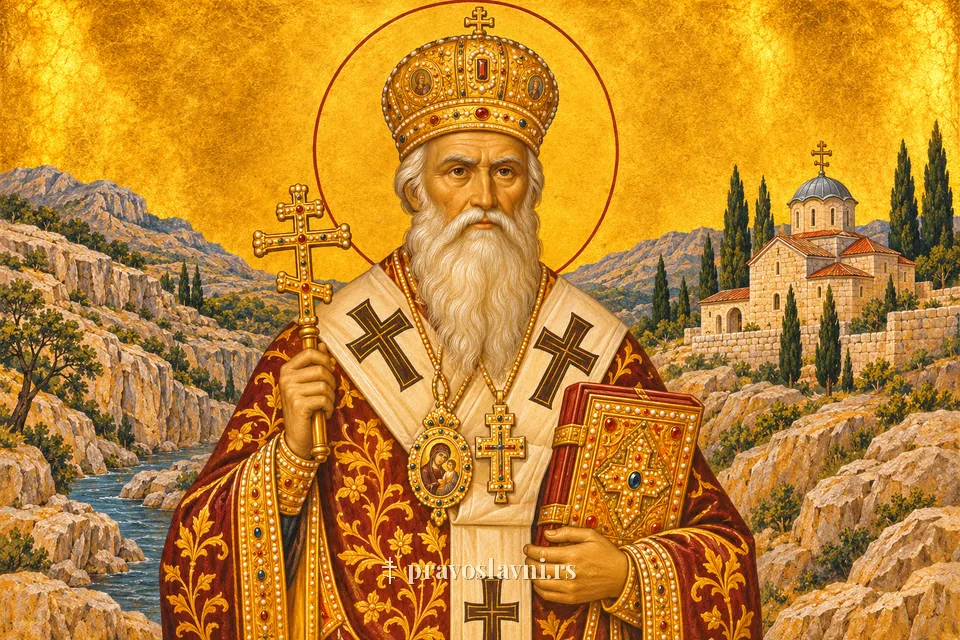
St Petar of Dabar-Bosnia was born in Herzegovina as the son of the priest and commander (vojvoda) Bogdan Zimonjić, and at baptism he received the name Jovan. He was educated for the priesthood and studied theology, and afterwards he taught in a theological school. He became a monk in the Žitomislić Monastery, where he received the name Petar, and soon he was ordained a hierodeacon and a hieromonk. After that, in the cathedral church in Mostar, he was consecrated Metropolitan of Zahumlje and Herzegovina. He renewed his diocese, built churches and schools and opened a monastic school at Žitomislić. Later he became Metropolitan of Dabar-Bosnia, with his seat in Sarajevo. He was arrested, taken away to Zagreb and held in camps, and then he suffered a martyr's death; his grave is not known. The Holy Assembly of Bishops of the Serbian Orthodox Church numbered him among the hieromartyrs.
Separate page: St Petar of Dabar-Bosnia →
Venerable Stefan of Tronoša was born in 1758 or 1759 in the extended family household (zadruga) of the Jovanović family, in the village of Tekeriš near Mount Cer. The Tronoša Monastery received him as a ten-year-old novice. There he attained the highest monastic rank and became an archimandrite. It was with him that Vuk Karadžić, as a boy of ten, first learned his letters; that was in the middle of the last decade of the eighteenth century. He took care that the people of his region should keep the Orthodox faith. When famine and plague struck the land, he went to Zvornik to beg maize from the Turkish authorities for the hungry people, with the promise that he would return it. There he was poisoned and died. According to his Life, he is the first saint of north-western Serbia. The monk who gave his people their first letters laid down his life seeking bread for the hungry.


