Saint of the day
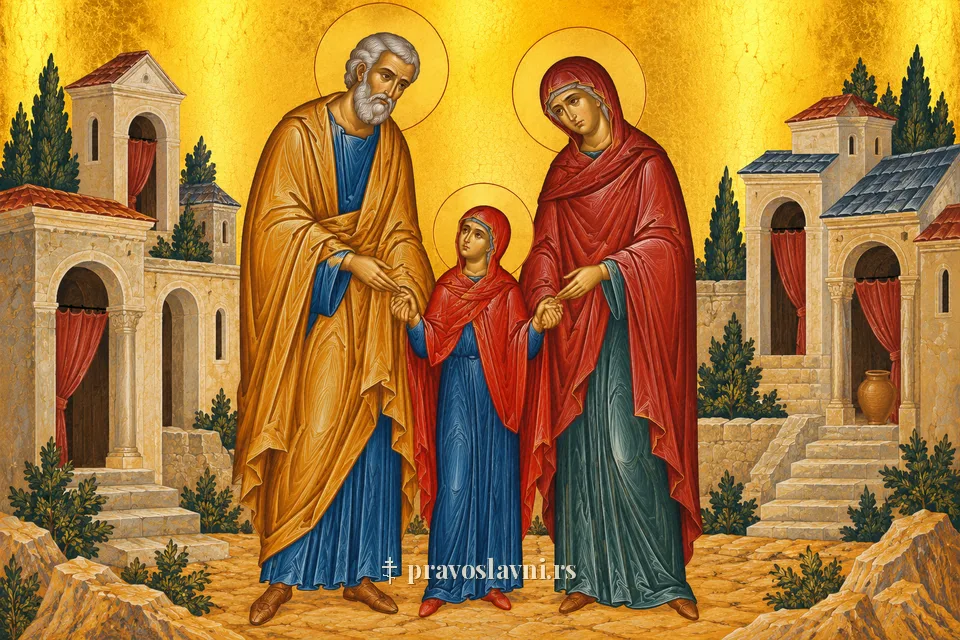
Joachim and Anna
Holy Righteous Ancestors of God Joachim and Anna
What happenedAfter fifty years of childless marriage, the righteous Joachim and Anna were given a daughter, Mary, who was to become the Mother of God.
Read the LifeOrthodox Calendar · 9 September according to the Julian calendar
Wednesday, 22 September 20279 September (according to the Julian calendar)Save your slava — you'll get a reminder a week and a day before.
Send a greeting card →What happenedAfter fifty years of childless marriage, the righteous Joachim and Anna were given a daughter, Mary, who was to become the Mother of God.
Read the Life
No meat, dairy products, eggs or fish — oil and wine are allowed.
This is a recommendation — for your own fast, consult your priest or spiritual father.More about the fast →
Many families celebrate their Krsna slava (family patron saint's day) today
More about the feast →
“For this child I prayed, and the LORD has granted me my petition which I asked of Him.”
— 1 Sam 1:27Sung at the Slava (family patron saint's feast) and on the saint's feast day.
Celebrating the memory of Thy righteous ones, O Lord, through them we entreat Thee: save our souls.
Translation: pravoslavni.rs
Sts Joachim and Anna are the righteous parents of the Most Holy Theotokos, whom the Church also calls the Ancestors of God. Their feast comes immediately after the Nativity of the Most Holy Theotokos, in its afterfeast, so the service to them is also joined with that of the feast. Many families celebrate this day as their Krsna slava (family patron saint's day).
The Church asks them to intercede for the faithful, that God may grant us a share in His eternal joy.
For fifty years Joachim and Anna bore the same pain: they had no children. And yet they lived righteously. Their Life says that they were of noble birth and well-to-do, but that their greatest wealth was virtue. They divided their income into three parts — for themselves, for the poor and for the Temple.
Joachim was descended from the tribe of Judah and the house of King David, and Anna, the daughter of the priest Matthan, from the line of Aaron. They were married and lived in Nazareth.
In Jerusalem the high priest Issachar refused the offering of Joachim, because he did not consider the childless Joachim worthy. Not even then did they cease to pray. According to their Life, Joachim withdrew into the wilderness and fasted for forty days, and Anna, in her garden, under a laurel tree, prayed and vowed that she would give the child to the service of God.
God sent an angel to announce to them the birth of a blessed daughter. Anna gave birth to Mary. They fulfilled their vow when Mary was three years old: according to their Life, they led her into the Temple with lighted candles.
Joachim lived for eighty years, and Anna for seventy-nine. They are called the Ancestors of God, because their daughter gave birth to the God-man.
The Prologue sings that the barren woman rejoices and that the love of God, when God wills, surpasses the order of nature. Their sharing with the poor and their patient prayer under reproaches did not remain without reward.
Joachim was the son of Barpathir, of the tribe of Judah and the house of King David; the Life says — through David's son Nathan. Anna was the daughter of the priest Matthan, of the tribe of Levi and the lineage of Aaron. Matthan had three daughters. Anna was married to Joachim in Nazareth, and her two sisters were married in Bethlehem; of them were born Salome and Elizabeth, the mother of John the Forerunner.
The Life says that they were of noble lineage and well-to-do, but richer still in virtue. They divided their income into three parts: for themselves, for the poor and for the Temple. Nevertheless, through fifty years of marriage they had no children.
When Joachim brought his offering to Jerusalem, the high priest Issachar refused him as unworthy, because he had no children. The Life adds that this was on a great feast and that a man of the tribe of Reuben also reproached him. According to the Life, Joachim went away grieved into the wilderness to his shepherds and fasted for forty days, vowing that he would neither eat nor return home until God had heard him.
According to the Life, Anna grieved at home: “Woe is me, the childless one!” In the garden, under a laurel tree, she caught sight of a nest with young birds and began to pray, remembering Sarah and Hannah, the mother of Samuel. She made a vow: “As the Lord God lives, if I bear a child, I will give it to the service of God”.
God sent an angel to announce to them the birth of a blessed daughter. According to the Life, the angel appeared to Anna in the garden with the words “Anna, your prayer has been heard”, and then to Joachim in the wilderness, and said that the child would be called Mary. As a sign, Joachim was to set out for Jerusalem; there, according to the Life, he found Anna praying at the Golden Gate. They worshipped in the Temple and returned home.
Anna conceived and gave birth to Mary. Joachim, as the Life records, offered gifts and sacrifices, received the blessing of the priests and held a feast at home. When Mary was three years old, they brought her to the Temple with lighted candles, as they had vowed.
Joachim lived for eighty years, and Anna for seventy-nine; the Life says that after her husband's death Anna moved to Jerusalem, near her daughter, and lived there for two more years. Their daughter gave birth to the God-man, and that is why the Church honours them as the Ancestors of God.
The Prologue in its hymn says that the barren Anna rejoices, and Joachim becomes the father of the Mother of the Creator: the love of God, when God wills, surpasses the order of nature. Their humble sharing with the poor and their patient prayer under reproaches did not remain without reward.
The holy martyr Severian was a respected man from Sebaste and a Christian. While the Forty Martyrs of Sebaste were in prison, he used to visit them, encourage them and serve them. His Life says that they suffered in the lake of Sebaste, confessing Christ. After their death he too was seized; according to his Life, he was questioned by the governor Lysias. He suffered for Christ, giving thanks to God until his last breath. The Prologue says that he suffered in the time of the Emperor Licinius, in the year 320. According to his Life, the Christians afterwards carried his body to his own village. The one who had served the martyrs took his own place in their ranks.


