Saint of the day
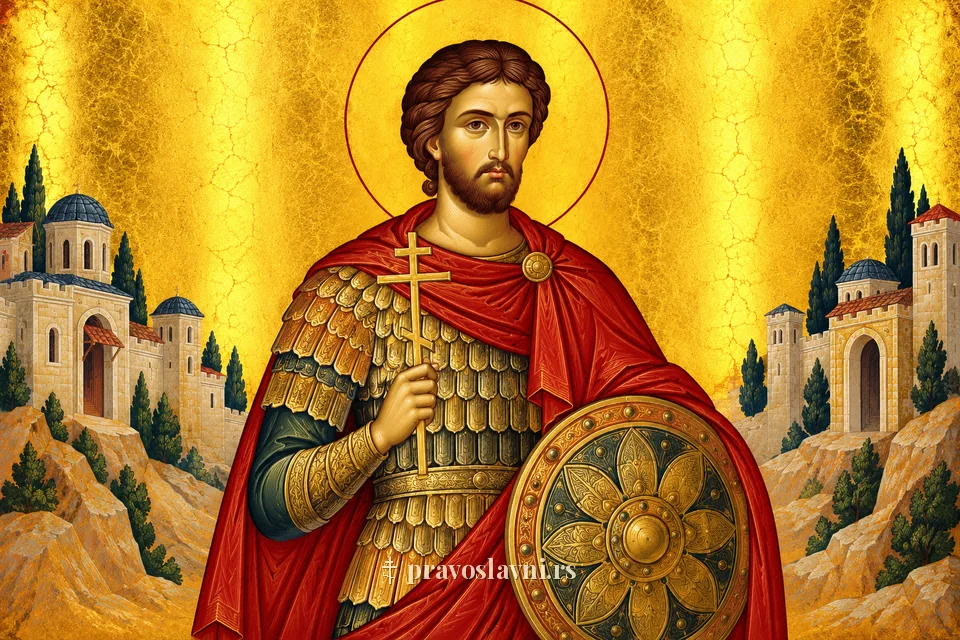
Great Martyr Nicetas
What happenedSt Nicetas, a Goth and a disciple of Bishop Theophilus, was thrown into the fire for his faith in Christ, but the flames did not touch his body.
Read the LifeOrthodox Calendar · 15 September according to the Julian calendar
Tuesday, 28 September 202715 September (according to the Julian calendar)Save your slava — you'll get a reminder a week and a day before.
Send a greeting card →What happenedSt Nicetas, a Goth and a disciple of Bishop Theophilus, was thrown into the fire for his faith in Christ, but the flames did not touch his body.
Read the Life
You may eat meat, eggs, milk and dairy products, as well as any other food — but try to be moderate.
More about the fast →
Many families celebrate their Krsna slava (family patron saint's day) today
More about the feast →
“For with the heart one believes unto righteousness, and with the mouth confession is made unto salvation.”
— Rom 10:10The marble slab on the tomb of St Nicetas in Mopsuestia cracked when Bishop Auxentius wished to separate a particle of the relics for Anazarbus. His Life says that the hand of the man who touched them withered and that there was thunder and lightning. Only when the bishop had repented and prayed was the hand healed by the touch of the relics, and the tomb was closed again.
Nicetas was a Goth, according to his Life of noble birth, a disciple of Theophilus, Bishop of the Goths, who took part in the First Ecumenical Council. According to his Life, he brought many to the faith. The persecution of the Christians was set in motion by the Gothic prince Athanaric, and Nicetas reproached him for his godlessness and cruelty. He was tortured, but he confessed Christ all the more. According to the Prologue, the Theotokos came to him in a vision and brought him comfort, and so he carried her icon next to his heart. He was thrown into the fire and in it gave up his soul, but the flame did not touch his body. According to the Prologue, he suffered in the year 372.
His friend Marianus took the body secretly, by night; his Life says that a heavenly light, like a star, led him to it. He carried it to Mopsuestia in Cilicia and at first, according to his Life, buried it in his own house, which was thereafter blessed with abundance. In Mopsuestia a church of St Nicetas was later built and the wonderworking relics were placed in it.
The victory of St Nicetas was the victory of the cross, and God answers repentance with mercy.
St Nicetas was a Goth. His Life says that he was born, baptised and brought up on the far side of the Danube, in the time of Constantine the Great, and that he was of very noble family. He was taught by Theophilus, Bishop of the Goths, who took part in the First Ecumenical Council; according to his Life, Theophilus signed the decisions of the Council and baptised Nicetas himself. Under Theophilus's successor Ulfilas, who, according to his Life, created the Gothic letters and translated books from the Greek, Nicetas brought many people to the faith.
His Life also describes the circumstances among the Gothic people. In a civil war Athanaric defeated Fritigern. Fritigern, with an army that the Emperor Valens sent to him, crossed the Danube carrying a cross before his army and defeated Athanaric, and after that many Goths became Christians. Athanaric then began to persecute the Christians.
He reproached the prince for being godless and cruel, and his Life says that he encouraged the faithful towards martyrdom. He was tortured, but he confessed Christ all the more and prayed with thanksgiving. The Prologue also records an icon of the Theotokos with the Christ Child, which he kept close to his heart, hidden under his clothing, because the Theotokos had come to him in a vision and brought him comfort.
In the end he was thrown into the fire and gave up his soul in it, and his body remained untouched by the flames. According to the Prologue, he suffered in the year 372.
The body, according to his Life, was left unburied. Nicetas's friend Marianus, from Mopsuestia in Cilicia, took it secretly, by night, because he feared the prince's command. His Life tells that on that dark and rainy night a heavenly light, like a star, led him to the body, stood over it, then accompanied him as far as the door and disappeared. Marianus carried the body to Mopsuestia and at first, according to his Life, buried it in his own house. That home afterwards abounded in God's blessing: from it the poor were helped, and the sick found healing there. Later a church of St Nicetas was built in Mopsuestia, and his wonderworking relics were placed in it.
His Life says that only Marianus kept one finger as a blessing, and that no one else managed to obtain a portion of the relics. When Bishop Auxentius opened the tomb in order to separate a particle for Anazarbus, the marble slab cracked, the hand of the man who touched the relics withered, and there was thunder and lightning. The bishop repented and prayed to the saint with the words: “it is easier for you to heal than to harm.” The man's hand was healed by the touch of the relics, and the tomb was closed once again.
St Nicetas conquered both the demon and the tyrant by the cross. The power of God and the prayer of the saint bring healing, and God answers repentance with mercy.
St Josif, Metropolitan of Temišvar, was born, according to his Life, in 1568 in Dubrovnik, into a family of Serbian origin, and at baptism he was given the name Jakov. After his schooling he went to the Holy Mountain (Mount Athos) and in the monastery of Pantokrator received the monastic tonsure with the name Josif. He lived in several monasteries of the Holy Mountain, and at Koutloumousiou he became abbot. His Life remembers him as a humble man of great prayer and a wonderworker even during his lifetime. In 1650 Patriarch Gavrilo I of Peć chose him as Metropolitan of Temišvar, at a time when the Banat and Temišvar were under Turkish rule and under the Patriarchate of Peć. In his pastoral work he travelled round his diocese and cared for the clergy, whom he ordained himself, and for the people, to whom he preached; to prepare future priests he founded a school. He knew Turkish and interceded with the authorities for his flock and for Christians in general. In old age he withdrew to the monastery of Partoš in the Banat, where he spent about three years; even there the people did not leave him, but kept coming to ask for his blessing, counsel and prayer. He reposed on the feast of the Dormition in 1656, in his eighty-eighth year, and a place beneath the altar in the church of his endowment (zadužbina) was appointed for his grave. In 1686 the Council of the Metropolitanate of the Banat named him Josif the New, and his relics rest today in the cathedral in Temišvar. The deacon Damaskin wrote down a number of his miracles in a Greek service book that was kept at Partoš. The Romanian Church entered him in its calendar, and the Serbian Church did so in 1965


