Saint of the day
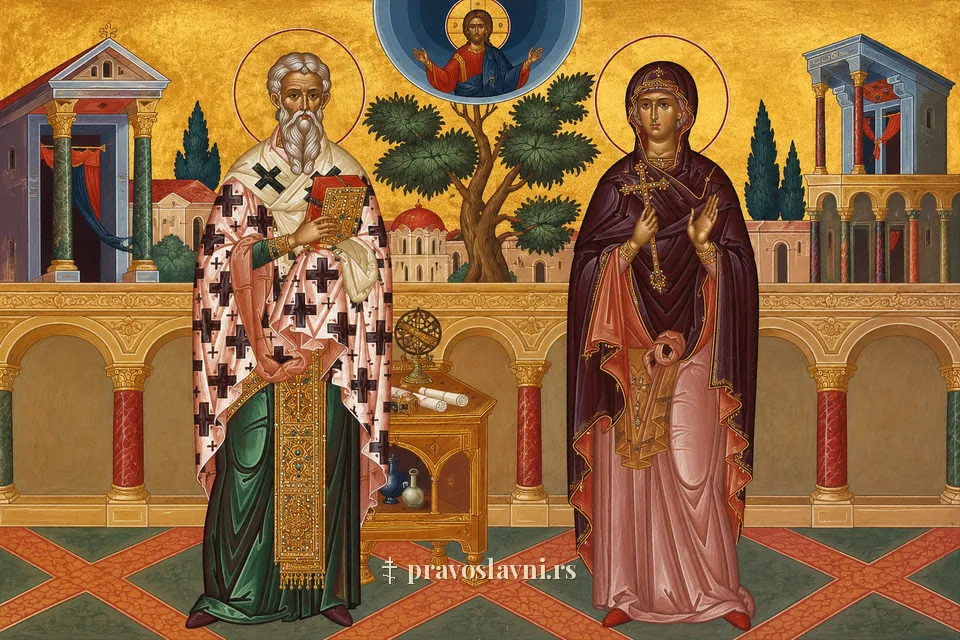
Hieromartyr Cyprian and Holy Martyr Justina
What happenedA sorcerer from Antioch who, powerless before the sign of the cross made by a young maiden, came to believe in Christ and became a bishop.
Read the LifeOrthodox Calendar · 2 October according to the Julian calendar
Friday, 15 October 20272 October (according to the Julian calendar)What happenedA sorcerer from Antioch who, powerless before the sign of the cross made by a young maiden, came to believe in Christ and became a bishop.
Read the Life
No meat, dairy products, eggs, fish or oil — food cooked in water.
This is a recommendation — for your own fast, consult your priest or spiritual father.More about the fast →
Today the Church keeps the commemoration of a saint · not a Red Letter day.
More about the feast →
“I say to you that likewise there will be more joy in heaven over one sinner who repents than over ninety-nine just persons who need no repentance.”
— Lk 15:7From his childhood Cyprian belonged to the darkness. His parents, pagans from Carthage, gave him over, according to his Life, to learn sorcery, and afterwards he gathered knowledge in many pagan shrines, from Greece to Egypt and Chaldea. In Antioch he passed for a great sage, but his knowledge served only evil. The Prologue remembers him as a magician who worked with demons.
In the same city lived Justina, the daughter of a priest of the idols. The preaching of the deacon Praylius brought her to Christ, and she drew her parents after her as well. She resolved to remain a virgin for the sake of the Lord. The wealthy Aglaidas would not accept this, and when he achieved nothing even by trying to abduct her, he paid Cyprian to help him.
The magician used all his power against the girl. According to his Life, Justina was not frightened even once: she would make the sign of the cross and pray, and not a single demon was able to harm her. At last one of them admitted to Cyprian: “We cannot look upon the sign of the cross.” The embittered magician then let loose a sickness upon the city, but Justina stopped it by her prayer.
In this way Cyprian understood that he was serving a weak master, and he broke with him. According to his Life, the devil tried to kill him, and he was saved when he called upon Justina's God and made the sign of the cross. He handed his books of magic over to Bishop Anthimus, who burnt them. He was baptised, and with the years he also became a bishop, while Justina became an abbess. The former magician and Justina, whom he had once persecuted, were now leading people to Christ together.
The persecution did not pass them by: after torture, the emperor in Nicomedia condemned them to death by the sword. His Life says that even in his last hour Cyprian was thinking of Justina and did not want her to watch his death, and so she was executed first. Their courage also moved Theoctistus, who, having confessed himself a Christian, suffered with them. The Prologue records that this was at the end of the third century.
No one has gone so far away that the road to God is closed to him, and whoever believes and prays need not be afraid of any power of darkness.
Cyprian was born in Carthage, in a pagan house, and while he was still a child his parents dedicated him to Apollo. According to the Life, his training in the secret arts began when he was very small and went on for years, from Olympus and the Greek sanctuaries to Memphis in Egypt and the Chaldeans. He arrived in Antioch in his thirtieth year, as one of the most learned men of his dark craft.
That he was not merely a deceived pupil we know from the man himself: by his own account, he met the devil and received from him power over a multitude of demons. The people of Antioch honoured him as a sage, yet his “help” always served someone's hatred or passion. The Prologue remembers him as a sorcerer who worked with demons.
In the same city lived Justina, the daughter of the pagan priest Edesius and of Cleodonia. She first heard about Christ from the deacon Praylius. According to the Life, those words changed her, and soon she brought both her mother and her father to Christ; Bishop Optatus baptised them. She resolved to live in fasting and prayer and to remain a virgin for the sake of the Lord.
A rich young man, Aglaidas, wanted to take her as his wife. She answered him that she already belonged to Christ. When he did not succeed by fair means, he wanted to carry her off by force, but the neighbours prevented him from doing so. Then he turned to Cyprian and offered him a rich reward.
Cyprian set all his demons upon Justina. According to the Life, against all of them Justina had only the cross and prayer — and that was enough for her. It did not help even when the very chief among the demons approached her, in disguise.
Cyprian demanded an explanation, and the demon, according to the Life, had to confess: “We cannot look upon the sign of the cross.” Defeated, Cyprian struck where he thought it would hurt most: he let loose sickness and plague first upon Justina's house, and then upon the whole city. Justina's prayer stopped the affliction, and the whole city saw whose power was the stronger.
Cyprian realised that he was serving a weak master and drove the devil away from himself. According to the Life, the devil fell upon him and wanted to kill him. At the end of his strength he remembered the girl whom he had attacked so many times. He cried out, “O God of Justina, help me!”, made the sign of the cross — and the devil left him.
He took his books to Bishop Anthimus. It was not easy for him to convince the bishop that he was sincere, but when Anthimus had heard the whole confession, he burned the books before the Christians. So greatly did Cyprian long for Christ that he was soon baptised, and later he became a priest and at last a bishop. According to the Life, Justina too received her place in the Church — she became a deaconess and the abbess of maidens dedicated to God. The former sorcerer and the girl whom he had once persecuted were now together bringing people to Christ.
They were denounced to the governor Eutolmius, who tried them in Damascus. Cyprian had nothing to hide: he told the story of his past as a testimony to Christ. According to the Life, the torture did them no harm, so the governor referred the case to the Emperor in Nicomedia, and from there the sentence arrived: death by the sword.
The Life records one moment which says a great deal about Cyprian. Even at the place of execution he was thinking of Justina and did not want her to have to watch his death, and so she went first. She met the sword calmly. Their courage won over one of the onlookers as well, Theoctistus: he declared that he too was a Christian and shared their fate. The Prologue records that they suffered at the end of the third century.
No one has gone so far away that the road to God is closed to him. And whoever believes and prays need not be afraid of any power of darkness.
Andrew was a Slav, brought to Constantinople as a slave in the time of Leo the Wise. His master Theognostus valued him so highly that he had him educated and took him as his scribe, so that his future was assured. The Prologue says that he was called to another path from on high. From then on he behaved like a madman, deliberately, for the sake of Christ. Theognostus thought that his servant had fallen ill, and since there was no cure for him, he let him go. The street became his home. According to his Life, everyone rejected him, both poor and rich, and passers-by and children ill-treated him. The Prologue also remembers his hidden almsgiving. Behind the mask of madness was hidden a man of unceasing prayer, to whom God gave the gift of clairvoyance. To him, the despised madman, the Church owes the feast of the Protection — it was he who saw the protection of the Theotokos at Blachernae. His Life says that he spent even his last hours praying for those who suffer, and the Prologue gives the year 911. A whole city may despise a man, and yet he may be close to God — for God looks at the heart, and not at what people see.