Red Letter day (great feast)noSunday — a festive day
Slavanone
Sunday24October 202711 October (according to the Julian calendar)‹›
Illustration
Saint of the day
Holy Fathers of the Seventh Ecumenical Council
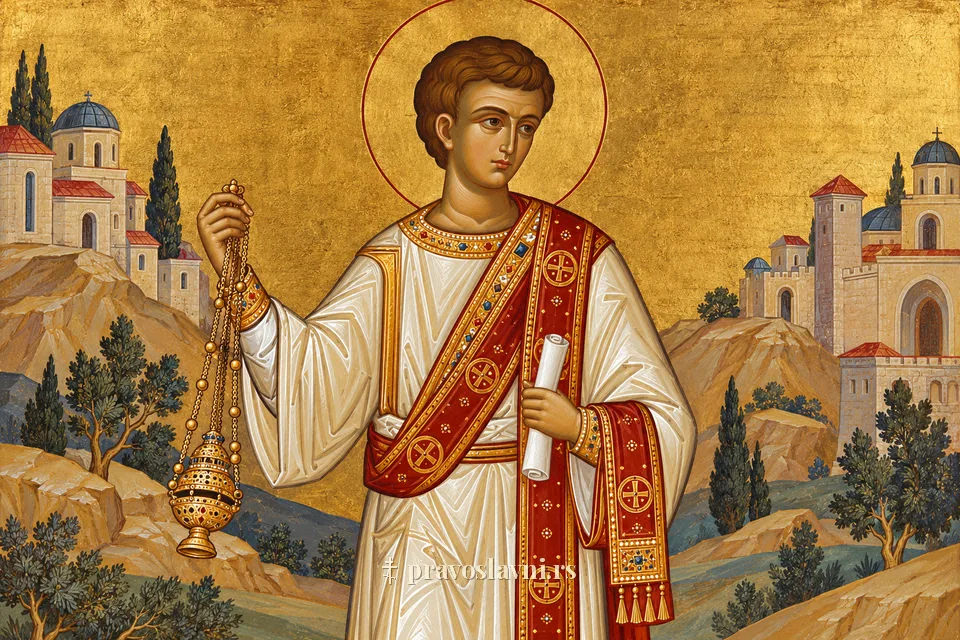
Holy Apostle Philip (the Deacon)
What happenedThe deacon who baptised the Ethiopian court official on the road to Gaza and brought Samaria to Christ; the father of four daughters who were prophetesses.
“How beautiful are the feet of those who preach the gospel of peace, Who bring glad tidings of good things!”
— Rom 10:15
About this day
Holy Fathers of the Seventh Ecumenical Council
This Sunday bears the name of the holy fathers of the Seventh Ecumenical Council and is recorded in the calendar as one of the Sundays after Pentecost. The Council is commemorated every year throughout the Orthodox Church, and when its commemoration falls on a weekday, the service to the fathers is moved to the nearest Sunday. At the Vigil the Old Testament readings (paremias) are then read as well. For more on fasting on this day, see the guide “Fasting — simply explained”.
The story of St Philip begins with a thoroughly practical difficulty. In the first community in Jerusalem, say the Acts of the Apostles, the widows of those who spoke Greek were being left without their share in the daily distribution of help. The apostles asked that seven trustworthy men be chosen, full of the Spirit and of wisdom, who would take over that care. Among them, immediately after Stephen, was Philip (Acts 6:1–6). The Prologue tells us still more about him: he was a man of Caesarea in Palestine, the father of a family, and his four daughters had the gift of prophecy. With all his heart he cared for those who needed help the most.
Soon Stephen was stoned, and the Church in Jerusalem was scattered before the persecutors. According to the Prologue, Philip went to Samaria, but he did not fall silent. He preached Christ, and the healings that accompanied his word brought joy to the city (Acts 8:5–8). The Prologue remembers that among the baptised was Simon Magus, the famous sorcerer.
The best-known encounter took place on the road. An angel sent Philip to the desert road towards Gaza. There he met an Ethiopian court official, the keeper of the queen's treasury, who was returning home from Jerusalem and reading Isaiah. Philip came up to the chariot and began a conversation about what was being read. From the prophetic words about the One who is silent before those who torment Him they arrived at Jesus. A single conversation by the roadside became the beginning of someone's new life. As soon as they caught sight of water, the official asked for baptism. Immediately after that the Spirit carried Philip away, and the Ethiopian went on his way rejoicing (Acts 8:26–39). The Prologue says that Philip found himself in Azotus and went on preaching there.
Years went by. The Apostle Paul, the former persecutor Saul, was a guest in Philip's house in Caesarea (Acts 21:8–9). The Prologue records that Philip was later bishop in Tralles, and his Life that he worked great miracles there. He departed to God in peace, after a long life.
God does not ask us to know everything in advance. It is enough to set out when He calls us, even if it is onto a desert road.
Full Life
Serving at tables
The first Church in Jerusalem grew quickly, and its cares grew with it. According to the Acts of the Apostles, those among the believers who spoke Greek began to complain: their widows were being neglected when the daily help was given out (Acts 6:1). The apostles knew that they could not preach and look after the food at the same time. So they proposed to the community that it should itself find seven proven men, in whom the Holy Spirit and wisdom could be seen. The choice fell on Philip too, whom the list names straight after Stephen (Acts 6:5). The apostles prayed over those who were chosen and laid their hands on them.
The Prologue reveals to us who this man was. He was a native of Caesarea in Palestine and had a family, a wife and four daughters. The daughters had the gift of prophecy and, out of love for Christ, did not marry. The Prologue remembers his zeal in caring for the poor and the forsaken widows. The ordinary work of giving out bread was the beginning of a great journey.
A persecution that spread the faith
Then Stephen, Philip's companion in service, was stoned to death. After that, according to the Acts of the Apostles, a fierce persecution fell upon the Church in Jerusalem, and all except the apostles had to scatter throughout Judea and Samaria (Acts 8:1). Among the persecutors was the young Saul (Acts 8:3).
Philip too had to leave Jerusalem, and the Prologue names Samaria as his refuge. The persecutors thought that by scattering the believers they would put out the faith, but they achieved the opposite: wherever the exiles came, they brought the Gospel. Philip preached Christ to the Samaritans. They listened to him, the sick recovered, unclean spirits left people, and joy filled the city (Acts 8:5–8). According to the Prologue, even Simon Magus, a sorcerer whose name was known to the whole region, received baptism.
A meeting on a desert road
Then Philip received an unexpected command. An angel of the Lord sent him to the desert road that goes down from Jerusalem to Gaza (Acts 8:26). There he caught up with the chariot of an Ethiopian, a high official at the court of Queen Candace, who was in charge of her treasury. This man had been in Jerusalem to worship, and on his way back he was reading the prophet Isaiah.
The Spirit prompted Philip to draw near. The conversation began with the question whether the stranger understood what he was reading. The official honestly admitted that he needed someone to explain it, and he invited Philip to sit beside him. He was reading precisely the prophecy about the Servant of the Lord who silently endures injustice (Acts 8:32–33). Starting from those words, Philip showed him that it was speaking of Jesus. When they came upon some water, the Ethiopian did not want to wait. Both of them went down into the water, where Philip baptised the official. Immediately afterwards the Spirit carried Philip away, and the official went on his way full of joy (Acts 8:36–39).
The next stop was Azotus. The Prologue records that Philip did not make that journey on his own either, for an angel brought him there. In that city too his word bore fruit. Acts adds that from there, town by town, he came to Caesarea (Acts 8:40).
A guest in Caesarea
Many years later the Apostle Paul and his companions came to Philip's house in Caesarea. There Acts calls Philip the evangelist and one of the seven (Acts 21:8). His four daughters were at that time still living in virginity and prophesying (Acts 21:9). That guest was none other than the former Saul, from whom the Christians used to hide. The former persecutor and the former exile now sat together as brothers in Christ.
The Prologue records that Philip later became bishop in Tralles. The Life adds that in Tralles too his preaching converted many, and God confirmed it with miracles. He ended his long life in peace.
Philip did not choose where he would serve — at table, in exile or on a desert road. Everywhere he listened to God, and therefore everywhere he bore fruit.
Other saints of the day
Venerable Theophanes the Branded
The name under which the Church honours him, the Branded, has a bitter history. Theophanes and his brother Theodore came, according to the Prologue, from Arabia, while their Life says that their home was in Palestine. They grew up in a devout family, as is written in the Prologue, acquired great learning, and then became monks in the Lavra of St Sabbas the Sanctified. When the Emperor Leo the Armenian turned against the icons, the Church had to have defenders, and the Patriarch of Jerusalem entrusted that task to precisely these two learned monks. Before the emperor they did not soften their words, but told him openly that he was in error. The price of that boldness, according to the Prologue, was torture and prison. From Theophilus, the next iconoclast emperor, they received a lasting mark: by his order their faces bore words of mockery inscribed upon them. According to the Prologue, Theophanes endured persecution for the sake of the icons for twenty-five years and did not yield. When the Church gained peace, Patriarch Methodius, according to his Life, raised him to the see of Metropolitan of Nicaea. The Prologue attributes one hundred and forty-five canons to him, and his Life particularly mentions the one he wrote in honour of the holy icons. He reposed in the year 847, and the mockery inscribed on his face became his name of honour.