Saint of the day
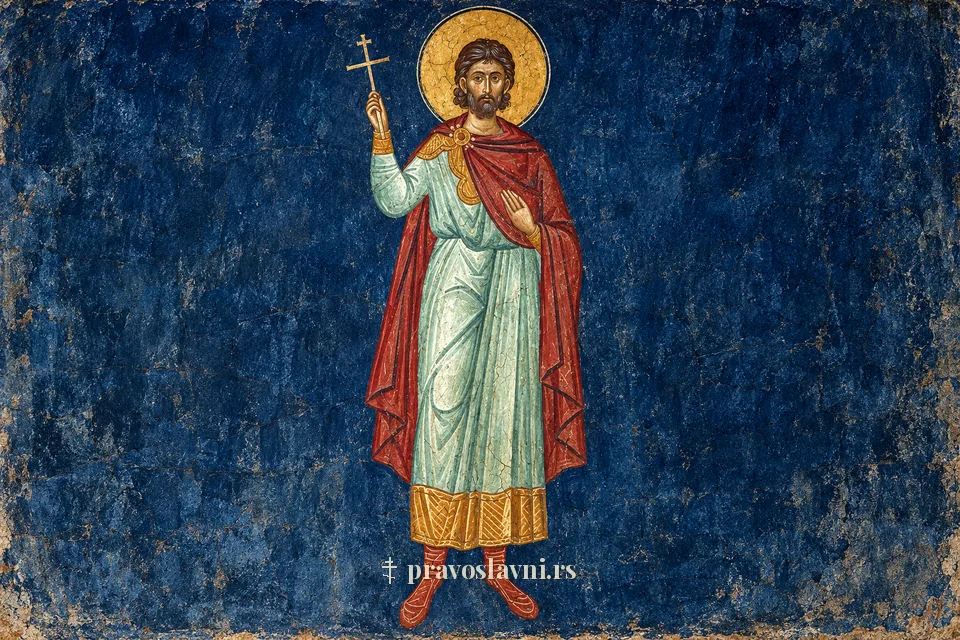
Holy Martyr Plato
What happenedWhen the governor Agrippinus urged him to save his life, the martyr Plato answered that he feared not temporal death but eternal death.
Read the LifeOrthodox Calendar · 18 November according to the Julian calendar
Wednesday, 1 December 202718 November (according to the Julian calendar)What happenedWhen the governor Agrippinus urged him to save his life, the martyr Plato answered that he feared not temporal death but eternal death.
Read the Life
No meat, dairy products, eggs, fish or oil — food cooked in water.
This is a recommendation — for your own fast, consult your priest or spiritual father.More about the fast →
Today the Church keeps the commemoration of a saint · not a Red Letter day.
More about the feast →
“For I consider that the sufferings of this present time are not worthy to be compared with the glory which shall be revealed in us.”
— Rom 8:18The holy martyr Plato came from Ancyra in Galatia. He was descended from a Christian family, which brought him up in piety, and his Life states that his brother was the holy martyr Antiochus. He stood out for his wisdom and virtue already in his youth, and he did not keep silent about his faith: he spoke to the pagans about Christ and called on them to leave their idols.
Before the governor Agrippinus, to whom the unbelievers handed him over, Plato, according to his Life, did not hide: he said that he belonged to Christ and that he served no one except the true God. The governor pretended to pity him and advised him to save his life. Plato answered him that he was not afraid of the death which quickly passes, but of the eternal one, and that he did not wish to lose, for the sake of a short earthly life, the life that has no end.
Not even long and heavy tortures shook him. His Life records that he declared to the governor that no torments would break his bond with God. Promises did not help either: according to the same Life, the governor offered him adoption, marriage and riches, and Plato answered that he had already chosen communion with Christ. According to the Life, the fire did him no harm, and many of those present, seeing this, glorified the God of the Christians. The martyr rejected the comparison with the famous philosopher whose name he bore: his wisdom, he said, comes from Christ.
Eighteen days of imprisonment passed without a bite of food or a sip of water, because Plato would not agree to be fed by idolaters. The Prologue records that the guards marvelled that he was still alive. He explained to them that he lived not on bread, but on prayer and on Christ. At last Agrippinus condemned him to death. After a prayer in which he gave thanks to Christ and committed his soul to Him, Plato was beheaded. The Prologue records that this was around the year 266.
His example teaches us that we should not fear temporal death, but eternal death. God does not abandon the righteous, and whoever dies for Christ lives and reigns with Him for ever.
The Prologue preserves the answer which St Plato gave to the governor Agrippinus when the latter, pretending to pity him, advised him to bow down to the idols and stay alive: “there are two deaths, the one temporal and the other eternal”. The death with which the judge was threatening him did not frighten him. He dreaded only the one that has no end, and he preferred the life without end to this short one.
Ancyra in Galatia was his native city. He grew up in a Christian home and learned piety from his parents; his Life adds that his brother was the holy martyr Antiochus. Wisdom and virtue adorned him even in his youth.
He did not keep silent about Christ. He told the pagans openly that statues are not gods and called them to God. So he found himself before the governor Agrippinus, into whose hands the unbelievers handed him over.
His Life says that the trial was held in the temple of Zeus. There Plato said that he was a servant of Christ, a Christian, and that he was from Ancyra. Agrippinus threatened him with the imperial law, by which a Christian is left only the choice between sacrifice to the gods and death. Plato's answer was brief: he acknowledges only the one true God, and the governor's gods are worth nothing to him. His Life also records these words of his: “I obey my King, God, and for Him I do battle”.
Not even long torture, according to his Life, drew a groan from him or broke him, and he would not renounce God, he said, under any torments whatever. Many people who accompanied him, Christians among them, followed him as far as the prison. To them, his Life states, he sent word that he was suffering gladly for the Creator and that they should not be afraid on that account, referring to the Psalms and to Paul's epistles to the Corinthians and the Romans. In the solitude of his cell he asked Christ for endurance and for an angel who would set him free, so that it might be shown to all who the true God is.
A week went by, and Plato was again standing in the temple of Zeus. This time, according to his Life, Agrippinus tried with promises: adoption, marriage to his niece, the only child of his brother, and a great fortune — all this he offered for a single sacrifice to the idols. Plato laughed at this: he would not take a girl from such a house even if he wished for marriage, for he had already given himself to Christ.
His Life then tells of a miracle. After hours of torture by fire the martyr rose up whole, those present sensed a sweet fragrance spreading from him, and many glorified the God whom Plato confesses. The offer of freedom in exchange for renouncing Christ he again refused, rebuking the governor. His trust, as his Life says, he expressed in these words: “I believe in my God, that He will not forsake me”. His Life also mentions the shaking of the temple, which followed when the martyr later prayed aloud for strength.
The governor, both sources record, found a likeness between the martyr and the philosopher Plato. The martyr rejected that likeness: the philosopher spread pagan learning, whereas he preaches Christ, and apart from the name nothing connects them. Here his Life cites the words of Scripture that God destroys the wisdom of the wise.
The governor, according to his Life, ordered that a little bread and water be brought to him every day in the prison, which no one was any longer allowed to enter. The martyr did not touch it, not wishing to accept anything that comes from idolaters, and he lived like that for eighteen days. The guards, according to his Life, feared punishment and begged him to eat, while the Prologue records their amazement that he was still alive. He explained to them that prayer and Christ were sustaining him. Here his Life recalls the words of Scripture that the just shall live by faith, and Daniel, whom God fed in the lions' den.
Since not even the prison had changed him, Agrippinus passed sentence: death by the sword. Outside the city Plato, according to his Life, prayed once more: he thanked Christ for having kept him from the snares of the devil and gave up his soul to Him. Then he called on the soldier to carry out the sentence, and he was beheaded. The Prologue records that he suffered around the year 266.
Plato's life teaches Christians to remain steadfast in persecution. It is not temporal death that should be feared, but eternal death. God upholds the righteous, and whoever dies for Christ lives and reigns with Him for ever.
St Romanus, a deacon of the Church of Caesarea, was, as his Life states, a native of Palestine, and at the time of the pagan persecution he was living in Antioch, where he preached and encouraged the faithful. His Life says that he urged the Christians to defend the altars against the prefect Asclepiades, who intended to pull down their church. On one pagan feast day Romanus stepped out before the prefect, who was on his way to offer sacrifice, and publicly rebuked him for his idolatry, bearing witness to Christ; his Life also hands down his words: “You are in error, ruler, when you go to the idols”. For this he was severely tortured, but he went on confessing the one Creator. Among those present was a Christian boy, Barulas, of whom Romanus said to the prefect that he knew more about the true God than he did. When he was questioned the boy did not hesitate: the Creator of all, he said, is Christ, and the pagan gods are demons; the Life also records his short answer: “I believe in Christ.” When under the blows he asked for water, his mother, according to the Life, encouraged him to hold out to the end. Barulas was put to death by the sword, and the Life says that his mother buried him with her own hands, after she had gathered up his blood. Romanus was condemned to death by fire but, according to his Life, he remained unharmed, because rain put the fire out. His Life adds that, although they cut out his tongue, he went on speaking clearly and glorifying God, and so Emperor Maximian ordered him to be strangled in prison, which took place in the year 303. Both of them laid down their lives for Christ and received His Kingdom, and their struggle bears witness that it is worth suffering for Christ and His Church and that knowledge of the true God does not depend on age.


