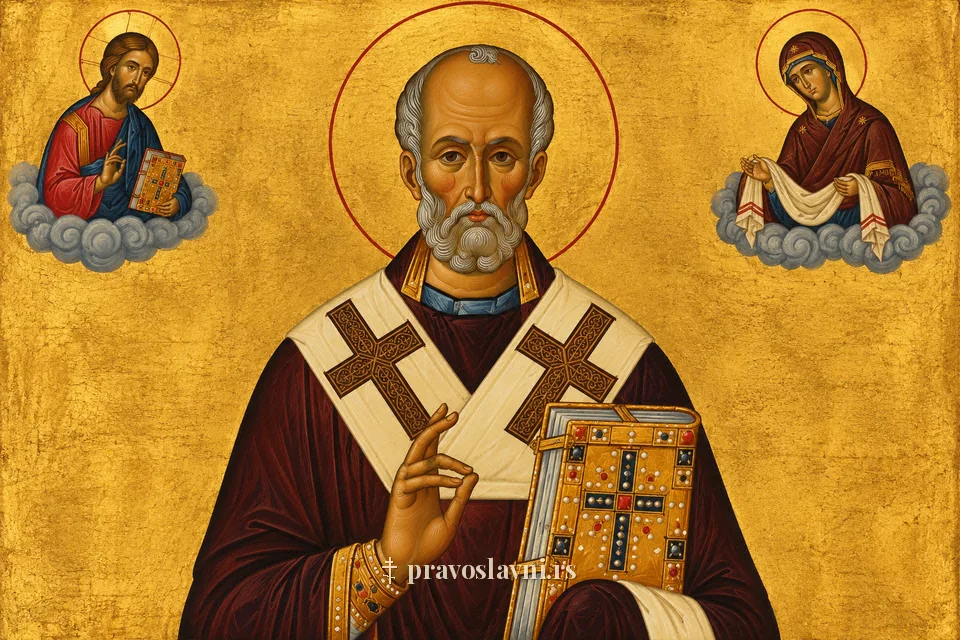
St Nicholas, whom the people celebrate on Nikoljdan (St Nicholas Day), has remained in memory for his secret almsgiving. His Life tells how, for an impoverished father in Patara who had no means to give his three daughters in marriage, he secretly threw bags of gold through the window by night, one after another. Only at the third bag did the father catch him and fall at his feet, and Nicholas made him swear to keep silent — for the Gospel teaches that a good deed should be hidden.
He was born in Patara in Lycia, into the rich and devout family of Theophanes and Nonna, who dedicated him to God. He was guided spiritually by his uncle, Bishop Nicholas, after whom he also received his name. From his earliest years he loved the church and Holy Scripture, and when his parents died, the poor received everything that he had inherited.
It was God who sent him among people, to serve them, although he himself desired a quiet, secluded life. His Life says that the bishops of Lycia, after prayer and by a sign from God, chose him as Archbishop of Myra. For a long time he refused, and when he accepted, he lived as modestly as before.
In prison, where he found himself under Diocletian and Maximian, he encouraged the other Christians. The blow that he dealt the heretic Arius in Nicaea, at the First Ecumenical Council, cost him the insignia of a bishop, but they were restored to him by a vision in which some of the fathers saw Christ and the Theotokos at his side.
His Life records that he saved those who were innocently condemned, that he delivered Myra from famine and that he calmed storms at sea. Even during his lifetime he helped those who turned to him in trouble. He died in old age and was buried in Myra, and his Life adds that the sick recovered through the myrrh from his relics.
St Nicholas teaches us that almsgiving is most beautiful when it is secret, and that humility and right faith go together. God glorified him with miracles, and to this day he hastens to the aid of everyone who calls upon him with faith, without doubting.
Full Life
A Child Dedicated to God
St Nicholas was born in Patara, a city in Lycia. His parents Theophanes and Nonna were rich and respected, but above all they were pious and known for their almsgiving. The Prologue and his Life record that they dedicated their son to God. His spiritual guide was his uncle, also Nicholas, the bishop in Patara, after whom the boy had been named.
His Life says that already at his baptism it was plain that this was no ordinary child: the newborn stood by himself in the font for three hours, in honour of the Holy Trinity. He grew up with the Holy Scriptures, kept away from idle talk and bad company and stayed for a long time in church. While still a young man he behaved like an elder. At his ordination to the priesthood his uncle, as his Life records, declared before the people: “Behold, brethren, I see a new sun” — he saw in him a future merciful comforter and caring shepherd.
Gold through the Window
The poor received everything that Nicholas inherited when his parents died. In this he kept to Christ's commandment that almsgiving should remain hidden: “Do not let your left hand know what your right hand is doing.”
His Life remembers one such story from Patara. A certain man who had once been rich became so poor that he meant to send his three daughters into harlotry. One night a purse full of gold fell into the house through the window, thrown in secretly by Nicholas. With that gold the eldest daughter was given in marriage, and the father thanked God, not knowing who had helped him. The same happened with the second daughter. The third time the father was awake: he caught up with Nicholas and on his knees thanked him for having saved him. Nicholas made him swear to tell no one.
The Shepherd in Myra
“Nicholas, go out to your labour among the people, if you wish to be crowned by Me” — with these words, as the Prologue relates, God called him out of the stillness for which he longed.
When John, the Archbishop of Myra, died, the bishops of Lycia, according to his Life, could not agree, and so they gave themselves over to prayer. The sign which the eldest among them received in a vision from a radiant man — to choose the one named Nicholas who would be the first to enter the church at dawn — was fulfilled that very morning: accustomed to midnight vigils, Nicholas came before everyone else, and when they asked him his name, he spoke it modestly. For a long time he refused, and then, at the urging of the council and the people, he accepted the ministry.
As archbishop he lived modestly, ate once a day, in the evening, and gave alms. The prison in Myra, into which he was cast with other Christians in the time of Diocletian and Maximian, became a place where he encouraged them not to lose heart. Because of the blow which he dealt the heretic Arius at the First Ecumenical Council in Nicaea, Nicholas was removed from the council and left without his episcopal insignia; according to both sources, only a testimony from heaven restored them to him — some of the fathers saw Christ and the Theotokos at his side — and from then on he was honoured among the fathers.
Help That Arrives in Time
During a famine in Lycia, his Life says, an Italian grain merchant dreamed of Nicholas, who, giving him three gold coins in advance, sent him to sell his grain in Myra; when he awoke, the gold coins really were in his hand, and so he obeyed, and the city survived.
His Life also tells of three innocent citizens of Myra whom the governor Eustathius, for a bribe, condemned to death: Nicholas reached the place of execution in time, took the sword from the executioner and set them free, and the governor, whom he warned of God's judgement, he pardoned only after he had admitted his guilt. His Life also says that Nicholas, when three commanders of Emperor Constantine had been unjustly thrown into prison, appeared to the Emperor in a dream and demanded that he release them. The Emperor freed them and told them to give thanks to Nicholas.
The Prologue and his Life testify that this was not the only such case: many others also called upon him in trouble while he was still alive and received help.
Miracles That Do Not Cease
He died in old age, and the Prologue gives the year 343. He was buried on 6 December in the cathedral church in Myra, in the presence of a multitude of bishops, clergy, monks and people. According to his Life, the tomb in Myra became a source of healings: the relics gave forth fragrant myrrh, and with it illnesses of both body and soul were cured. His Life also lists many other miracles of his: the drowning, slaves and prisoners received deliverance, the mute, the deaf, the lame and the blind received healing, and the poor received food.
St Nicholas teaches us secret almsgiving, humility and zeal for the true faith, and to this day he helps everyone who calls upon him with faith, without doubting.