Friday31December 202718 December (according to the Julian calendar)‹›
Illustration
Saint of the day
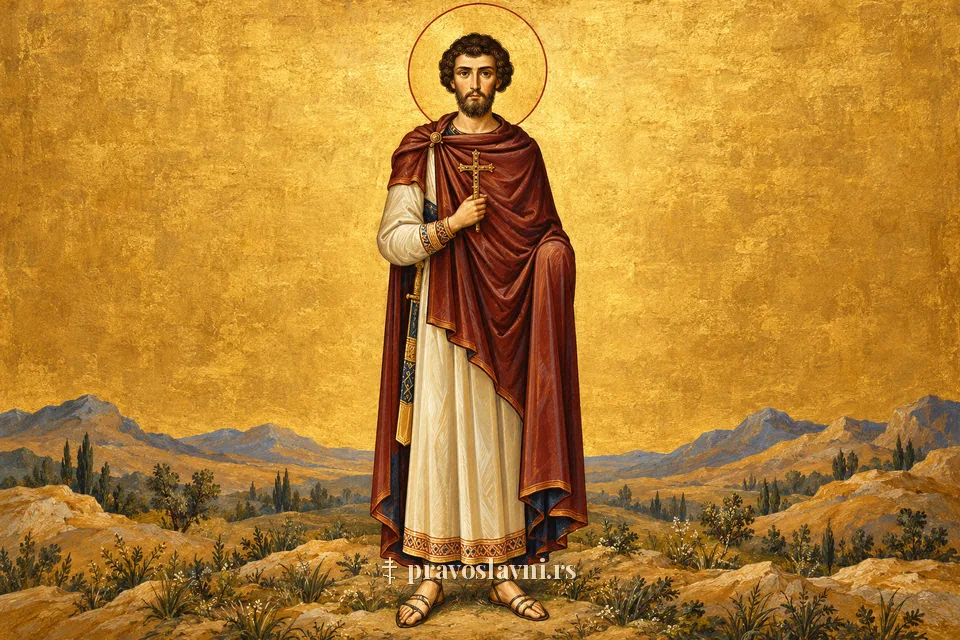
Holy Martyr Sebastian
What happenedSebastian, commander of the imperial guard, served Christ in secret, encouraged the brothers Mark and Marcellinus before their death, and by his faith brought a multitude of people to baptism.
St Sebastian was a soldier and a secret Christian. He grew up and studied in Milan, but as to where he was born the sources do not agree — the Prologue says in Italy, his Life in Narbonne. According to the Prologue, he was brave, handsome and educated. Diocletian entrusted him with command of the imperial guard, and his Life mentions Maximian alongside Diocletian. The persecuted Christians had in him a quiet protector, and to the condemned, whom he could not help, he gave the strength to accept death for Christ.
He had a particular gift for restoring courage to those who were wavering. The brothers Marcellinus and Mark, condemned to be beheaded, were already giving way before the pleas of their relatives. Sebastian reminded them that this life passes away, while the Kingdom of Heaven endures, and that a man's enemies are those of his own household. Both sources mention the light that then shone upon his face and a vision of seven angels with a certain youth; his Life also records what the youth said to him: “You shall always be with Me.”
His words were accompanied by healings too. Zoe, the wife of Nicostratus, who had been mute for six years, began to speak and confessed the faith. The sons of Claudius also recovered, and then Tranquillinus, the father of the two brothers, who had been tormented for eleven years by a disease of the legs, and the prefect Chromatius, who was ill with the same disease. In the house of Chromatius more than two hundred idols were destroyed, and he was baptised together with his son Tiburtius and about one thousand four hundred members of his household, and then withdrew to Campania.
Many of the newly baptised gave their lives for Christ: Zoe, Tranquillinus, Nicostratus, Tiburtius, whom, according to both sources, not even burning coals scorched, and the brothers Marcellinus and Mark, who sang all night long before their death.
The Prologue relates that at last he himself was denounced to Diocletian as a traitor, and his defence was that he constantly prayed to Christ for the emperor's health and for the peace of the empire. By the emperor's order they showered him with arrows and left him for dead. Yet he survived — his Life says that Irene, the widow of Castulus, found him alive and nursed him — and he appeared once more in good health, to rebuke the emperors. This time he did not survive: he was killed with blows from clubs. According to the Prologue, this was in the year 287, and his Life adds that Lucina buried him in the catacombs on the Appian Way.
Sebastian teaches us that not even those dearest to us may stand between us and eternal life. Faith heals both body and soul, and whoever perseveres receives the heavenly crown.
Full Life
A Secret Christian in the Imperial Guard
Sebastian grew up and was educated in Mediolanum. The Prologue says that he was born in Italy, and his Life that he was a native of Narbonne. The Prologue describes him as an educated and brave young man of handsome appearance, who chose the calling of a soldier. He became commander of the imperial guard by the decision of Diocletian — his Life also mentions Maximian alongside him.
At court he kept his faith hidden. He delivered many Christians thanks to his position, and to the condemned, for whom there was no rescue, he was a support so that they might bravely accept death for Christ.
A Word That Restores Courage
In the prison there were two brothers, Marcellinus and Mark, condemned to be beheaded for their faith. His Life records that their father Tranquillinus, their mother Marcia, their wives and their children begged them to renounce Christ, and the prefect Chromatius granted them a delay of thirty days. It looked as though the brothers would give way.
Then Sebastian intervened. He spoke to them about the shortness of this life and about the eternal Kingdom, quoting the words of Christ that a man's enemies will be those of his own household (Mt 10:36), and as he did so his face, according to both sources, shone with an angelic light. His Life says that he then had a vision of seven angels and of a young man, who said to him: “You shall always be with Me.” The brothers were made firm in the faith.
Miracles That Open Hearts
Both sources remember that Sebastian healed Zoe, the wife of Nicostratus, who had been unable to speak for six years. She began to speak and confessed the faith. According to his Life, Nicostratus then set free the brothers and other prisoners, and the presbyter Polycarp, who was in hiding, baptised them. His Life states that sixty-four people were baptised, among them Tranquillinus, Marcia, Zoe and the household of Nicostratus, and Sebastian was their godfather. He also healed the sick sons of Claudius and baptised his household.
Tranquillinus had suffered for eleven years from a disease of the legs. His Life preserves his confession: “I believe that Christ, the Son of God and God, can do all things.” He was healed, and the prefect Chromatius was also healed of the same disease. In his house more than two hundred idols were destroyed. Chromatius and his son Tiburtius were baptised together with about one thousand four hundred members of their household, and Chromatius gave up his office and withdrew to Campania. His Life says that Gaius, the Bishop of Rome, then named Sebastian Defender of the Church.
Crowns of Martyrdom
Soon the persecution of these new Christians began. Zoe was seized while she was praying at the tomb of the Apostle Peter; she refused to offer sacrifice to Mars and after being tortured she was thrown into the Tiber. Tranquillinus and Nicostratus suffered as well, although the Prologue and his Life record differently how this happened. Tiburtius was betrayed by a false Christian, Torquatus. Faced with the choice between burning incense to the idols and walking on live coals, he chose the latter: he protected himself with the sign of the cross and, according to both sources, remained unburnt, and then he was beheaded three miles from Rome. The brothers Marcellinus and Mark, for whom Sebastian had fought so hard, died by spears after a night which, nailed to a post, they spent in singing.
Twice before the Emperor
At last Sebastian too was accused of treason before Diocletian. The Prologue has preserved the beginning of his answer — “I always pray to my Christ” — by which he said that he prayed for the Emperor's health and for peace in the state. They stripped him and, on the Emperor's orders, showered him with arrows, and then they left him for dead.
Sebastian nevertheless survived: his Life says that Irene, the widow of Castulus, found him alive and nursed him, and he came out before the people again in good health. He took his stand on the steps of Heliogabalus and rebuked the Emperors. Then he was killed by blows from clubs — according to his Life, in the Hippodrome. His Life records that Lucina buried his body in the catacombs on the Appian Way. According to the Prologue, he suffered in the year 287, in the time of Diocletian, while Gaius was Bishop of Rome.
St Sebastian teaches us that love for our kin must not be stronger than love for eternal life. Faith heals both body and soul and converts opponents, and whoever remains steadfast receives a heavenly crown.
Other saints of the day
St Modestus and those with him
St Modestus was Patriarch of Jerusalem, but the Prologue and his Life tell two different stories about his earlier years. According to the Prologue, he was left an orphan while still an infant of five months, and God's providence saw to it that he grew up in the faith. Later, according to the same source, he ended up as a slave in Egypt in the house of a pagan, whom he brought to the faith and from whom he received his freedom for it. Mount Sinai was then, according to the Prologue, the place of his ascetic struggle, until he had reached the age of fifty-nine. According to the Life, on the contrary, Sebaste was his native city, Eusebius and Theodula were his devout parents, the monastic life was his path from his youth, and the Monastery of St Theodosius the Great in Palestine was the place where he became abbot. At that time, according to the Life, Syria and Palestine were laid waste by the armies of the Persian King Chosroes: many Christians, monks and priests perished, and along with many churches the Church of the Holy Sepulchre was burnt as well. While Patriarch Zacharias, together with the Cross of the Lord, was in Persian captivity, the Church of Jerusalem was governed, as the Life records, by Modestus as locum tenens. He saw to it that the bones of the monks who had been slain were gathered in the Lavra of St Sabbas the Sanctified, and the Holy Sepulchre, Golgotha and Bethlehem once again received their churches, through his labours and with the help of St John the Merciful. When Zacharias returned with the Cross after fourteen years and then died, Modestus, according to the Life, became patriarch. Both sources agree that he was a faithful shepherd who worked miracles and healings and that he fell asleep in peace in his ninety-seventh year, and the Prologue states that this was in the year 633. Neither the Prologue nor the Life gives the names of those who are commemorated with him. Whichever of the two stories one follows, St Modestus remains an example of a steadfast shepherd who did not abandon his flock.