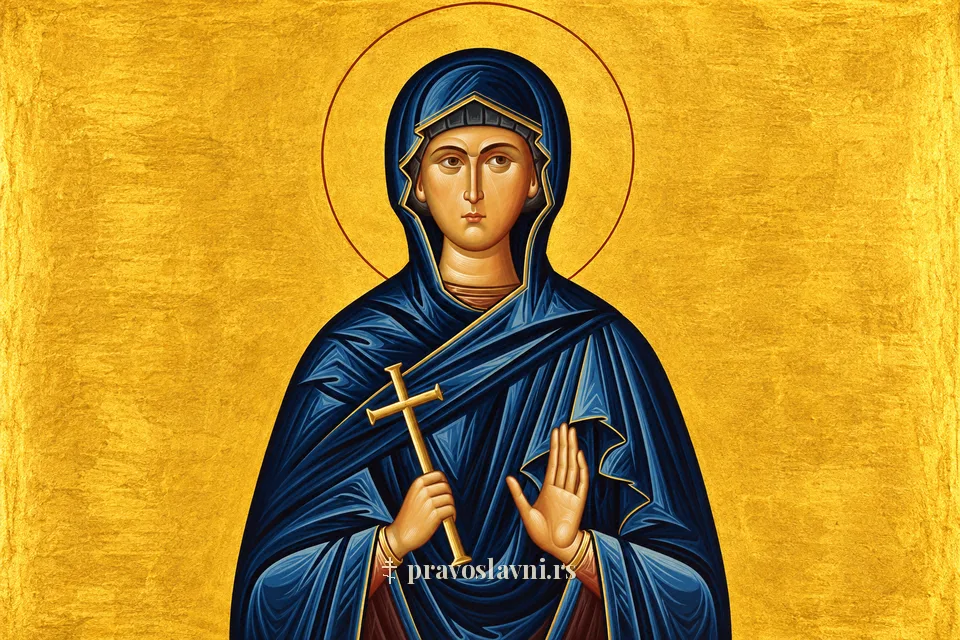
St Eugenia was the daughter of Philip, the prefect of all Egypt. Her Life says that she came with her family from Rome to Alexandria and that she was educated, beautiful and chaste. She refused her suitors, because she wished to remain a virgin. Reading the epistles of the Apostle Paul, she came to believe in the one God, but she hid this from her parents.
She left her home in secret, and with her were Protus and Hyacinth, two eunuchs devoted to her. They were baptised by Bishop Helenus. Eugenia then, concealing that she was a woman, became a monk among men. Her Life records that after three years the brethren chose her as abbot and that even then she lived modestly — in the gatekeeper's cell, working with her hands and not missing a single service. God endowed her with the power to heal the sick and to cast out demons.
Among those to whom she restored health was Melanthia, a rich widow, who saw a man in the abbot and tried to seduce him; when she did not succeed, she falsely accused him before the prefect. The judge was Philip, Eugenia's father, and the whole brotherhood ended up in prison. At the trial Eugenia revealed that she was his daughter and in this way proved her innocence. The whole household of Philip then received baptism, and many pagans along with it. Philip later became Bishop of Alexandria and was killed.
Eugenia then moved to Rome with her mother and brothers. The maidens of Rome, and many others besides, came to faith in Christ through her. She also converted the virgin Basilla, who, having refused her betrothed with the words that her Bridegroom was Christ, was beheaded. Protus and Hyacinth were beheaded too.
At her interrogation she confessed her faith in the one God. When they led her into the temple of Diana, the temple collapsed. Neither water nor fire did her any harm, for God was guarding her. The sword put her to death on Božić (Christmas), and that hour did not come unexpectedly: the Lord Jesus had revealed it to her beforehand.
Her life bears witness that humility and faithfulness to Christ are worth more than anything the world can offer, and that in the end truth prevails over slander.
Full Life
A maiden who sought the truth
Eugenia was the daughter of Philip, the prefect of all Egypt. The Prologue says that she was born in Rome. Her Life says that Philip, a Roman nobleman, received this office in the seventh year of the Emperor Commodus and that he came to Alexandria with his whole family: his wife Claudia, his sons Avitus and Sergius, and his daughter.
According to the Life, she was beautiful, chaste and gifted, schooled in Greek philosophy and in Latin and Greek letters. To the high Roman official Aquilinus, who sought her hand for his son Aquilius, she replied: “One should choose for oneself a husband who is better in his life, and not in his descent”. She refused other wealthy suitors as well, for she wished to remain a virgin.
She read the epistles of the Apostle Paul and came to believe in the one true God, but out of fear of her parents she kept it hidden. There was no place for Christians in Alexandria at that time — banished, they lived in the country around it. According to the Life, on one of the family estates outside the city, to which she went with her parents' permission, she heard monks chanting the psalm that calls the gods of the pagans demons.
The flight to the monastery
The Life says that she cut her hair and put on men's clothing, and that by night, without the knowledge of her father and mother, she left her home, accompanied by two eunuchs on whom she could rely — Protus and Hyacinth. On the way they came upon Bishop Helenus, who was followed by a multitude of people singing a hymn from the Prophet Isaiah, and Eugenia, as the Life records, took this as a sign from God.
Both she and her two companions received baptism at the hands of that bishop. Then, still in the appearance of a man, she became a monk in a brotherhood of men. When the abbot died three years later, the brethren, according to the Life, chose her as his successor. She agreed only after she had opened the Gospel and read Christ's commandment that whoever wishes to be first must serve the others. As abbot she lived in the gatekeeper's cell, worked with her hands and was present at all the services. According to the Life, she needed no more than two years to learn the whole of Holy Scripture by heart. Through her ascetic struggle she received the gift of healing and authority over demons.
Slander and truth
Eugenia healed of a fever a wealthy widow from Alexandria, Melanthia. Melanthia saw a man in the abbot and desired to seduce him. Rejected, she repaid it with a lie: she reported to the prefect that the monk had assaulted her. It was the old story of Joseph and Potiphar's wife, repeated in Alexandria, and the Life adds that a maidservant also confirmed the lie.
The prefect who sat in judgement was Philip himself. By his command the whole brotherhood ended up in chains and in prison, and Eugenia with it. At the trial Eugenia revealed to her father that she was his daughter, and in this way proved her innocence. The truth opened the door to the faith: the whole of Philip's household received baptism, and after it many pagans as well.
Philip then became Bishop of Alexandria. He was secretly murdered on the orders of Terentius — according to the Prologue the emperor's envoy, and according to the Life his successor in the office of prefect. The Life says that he spent a year and three months as bishop and died as a martyr.
A witness in Rome
After her father's death, Eugenia moved to Rome with her mother and brothers. The maidens of Rome, and many other pagans too, came to faith in Christ through her, and she encouraged them towards a life of virginity. The Life records her words: “Virginity is the very first sign of nearness to God”. She also brought to the faith the virgin Basilla, an orphan of imperial lineage, betrothed to the noble soldier Pompey. Basilla refused Pompey, saying that Christ, the King of kings, was her Bridegroom, and she was beheaded. Protus and Hyacinth were beheaded as well.
At her interrogation, where she was charged with sorcery, Eugenia confessed her faith in the one God. They took her to the temple of Diana, and the temple collapsed. Neither water nor fire could do anything to her: God preserved her, so that even the flames died down. The Life also mentions punishment by hunger: for ten days they kept her in a dark pit without food, but she was not abandoned there either — God sent her both light and food from above.
The Lord Jesus, who appeared to her in her confinement, also told her when she would suffer — on the Nativity of Christ (Christmas). And so it was: on that feast the executioner put her to death by the sword. The Prologue places this in Rome, in the year 262. The Life says that her mother Claudia buried her on the family estate near Rome. Later a consolation was given to Claudia — Eugenia appeared to her in glory.
The lesson
Eugenia left her home and her standing for Christ, and in the end gave her life as well. The Life teaches that virginity, humility and faithful witness to Christ are worth more than any earthly loss. Slander and violence may last for a while, but truth and God's providence prevail in the end.