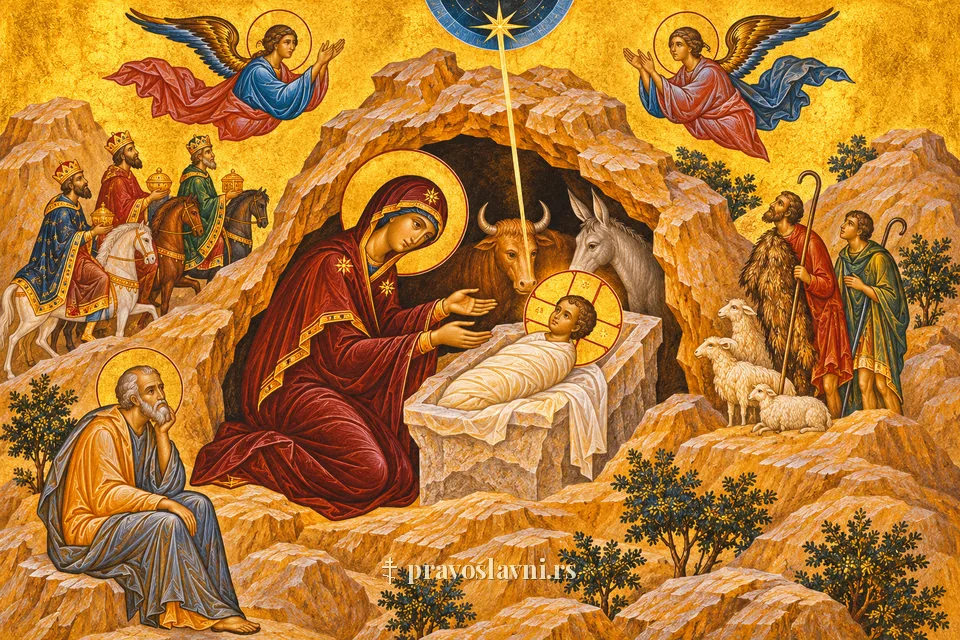
The Nativity of Christ is the feast of the birth of the Lord Jesus Christ in the flesh. It is celebrated on 25 December according to the Church calendar, that is, on 7 January according to the civil calendar.
The Archangel Gabriel announced to the Most Holy Virgin in Nazareth that She would bear a Son. The Life says that the righteous Joseph, to whom Mary had been entrusted, at first thought of quietly putting Her away, but that an angel told him in a dream to take Her and to give the Child the name Jesus.
The Emperor Augustus ordered a census of the whole Roman Empire, and everyone had to be registered in his own city. Since both Joseph and Mary were descended from David, they had to go to the city of David, Bethlehem. There they found no lodging, and so a cave, otherwise a shelter for flocks, gave them refuge. There, in the night, Christ was born. The Child, born without pain for His Mother, lay wrapped in swaddling cloths in a manger.
In the night, as the Gospel records, an angel announced the glad tidings to the shepherds: a Saviour had been born, Christ the Lord. A multitude of angels glorified God, and the shepherds went, found the Child and worshipped Him. From the east, led by a star, came the wise men, and they brought gold, frankincense and myrrh. According to the Life, the gifts themselves confess who this Child is: the myrrh shows that He became a mortal man, the frankincense that He is God, and the gold that He is King. King Herod was troubled, and the wise men, warned in a dream, went back by another way.
Thus was fulfilled what the prophets had said beforehand: the Messiah would come from the line of David, a Virgin would bear Him, and His birthplace would be Bethlehem. As a sign of the fulfilment of prophecy the Prologue and the Life also point to the foreign rule of Herod over Judea.
According to the Prologue, Christ came in person, to save the human race — a work that was beyond the measure of any prophet or king. God did not come in power and splendour, but as a Child in a manger. Joseph and Mary obeyed God, the shepherds came to Him, and the wise men worshipped Him. That is also our response to Božić (Christmas): to worship Christ, to believe in Him and to glorify God.
Full Life
When the fullness of time had come
Božić (Christmas), the Nativity of Christ, is the feast of the birth in the flesh of our Lord, God and Saviour Jesus Christ. By the church calendar it falls on 25 December, and by the civil calendar on 7 January. At the beginning of its account of this day the Ohrid Prologue quotes a thought from the Epistle to the Galatians: when the fullness of the time had come, God sent forth His Son.
The Archangel Gabriel announced to the Most Holy Virgin in Nazareth that she would bear a Son, and nine months later the birth took place. The Righteous Joseph was already an old man — the Life says about eighty years old — a carpenter of the lineage of David. According to the holy fathers whom the Life cites, Mary was entrusted to him in the form of a betrothal, so that her virginity might be preserved and the Incarnation remain hidden from the devil.
The Life records that Joseph was troubled when he noticed that Mary was with child, and that he thought of putting her away quietly. Then an angel appeared to him in a dream and told him to take Mary as his wife and to give the Child the name Jesus.
No room in the inn
The Emperor Augustus ordered a census of the whole Roman Empire: everyone had to be registered in his own city. The Gospel according to Luke records that this was the first census, at the time when Quirinius was governing Syria. Since both Joseph and Mary traced their descent from David, their place of registration was the city of David — Bethlehem.
The Life describes Bethlehem as a small town south of Jerusalem, near the road to Hebron, about three days' walk from Nazareth. It was once called Ephrathah, and Jacob called it the house of bread.
Because of the multitude of people in the town they found no lodging. A cave, otherwise a shelter for flocks, gave them refuge. There, as the Prologue records, at night, on 25 December, Christ was born. The Life says that it was at midnight.
The Most Holy Virgin had no need of a midwife, nor did any pain come upon her. The Gospel describes the event itself simply: “And she brought forth her firstborn Son, and wrapped Him in swaddling cloths, and laid Him in a manger”, because there was no room for them in the inn. The Life also mentions the ox and the ass beside the manger, whose breath made the Child warmer; the Life connects that image with the Prophet Isaiah. Joseph too bowed down before the Newborn.
The Life also mentions the miraculous signs which, according to it, accompanied that night, both in Judea and far from it, and one of them was in the cave itself: water flowed from the rock.
The shepherds and the wise men
By night the shepherds were keeping watch over their flocks — the Life, referring to St Jerome, says that this was near the tower of Eder. The Gospel according to Luke records that an angel appeared to them and announced that in the city of David a Saviour had been born, Christ the Lord, and that the sign would be a Babe wrapped in swaddling cloths in a manger. A multitude of the heavenly host was praising God. The Prologue quotes the angelic hymn: glory to God in the highest, peace on earth and goodwill among men. In the cave the shepherds found Mary and Joseph with the Child and bowed down before Him, for they recognised in Him the promised Saviour. And Mary, the Gospel records, kept all those words in her heart.
From the East, led by a star, came the wise men. The Gospel according to Matthew says that in Jerusalem they asked where the newborn King of the Jews was, and Herod was troubled. The chief priests and scribes cited the prophet: in Bethlehem. The wise men went in, saw the Child with Mary, His mother, bowed down before Him and offered gold, frankincense and myrrh. According to the Life, these wise men were learned people who studied the stars, and not sorcerers. Their gifts also had a deeper meaning: the Child who received the gold is King, the frankincense was offered to Him because He is God, and the myrrh says that He became a mortal man. The Life also cites a tradition, with the reservation that it is not entirely certain, according to which their names were Melchior, Caspar and Balthasar. Warned in a dream, they returned by another way.
Prophecy fulfilled
What the prophets had long ago foretold about His coming — the lineage of David, Bethlehem and the Virgin Mother — was fulfilled. The Gospel according to Matthew recalls the prophecy that a virgin shall conceive and bear a Son and that His name shall be called Immanuel, which means God with us. Here the Prologue and the Life also mention Herod: the fact that Judea was at that time under the rule of a foreigner they too see as a fulfilment of prophecy.
What Božić tells us
According to the Prologue, no prophet and no king was able to bring salvation to the human race, and for that reason Christ came in person. God sent His Son in humility, in a cave and a manger, to deliver man from sin, death and the devil. The obedience of Joseph and Mary and the faith of the wise men show how one responds to that gift: with worship, with trust and with praise to God.