Save your slava — you'll get a reminder a week and a day before.
Wednesday07July 202724 June (according to the Julian calendar)
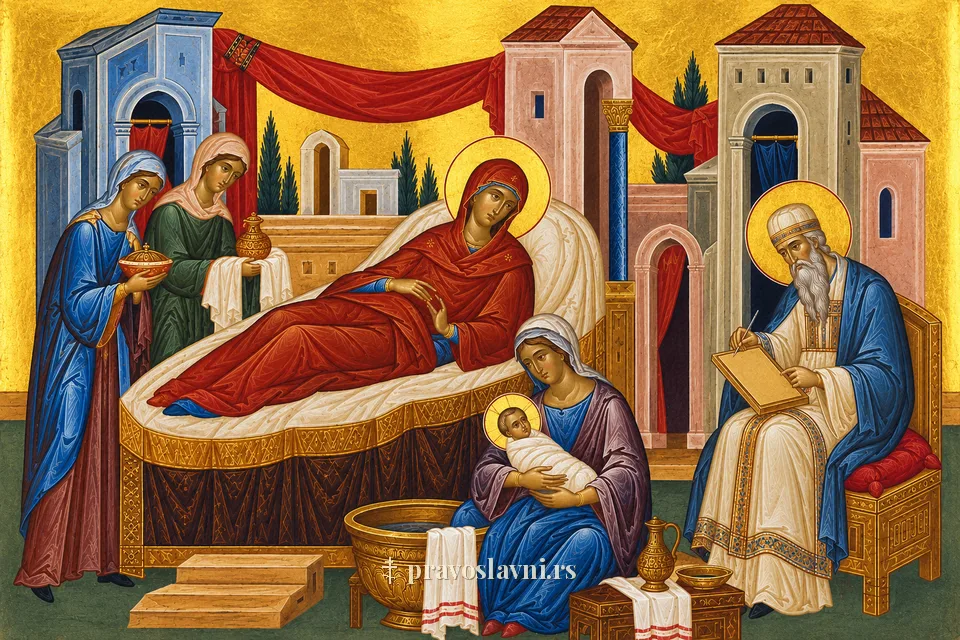
Illustration
Great feast
Ivanjdan — Nativity of St John the Forerunner (the Baptist)
Nativity of St John the Forerunner
What happenedThe Church celebrates the birth of St John the Forerunner, son of the priest Zacharias and Elizabeth, whom the Archangel Gabriel announced in the Temple.
Sung at the Slava (family patron saint's feast) and on the saint's feast day.
O Prophet and Forerunner of the coming of Christ, we who honour thee with love are at a loss how worthily to praise thee; for by thy glorious and honoured nativity the barrenness of her that bore thee and the speechlessness of thy father were loosed, and the incarnation of the Son of God is proclaimed to the world.
Ivanjdan is the feast of the Nativity of St John the Forerunner and Baptist of the Lord. On the same day the Church also commemorates St Nicetas, Bishop of Remesiana. Among Serbian families St John is one of the most common Krsna slavas (family patron saint's day).
The right hand of St John is today kept in the Cetinje Monastery, and the Church remembers this saint several times during the year. By folk custom, Ivanjdan is also a day of kumstvo (godparenthood) and pobratimstvo (sworn brotherhood). By folk custom, little wreaths are made from the herbs and flowers that grow in the fields, hung on the gate and left there for the whole year, right up to the next Ivanjdan. In many Slavic lands, by folk custom, fires were lit on high places on the eve of the feast, with dancing and song.
John the Forerunner was the son of the priest Zacharias and Elizabeth. While Zacharias was serving in the Temple in Jerusalem, the Archangel Gabriel appeared to him and announced the birth of a son. Zacharias did not believe and was struck dumb. The Life sees in this birth from a barren woman a miracle that prepares the way for a greater miracle, the birth from the Virgin. Elizabeth was barren, and she bore her son in old age, to the joy of her relatives and neighbours.
On the eighth day, at the circumcision, the relatives wanted to name the child after his father, but Elizabeth asked for the name John. Zacharias wrote on a tablet: “His name is John” (Lk 1:63), and at once his speech returned to him.
When King Herod ordered the children in Bethlehem to be killed, he also sent men to kill John. Elizabeth hid the child; the Life records that a rock opened before them and took them in. Zacharias, who was serving in the Temple, did not reveal where the child was, and he was killed between the temple and the altar. Elizabeth lived with the child hidden in a cave, and there she died. John remained in the desert under God's care — according to the Life, an angel fed him — until he showed himself to Israel.
The Life compares him to the morning star that goes before the Sun of Righteousness. He himself said: “There comes One after me who is mightier than I” (Mk 1:7). The people call this feast Ivanjdan.
Full Life
The announcement in the Temple
John was the son of the priest Zacharias and of Elizabeth; the Prologue calls Zacharias a high priest. While Zacharias was serving in the Temple in Jerusalem, the Archangel Gabriel appeared to him — according to the Prologue, six months before he was to appear to the Virgin Mary in Nazareth. Zacharias did not believe the news and was struck dumb; according to the Prologue, he remained mute until the eighth day after the birth of the child.
Elizabeth was barren, and she bore her son in old age. The relatives and neighbours rejoiced, just as the angel had foretold. The Life sees in this birth a miracle that prepares a greater miracle, the birth from the Virgin, and compares it with the birth of Isaac, whom Sarah bore in her old age.
“His name is John”
On the eighth day, at the circumcision, the relatives wanted to name the child after his father. Elizabeth asked that he be called John — the Life says, by the gift of the Holy Spirit. Then Zacharias wrote on a tablet: “His name is John” (Lk 1:63), and at once his speech returned to him. According to the Life, all this took place in Hebron, a town in the hill country of Judea. The Life also gives a homily of St John Chrysostom on these events: on the doubt of Zacharias before the altar, on John, who while still in the womb recognised Christ and leaped, on the return of Zacharias's speech and on his blessing: “Blessed is the Lord God of Israel, for He has visited and redeemed His people” (Lk 1:68).
The flight and the suffering of Zacharias
Word of the child reached King Herod. According to the Prologue, when he ordered the children in Bethlehem to be killed, he also sent men to the house of Zacharias in the hill country near Hebron to kill John. Elizabeth hid the child; the Life records that she fled with him into the mountain and that the rock opened and received them, so that Herod's men did not find them.
The soldiers then came to Zacharias, who was serving in the Temple. He told them that he did not know where the child was. The blood of Zacharias, shed between the temple and the altar (cf. Mt 23:35), according to both sources became as hard as stone — the Life says, on the marble — and remained to bear witness to Herod's crime.
A child in the wilderness
Elizabeth lived hidden with the child in a cave, and there she died — according to the Life, forty days after the death of Zacharias. The Life records that in the cave there was a spring and a palm tree that bent down to give them its fruit. When he was left without his mother, the boy grew up in the wilderness, without a single person beside him; God and the angels took care of him, and the Life says that an angel fed him until he was grown. There he remained until the day when he appeared to Israel.
The Life says that he served in the spirit and power of the Prophet Elijah and that he was the Forerunner, who came before Christ as the morning star comes before the Sun of righteousness. He himself said: “There comes One after me who is mightier than I” (Mk 1:7). The people call this feast Ivanjdan (St John's Day).
God begins great things quietly and in secret: a barren woman gives birth, the father is mute, the child grows up in the wilderness. Zacharias remains at his service and would rather give his life than betray the child. On this day the Prologue teaches us not to rejoice when an enemy falls (Prov 24:17), but to pray for him and to replace malice with compassion.
Other saints of the day
St Nicetas, Bishop of Remesiana
St Nicetas was bishop in the city of Remesiana, which some identify with present-day Pirot. He was a friend and contemporary of St Paulinus of Nola. According to the Prologue, he may have been a Slav; his Life says that he was, as it seems, a Slav from Niš. His missionary field was the Slavs in the region around Niš and Pirot. His preaching changed that region so much that those who had once been robbers in the mountains became monks. Paulinus of Nola wrote a poem about this, in which he praises that change. He also left writings, among them six books on the faith and a book about a maiden who fell into sin; reading them, many people repented. He reposed in the fifth century.