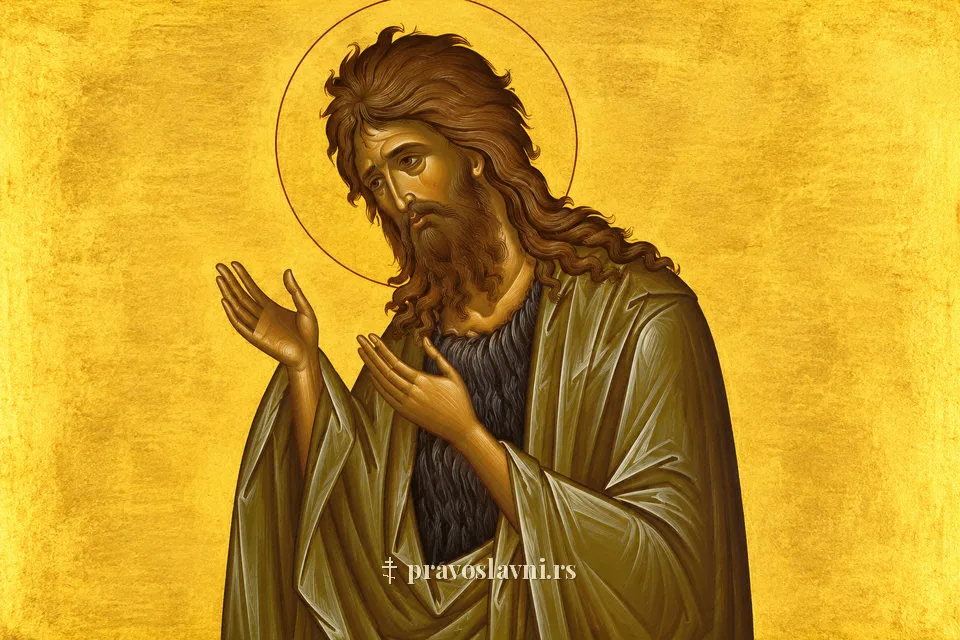
Jovanjdan, the Synaxis of St John the Baptist, is celebrated on 7 January according to the old calendar, that is, on 20 January according to the new calendar, immediately after Theophany. Theophany is the day when John did that for which he had been sent — he baptised the Lord in the Jordan — and that is why the Church celebrates him too on the very next day. His Life says that he is venerated as the one who at the baptism laid his hand upon the head of the Lord.
The word synaxis, as his Life explains, means that the faithful gather in church to glorify God in honour of St John. There are several feasts of John in the year, and the Prologue singles this one out as the most widespread. The other prophets foretold Christ, but John, according to the Prologue, was able to point his finger at Him and to baptise Him.
John was put to death by Herod in Sebaste. The holy Evangelist Luke wanted to translate the relics of the Forerunner to Antioch, which the Prologue calls his native city, but he managed to carry away only the hand — according to the Life, the right one. The Life says that this hand was venerated in Antioch as a treasure and that many miracles took place through it. Among them the Life also mentions the rescue of a maiden who had been chosen to be given to a serpent which the pagans worshipped.
In the time of Julian the Apostate, according to the Life, the hand was hidden in the city tower called Gonia and was preserved in that way.
The Prologue and the Life also record a yearly custom: the hierarch would bring the hand out before the people, and everyone watched to see what it would show. A good year was foretold by an open hand, a bad and hungry one by a closed hand. The Prologue says that this was done on the saint's day, while the Life names Krstovdan (the Exaltation of the Cross).
Only in the tenth century, as the Prologue states, did the hand leave Antioch. The Life tells that the deacon Job secretly carried it to Chalcedon, and from there it was solemnly translated to Constantinople. The Life says: “It was a great joy both for the Emperor and for all the people.” According to the Prologue, in Turkish times all trace of it was lost in Constantinople.
On the day after Theophany the Church gathers around the Forerunner and asks for his prayers, that we ourselves may also be gathered into the heavenly Church.
Full Life
A Synaxis on the Day after Theophany
Jovanjdan (St John's Day), the Synaxis of St John the Baptist, is celebrated on 7 January by the old calendar, that is, on 20 January by the new calendar — the day after Theophany. The Prologue and his Life explain why it falls precisely then. Theophany is the day on which John did that for which he had been sent — he baptised the Lord — and so the Church does not wait, but honours him too on the very next day. His Life says that he is venerated as the one who, at the baptism, laid his hand on the head of the Lord.
The word synaxis itself, as his Life notes, means that the faithful gather in church to glorify God in honour of St John. This day is celebrated in all churches, and with particular solemnity in the churches that are dedicated to him. There are several feasts of John in the year, and of them all the Prologue singles out this one as the most widely kept.
The Prologue also points out what made John special. He did not only baptise people who repented, but he baptised the Messiah Himself as well. The other prophets foretold Christ, whereas John, according to the Prologue, was able to point his finger at Him.
The Hand That Baptised Christ
John was put to death by Herod in Sebaste. His Life says that this happened at a feast, after the dance of the daughter of Herodias. His disciples, according to his Life, buried his body in Sebaste, near the tomb of the Prophet Elisha.
The holy Evangelist Luke, according to the Prologue and the Life, wished to translate the relics of the Forerunner to Antioch — the Prologue calls it his birthplace, and the Life the city where he was educated — but he managed to take away only the hand — the Life says the right one. The Life says that Luke gave this hand to Antioch as a treasure, that the faithful venerated it and that many miracles were worked through it.
In the time of Julian the Apostate, who was destroying relics, the hand, according to the Life, was hidden in the city tower of Gonia, and so his men did not find it. The Life says that in Sebaste they burned the body, the tomb and the church, all except the head and the hand. The Life nevertheless remarks that the accounts of this differ: according to Nicephorus and Cedrenus the body was burned, while according to Symeon Metaphrastes it was someone else's body that was burned, whereas the Patriarch of Jerusalem hid the true relics and sent them to Alexandria.
The Girl Who Was Saved
The Life also tells of an event that took place in Antioch. In the countryside around the city there lived pagans who worshipped an enormous serpent; every year the lot decided which girl they would have to give to it. So one year the turn came to the daughter of a certain Christian, and her father, in tears, begged for help from Christ and St John.
According to the Life, the father scattered gold coins in the church. While the sacristan was gathering them up, he kissed the hand and secretly separated from it a small piece of a finger. When he threw that small piece to the serpent, it died. The girl was saved, many pagans came to believe, and on that spot a church of St John was built.
A Sign for the Whole Year and the Journey to Constantinople
The Prologue and the Life also record a yearly custom: the hierarch would bring the hand out before the people, and everyone watched to see what it would show. A good year was foretold by an open hand, a bad and hungry one — by a closed hand. The Prologue says that this was done on the saint's day, while the Life names Krstovdan (the Exaltation of the Cross).
Only in the tenth century, as the Prologue notes, did the hand leave Antioch. The Life tells that, while the Hagarenes held Antioch, the Christian emperors were unable to ransom it. In the time of the Emperors Constantine VII and Romanus, the deacon Job, at a certain festival, made the keeper of the church of the holy Apostle Peter in Antioch drunk, took the hand by night and fled to Chalcedon.
The emperors sent a ship with the patriarch and senators, and the hand was brought to Constantinople. The Life says: “It was a great joy both for the emperor and for all the people.” A church in the imperial palace was appointed for it, and it arrived there on the eve of Theophany, before the water was blessed. According to the Prologue, in Turkish times all trace of it was lost in Constantinople.
Gathered around the Forerunner
On the day after Theophany the Church gathers around the Forerunner, who with his own hand served the baptism of the Lord. The faithful ask for his prayers for themselves, in the hope that one day they too will stand in the synaxis of the heavenly Church and behold the Triune God without end.