Save your slava — you'll get a reminder a week and a day before.
Saturday24April 202711 April (according to the Julian calendar)
Illustration
Feast of the day
Lazareva subota — Lazarus Saturday
What happenedOn Lazareva subota (Lazarus Saturday) the Church celebrates Christ's raising of Lazarus in Bethany after four days in the tomb, which bears witness to the general resurrection of the dead.
Sung at the Slava (family patron saint's feast), on Lazarus Saturday and on Palm Sunday.
Thou didst raise Lazarus from the dead, O Christ our God, making certain the universal resurrection, before thy Passion. For which cause we also, like unto the children, bearing the emblems of victory, cry aloud unto thee, the Conqueror of Death: Hosanna in the highest! Blessed is he that cometh in the Name of the Lord.
The day got the name Vrbica (Lazarus Saturday) from the willow (vrba). The blessed twigs are, by custom, carried home from church and kept by the icon, and in some places a little wreath for the icon is woven from them. The willow was important among the people because it grows quickly and luxuriantly, and it was believed that it gives its green strength to both children and adults. Still, Vrbica is above all a feast of children. By custom, even the youngest come to church in their finest clothes, with a little bell around the neck, hung on a ribbon in the colours of the tricolour; they ring as they run about the churchyard, sing and follow the procession around the church. Before the Second World War schools too celebrated this day: the pupils, ringing their bells, went in procession to a spring, played there and, in the company of the teacher and the priest, gathered willow, which was then carried to church. By old custom, girls went about as lazarice (girls who go from house to house on Lazarus Saturday), in embroidered folk costumes, with strings of coins around their necks and flowers on their hats. After washing their faces, dancing and singing at the spring they went round the houses, sang and danced for each one, and the householders gave them food and drink.
About the feast
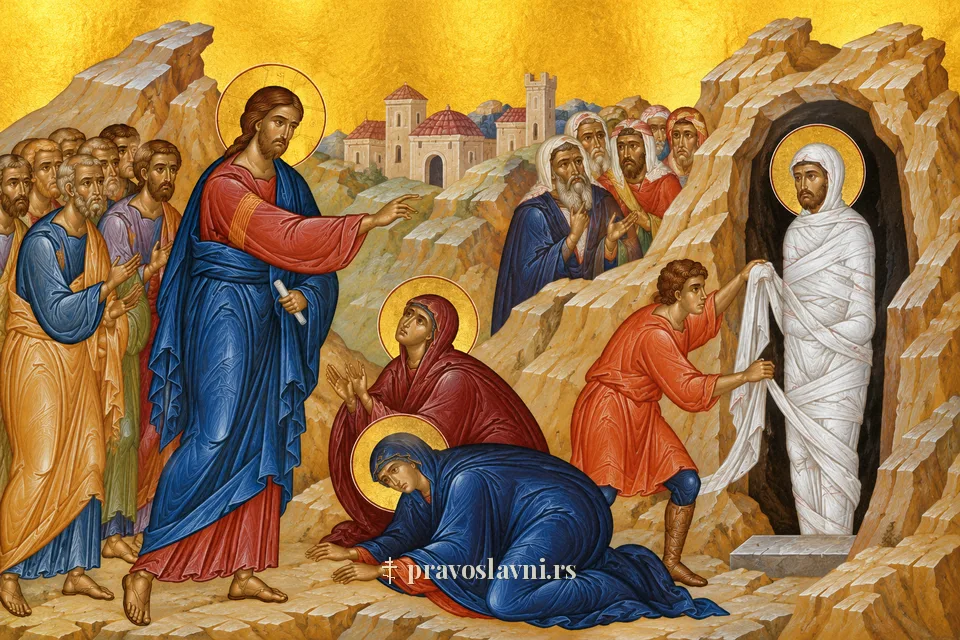
Lazareva subota (Lazarus Saturday), also known among the people as Vrbica, is the day before Cveti (Palm Sunday) and it joins Great Lent with Holy Week. On that day the Church remembers Christ's friend Lazarus of Bethany, the brother of Martha and Mary. When Lazarus fell ill, the sisters sent word to Jesus that the one whom He loved was sick. The Lord came only when Lazarus had already been lying in the tomb for four days. To Martha He said: “I am the resurrection and the life. He who believes in Me, though he may die, he shall live.” Seeing Mary and those gathered there weeping, He Himself wept as well. Then He ordered the stone to be rolled away from the tomb, gave thanks to the Father and cried out: “Lazarus, come forth!” The dead man came out bound in his grave-clothes, and Jesus said that they should loose him and let him go. Many who saw this believed in Him, and afterwards the people, because of this sign, went out to meet Him at His entry into Jerusalem.
By the raising of Lazarus Christ, before His own Passion, confirmed that all the dead will rise, and so the divine services of this day too are paschal in spirit. Only then in the whole year does the Sunday, Resurrection service pass over to another day, and the faithful do not kneel even at the consecration of the Gifts. Recalling the ancient baptisms of the catechumens, the Church sings on that day: “For as many of you as were baptized into Christ have put on Christ.” At Matins the Resurrection hymns and the Great Doxology are heard, and there is also a procession around the church. The feast was established in Jerusalem at the end of the 4th century, and among the Serbs it is greatly honoured and many keep it as their Krsna slava (family patron saint's day). The name Vrbica comes from the young willow twigs that are gathered on that day. Death does not have the last word: He who weeps with those who mourn is the Resurrection and the Life.
Full Life
The illness and death of a friend
Lazarus of Bethany, the village of Mary and her sister Martha, fell ill. The sisters sent word to Jesus: Lord, behold, he whom You love is sick. The Evangelist John records that Jesus loved Martha, her sister and Lazarus. Yet He stayed two more days where He was, and then set out for Judea, although the disciples reminded Him that the Jews had only lately sought to stone Him. At first He said that Lazarus had fallen asleep, and then He told them plainly that he had died. Thomas, who is called the Twin, said to the rest of the disciples: let us also go, that we may die with Him.
The resurrection and the life
When Jesus arrived, Lazarus had already been lying in the tomb for four days. Bethany was near Jerusalem, and many of the Jews had come to comfort the sisters. Martha went out to meet Jesus and said: Lord, if You had been here, my brother would not have died. Jesus answered her: “I am the resurrection and the life. He who believes in Me, though he may die, he shall live.” (Jn 11:25) Martha confessed Him as the Christ, the Son of God. Mary came too, fell down at His feet and said the same words. Seeing her and the Jews weeping, Jesus was deeply moved in spirit, and “Jesus wept” (Jn 11:35). Those who were gathered there said: see how He loved him.
Lazarus, come forth
The tomb was a cave, and a stone lay upon it. Jesus told them to take away the stone, and Martha objected that after four days the dead man already had a stench. The Lord told her that, if she believed, she would see the glory of God. He lifted up His eyes and gave thanks to the Father aloud, for the sake of the people who were standing around, that they might believe that the Father had sent Him. Then He cried out with a loud voice: “Lazarus, come forth!” (Jn 11:43) The dead man came out, bound hand and foot, with his face wrapped in a cloth, and Jesus said: “Loose him, and let him go.” (Jn 11:44) Many of the Jews who saw this believed in Him. Later, when Jesus came to Bethany again six days before the Passover, many people came to see the risen Lazarus, and so the chief priests plotted to kill him as well, because on account of him many were believing in Jesus. According to tradition, Lazarus was later a bishop in Cyprus.
The feast before Holy Week
The feast was established in Jerusalem at the end of the fourth century. It stands on a boundary: behind it lies Great Lent of forty days, which comes to an end with Vespers on the eve of Lazarus Saturday, and before it lies Holy Week; the next day is Cveti (Palm Sunday). The raising of Lazarus, which came before the Passion of Christ, bears witness that all the dead shall rise as well. The service is paschal in spirit and sings of Christ as the Resurrection and the Life. At Matins the hymns of the Resurrection are heard, and it ends with the Great Doxology. Nowhere else in the year does the Sunday, Resurrection service pass over to another day; for that reason the faithful do not kneel even when the Gifts are being consecrated. In ancient times the catechumens were baptised on this day, as on few other days in the year, and hence, instead of the Trisagion, there resounds: “For as many of you as were baptized into Christ have put on Christ.” (Gal 3:27) There is also a procession around the church, with the troparion of the feast. The Serbs greatly honour this day, and in many homes it is the Krsna slava (family patron saint's day).
Other saints of the day
Hieromartyr Antipas, Bishop of Pergamum
In the Book of Revelation the Lord calls Antipas “My faithful martyr” (Rev 2:13). He was bishop of the Church in Pergamum, in Asia, at the time of the persecution which his Life connects with the Emperor Domitian. The city was sunk deep in idolatry, and Antipas was a light among his fellow citizens.
The demons were afraid of him: the Prologue and his Life say that they appeared to the pagan priests in their sleep and told them that because of Antipas they had to leave the city. The priests therefore stirred up the people, and the crowd demanded that he renounce Christ. Antipas answered that gods who flee from a mortal man themselves prove that faith in them is false, and he preached Christ to them as the one saving faith. The Life also remembers his words to the commander: “Commander, know this: I am a Christian, and therefore I will not submit to the senseless and godless order of the Emperor.”
The enraged pagans threw him into a red-hot bronze bull before the temple of Artemis. There too he praised God and prayed for his flock and for the world, until he gave up his soul. The Prologue records that he died in the year 92. His relics were buried in Pergamum, and from them, according to the Life, there flowed myrrh which healed diseases.
The hymn sings of him as fearless in the fire, one who prayed for his flock, for the unbelievers, for sinners and for the Church.