Oci — Sunday of the Holy Fathers (before the Nativity of Christ)
4 January 2026 · 3 January 2027
Oci — Sunday of the Holy Fathers (before the Nativity of Christ)4 January 2026 · 3 January 2027
Dates and fasting
Sunday, 4 January 2026fast with oil · Sunday — a festive day · 22 December (according to the Julian calendar)
Sunday, 3 January 2027fast with oil · Sunday — a festive day · 21 December (according to the Julian calendar)
Sunday03January 202721 December (according to the Julian calendar)
Illustration
Saint of the day
Oci — Sunday of the Holy Fathers (before the Nativity of Christ)
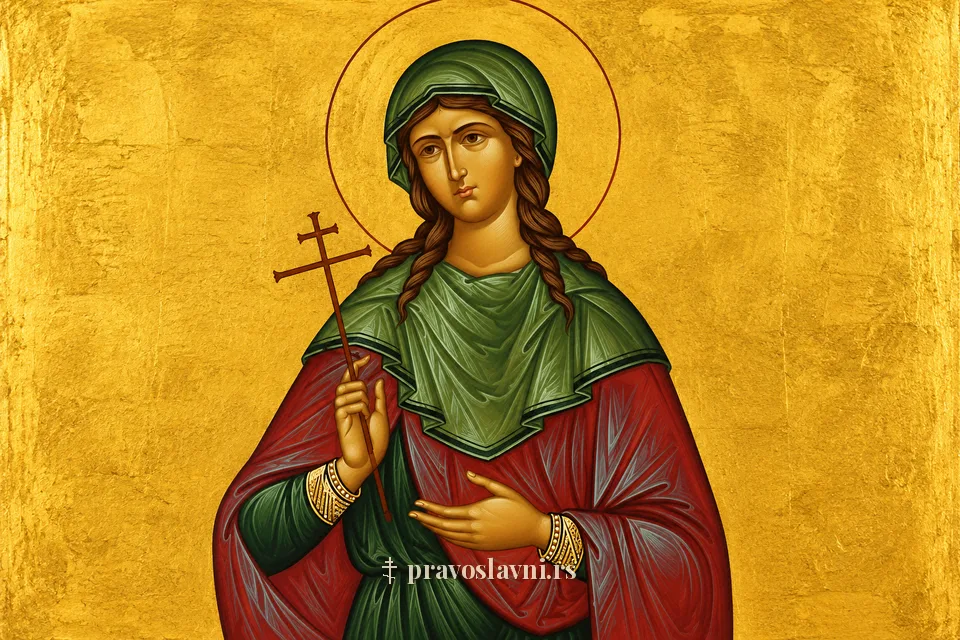
Holy Martyr Juliana
What happenedSt Juliana refused to marry the prefect of Nicomedia because she did not want to be divided in spirit from her husband, and she suffered for Christ.
“Do not fear any of those things which you are about to suffer. Indeed, the devil is about to throw some of you into prison, that you may be tested, and you will have tribulation ten days. Be faithful until death, and I will give you the crown of life.”
— Rev 2:10
About this day
Oci (Fathers' Day), also called Očevi, is the last in the series of family feasts before Božić (Christmas). It is celebrated on the Sunday before Christmas, which comes after Detinjci (Children's Day) and Materice (Mothers' Day). It is counted among the movable feasts. In the church calendar this Sunday bears the name Sunday of the Holy Fathers.
By folk custom, on that day children tie up their fathers, just as they tied up their mothers on Materice. The fathers are untied by giving the children presents, just as the mothers were. Among us it is the custom that everyone in the family has their own day for gifts: children on Detinjci, mothers on Materice, fathers on Oci, and other relatives on Badnji dan (Christmas Eve). For the feast the lady of the house prepares a festive lunch which gathers the whole family.
The meaning of these customs is to bring parents and children, older and younger, closer together, and to foster harmony, understanding and mutual respect in the home. Detinjci, Materice and Oci are celebrated above all within the home, around a shared table. The family is, after all, the foundation on which the Church, the state and the whole of society rest. Oci falls during the Nativity Fast; for more on fasting, see the guide “Fasting — simply explained”.
The feast of St Juliana also bears in the calendar the name “Holy Martyr Juliana and the six hundred and thirty martyrs with her”. Those six hundred and thirty — five hundred men and one hundred and thirty women — came to believe, according to the Prologue, as they watched how the fire could do nothing to her, and for that faith they were all put to death by the sword.
Juliana was a maiden from Nicomedia, from a pagan family, who learned of Christ from the preaching of the Gospel. She had been promised to the senator Eleusius, of whom she first asked that he become prefect. When he reached that position by dishonest means, she told him the truth about her faith and asked that he too should accept it. “What good is it for us to be united in body but divided in spirit?” she asked him.
Her betrothed then began a persecution, and her own father took part in it as well; the daughter was mocked, beaten and brought before the prefect's court. After the beatings and the prison, the Prologue records that the Lord Himself healed her, and that after the fire she remained unharmed.
According to the Prologue, she went to her execution with joy, and before the sword she prayed on her knees. This was in the year 304. The Prologue also mentions the end of Eleusius: a shipwreck and a terrible death.
Her story shows that faith is worth more than any earthly union and that God does not abandon those who remain faithful to Him.
Full Life
A question before the wedding
“What good is it for us to be united in body but divided in spirit?” — this, according to the Prologue, is the question Juliana put to the man to whom she had been promised. Her whole choice is contained in it: a marriage in which husband and wife would believe differently was something she did not want, not at any price.
The Prologue records that Juliana of Nicomedia came from a pagan house. Her faith did not come to her from her family, but from the preaching of the Gospel, which she heard from someone, and she gave herself up to that message without reserve.
A condition that became a test
Her betrothed was the senator Eleusius. Juliana tied her consent to the marriage to one condition: that he should become prefect, the governor of the city. Eleusius did obtain the post in Nicomedia, but not honestly — the Prologue says that flattery and bribery helped him to it.
Only then did the real question come. Juliana revealed that she was a Christian and set a new condition, harder than the first: that Eleusius should accept her faith. Without that there would be no marriage.
From betrothed to judge
The rejected suitor turned to Juliana's father, and the father himself had no mercy: he mocked his daughter, beat her and left it to the prefect to judge her. So Juliana found herself before the court, and against her stood both her betrothed and her own father.
The prefect's order brought her a beating and the prison, into which she was thrown all covered in blood. Before the prefect, however, she came out again in good health, because, according to the Prologue, the Lord Himself had healed her in the prison. Nor did the red-hot furnace, into which she was then thrown, do her any harm.
Six hundred and thirty
The miracle of the furnace did not remain without witnesses. According to the Prologue, five hundred men and one hundred and thirty women came to believe in Christ at that time, and the prefect put them all to death by the sword. It is from them that the feast bears its name in the calendar as well: the Holy Martyr Juliana and the six hundred and thirty martyrs with her.
In the end the turn came for Juliana too. The Prologue says that she received the death sentence with joy and that before her beheading she prayed on her knees. She suffered in the year 304.
Of the end of Eleusius the Prologue speaks briefly: he was shipwrecked and, although he swam to an island, there he came to a dreadful end.
Juliana did not want to share her life with a man from whom her faith would separate her, and she preferred Christ to marriage. God did not abandon her in that choice — He healed her in the prison and preserved her in the fire — and the miracle that was worked upon her brought six hundred and thirty souls to the faith.
Other saints of the day
St Peter, Metropolitan of Kiev
Peter was a native of Volhynia, the child of devout parents. His Life mentions signs even from his childhood: the boy, who for a long time found learning hard, began to learn easily after a dream in which a hierarch appeared to him. He became a monk — according to the Prologue at the age of twelve, and according to his Life at twenty. The river Rata remembers him as the founder and abbot of a monastery with a church of the Saviour, in which he lived the ascetic life and painted icons; his Life also mentions an icon of the Theotokos by his hand, which he gave to Metropolitan Maximus. At the urging of the prince of Volhynia, and against his own will, he set out for Constantinople, where Patriarch Athanasius consecrated him Metropolitan of Kiev. His Life records that those who watched this said: “Truly this man has come to us by the command of God.” Envy and heresies caused him many troubles, and his Life records that when Andrew, Bishop of Tver, slandered him, the council at Pereyaslavl uncovered the slander, and that Peter forgave him. According to his Life, he stayed mostly in Moscow and encouraged Grand Prince Ivan Danilovich to build the stone Church of the Dormition. While still alive he chose the place in the Church of the Dormition where he would lie, and his wonderworking relics are there; the Prologue says that he led the Church for eighteen years and reposed in the year 1326. His Life records that, sensing his death approaching, he served the Liturgy, gave out alms and reposed while at prayer. His life teaches humility, obedience and meekness, for God's providence raised him to high service even against his will, and he forgave even the man who slandered him.