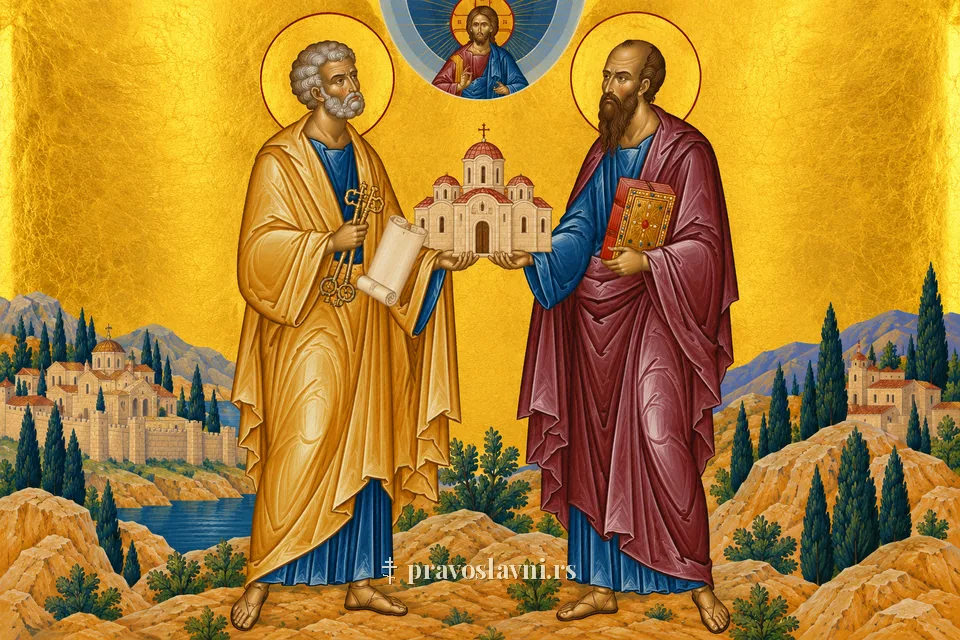
Peter, the brother of Andrew, was a fisherman from Bethsaida in Galilee. The Lord named him, instead of Simon, Cephas, which means Peter. He was the first to utter the confession of faith: “You are the Christ, the Son of the living God” (Mt 16:16). He walked on the water, and with James and John he saw the Transfiguration. And yet this same disciple three times denied that he knew the Teacher, and he repented when the Lord looked at him; after the Resurrection the Lord asked him three times whether he loved Him. When the Holy Spirit descended, Peter's preaching in Jerusalem brought about three thousand people to the faith. He healed the sick and raised the dead, and the sick recovered even when his shadow fell upon them. He put Simon Magus to shame and preached from Palestine to Italy, and he appointed Linus as Bishop of Rome. Under Nero he was crucified in Rome head downwards, for he did not consider himself worthy of the same death as Christ.
Paul, born in Tarsus of Cilicia as Saul, was a Pharisee and a disciple of Gamaliel, and he persecuted the Christians until the Lord appeared to him on the road to Damascus: “Saul, Saul, why are you persecuting Me?” (Acts 9:4). For three days he was blind, and Ananias restored his sight and baptised him. With Barnabas he worked in Antioch, where the disciples were first called Christians, and later, with Silas and Timothy, he preached in Macedonia, Athens, Corinth and Ephesus. He preached from Arabia to Spain, to Jews and to pagans, and so he is called the Apostle to the Gentiles. He founded churches in many places and wrote epistles to them. He suffered much and bore everything with patience. He was arrested in Jerusalem, appealed to Caesar and spent two years in Rome under guard, preaching freely. He was beheaded with the sword in Rome under Nero; according to the Life, he was buried beside Peter.
The fisherman who denied and the Pharisee who persecuted became, through repentance and grace, pillars of the Church.
Full Life
The fisherman from Bethsaida
Peter was the son of Jonah, the brother of Andrew the First-Called, of the tribe of Simeon, from Bethsaida in Galilee, a fisherman by trade. At first he was called Simon, and the Lord gave him the name Cephas, which means Peter (Jn 1:42). The Life says that he was married and that he had a son and a daughter.
Peter was the first to confess Jesus clearly as the Christ: “You are the Christ, the Son of the living God” (Mt 16:16). The Lord answered him: “And I also say to you that you are Peter, and on this rock I will build My church, and the gates of Hades shall not prevail against it” (Mt 16:18). He walked on the water, with James and John he saw the Transfiguration, and he cut off the ear of Malchus.
Fall and repentance
Although Peter three times denied that he knew Christ, it was enough for the Lord to look at him for him to be ashamed and to repent. After Christ's Resurrection the Lord asked him three times whether he loved Him (Jn 21:15–17).
After the descent of the Holy Spirit Peter preached boldly; after one of his sermons in Jerusalem about three thousand people believed (Acts 2). He healed the sick and raised the dead; for the sick it was sometimes enough that his shadow should fall on them for them to recover. He healed Aeneas in Lydda, raised Tabitha in Joppa and baptised the centurion Cornelius, and an angel led him out of Herod's prison (Acts 9–12).
Preaching and the cross in Rome
According to the Prologue, Peter preached in Palestine, Asia Minor, Illyricum and Italy. He put to shame Simon Magus, who, as the Prologue says, passed himself off as a god. Before his death he appointed Linus as Bishop of Rome. He was condemned in Rome under Nero. Since he did not consider that he deserved the same death as Christ, he was crucified head downwards. The Life says that Clement took down his body and buried it.
The persecutor who became an apostle
Paul was born in Tarsus of Cilicia, a Jew of the tribe of Benjamin; at first he was called Saul, and the Life says that he was a Roman citizen by birth. As a Pharisee and a disciple of Gamaliel, he persecuted the Christians; according to the Life, he guarded the clothes of those who stoned Stephen. On the road to Damascus the Lord appeared to him: “Saul, Saul, why are you persecuting Me?” (Acts 9:4). For three days he was blind, and Ananias restored his sight and baptised him. Then he went away to Arabia, returned to Damascus, and after three years went up to Jerusalem to see Peter (Gal 1:17–18).
The Apostle to the Gentiles
Together with Barnabas he worked in Antioch, where the disciples were first called Christians, and then they travelled through Cyprus and Asia Minor. Later, with Silas and Timothy, he went to Macedonia, to Philippi and Thessalonica, then to Athens, where he spoke on the Areopagus, and to Corinth, and afterwards to Ephesus. He preached from Arabia to Spain, to Jews and to pagans, and so he is called the Apostle to the Gentiles. He founded and set in order churches in many places and wrote epistles to them. He endured countless troubles and dangers (2 Cor 11:23–28), with a patience that surpasses human measure. Of himself he wrote: “It is no longer I who live, but Christ lives in me” (Gal 2:20).
He was arrested in Jerusalem, appealed to Caesar, was shipwrecked off Malta and spent two years in Rome under guard, preaching freely (Acts 21–28). He was beheaded in Rome under Nero. The Prologue says that he suffered at the same time as Peter; the Life notes that the sources differ — whether it was on the same day and in the same year, or a year later on the same date. According to the Life, he was buried beside Peter.
Two entirely different men, a simple fisherman and a learned Pharisee, one who denied and another who persecuted, became pillars of the Church through repentance and grace. On this day the Prologue teaches us to live in the constant fear of God (1 Pet 1:17).