“My brethren, count it all joy when you fall into various trials, knowing that the testing of your faith produces patience. But let patience have its perfect work, that you may be perfect and complete, lacking nothing.”
— Jas 1:2–4
About this day
Great Lent begins on Clean Monday, the first day after Bele poklade (the last day before Great Lent, Forgiveness Sunday). It is called Great because of its importance, its length and its particular strictness, Honourable because it is devoted to the remembrance of Christ's passion, death and crucifixion, and the Holy Forty Days because it lasts forty days. Together with Holy Week, which follows it, it lasts forty-eight days, so it is the longest fast of the year, which ends with the feast of the Resurrection. The first week of the fast is called Clean Week.
The fast is above all a time of repentance, cleansing of the soul and sanctification, and since the feeling of repentance is not born of itself, the Church prepares the faithful for it in advance. The bodily fast is accompanied by a spiritual one as well: abstaining from passions and pleasures, more prayer, almsgiving and good works. The mark of the first week is the Great Penitential Canon of St Andrew of Crete, which, divided into four parts, is read on the first four evenings at Great Compline. That week is the strictest in the whole fast, so nothing festive is heard even in the services of those days.
Great Lent is regarded as the strictest of the four long fasts of the year. For more on how to fast, see the guide “Fasting — simply explained”.
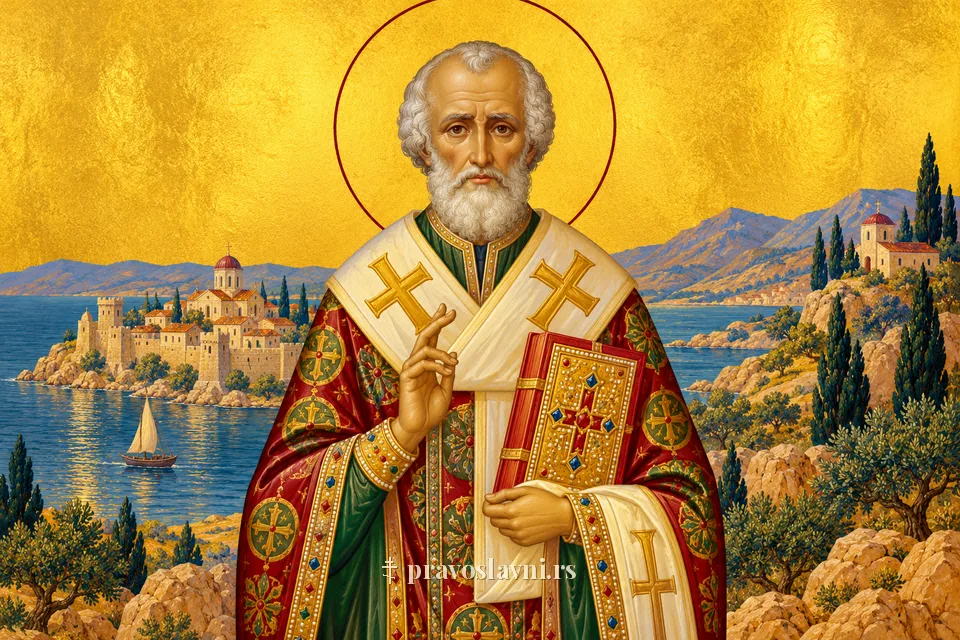
St Theodotus, a shepherd at Kyrenia in Cyprus, did not hide when they came for him. In the time of the Emperor Licinius, Sabinus, the governor of Cyprus, ordered that he be arrested, and the Life says that Theodotus himself came out before him with the words: “I am the one you are looking for.”
Before that, according to the Life, he had come from his native Galatia, from a Christian home and with a good education, to Cyprus, where he brought many pagans to Christ. His wisdom and uprightness brought him, as both sources say, to the bishop's throne.
Before Sabinus he endured heavy tortures: beatings, iron, prison, and then a red-hot bed and nails. Yet not for a single moment did he lose either his peace or his boldness. He called the pagan gods powerless, and of himself he said that joy in God made him insensible to tortures. He told Sabinus to his face that he was spiritually blind, and he even asked the torturers for death under torture, believing that this would bring him nearer to heaven. To the torturer, according to the Prologue, he said: “If you knew the goodness of my God, in whom I hope”, you too would suffer for Christ. From his lips, even in the hardest hours, there came thanksgiving to God and prayer for others who were persecuted.
His witness, according to the Life, brought many pagans to the faith, and Sabinus, fearing the people, sent him back to prison. There the faithful came to him and tended his wounds. Freedom was brought to him not by the mercy of Sabinus, but by the victory of Constantine the Great over Maxentius, after which the persecution ceased. Freedom, says the Life, did not gladden him: he wished to end his life as a martyr. He returned to Kyrenia, was shepherd of his flock for two more years, and then reposed in the Lord. Because of all this the Life honours him both as a bishop and as a martyr.
His life recalls the lesson which the Life finds in the Epistle to the Romans: what is endured for Christ lasts a short time, while what is received lasts for ever.
Full Life
The shepherd who did not hide
When the persecution of Christians began on Cyprus under the Emperor Licinius, the governor Sabinus was searching for the bishop of Kyrenia. His Life says that Theodotus appeared before him of his own accord and said: “I am the one you are looking for.” He explained that he was coming of his own free will, to preach Christ.
He had been like that before then too. He came from Galatia, from a Christian family, and he was an educated man. On Cyprus, where he arrived as a wise and upright man, he turned many pagans from idols to Christ. Both sources say that he received the rank of bishop in Kyrenia precisely because of such a mind and such a life, and he led his flock with care and devotion.
Words stronger than the torturers
His Life preserves a great many of his answers, and all of them show the same thing: fear had no power over him. When they threatened him with tortures, he said that the pagans and the soldiers were afraid of one Christian, while their gods were powerless. To the mockery of Sabinus he replied that his joy in God was stronger than any pain. He openly called the governor spiritually blind, and compared his authority to that of a robber. When they forbade him to utter the name of the Crucified One, he compared him to the demons in the Gospel who were afraid of that name (Mk 1:24; Mt 8:29), and he did not spare his words about the man's folly.
Both sources also remember his conversation with the torturer. First, according to the Prologue, he said to him: “If you knew the goodness of my God, in whom I hope”, you too would suffer for Christ. And when the torturer called him a skilful deceiver, Theodotus replied that Christ Himself was speaking through him.
A spirit that would not be broken
His Life lists his tortures in order: beatings, iron, the dungeon, and after five days a red-hot bed and nails. While they were beating him, he kept repeating a verse of the psalm: “The sinners ploughed upon my back” (Ps 128:3). When they bound him to a pillar, he prayed to Christ, remembering His victory over death, David and the three youths in the furnace. While they were leading him through the streets to the dungeon, he told those who had gathered that his suffering was not without hope and that a heavenly reward awaits the martyrs. When they brought him out again after five days, he refused to offer sacrifice, saying that his body was already destroyed, but that he was ready to suffer still more for the crown of righteousness, and he even begged them to bring him to death by tortures, for that would bring heaven nearer to him. Wounded as he was, the soldiers drove him along the road, while he gave thanks to God and prayed for the persecuted. Thinking that his end was near, he said, according to the Life, to the Christians around him: “Brethren, my struggle is coming to an end, and the crown is near.”
A witness that converted
His bearing had its effect on those who were watching. The Life says that many pagans were converted and began to mock their own idols, and so Sabinus, afraid that he would win the people over, sent him back to the dungeon. There the faithful visited him and tended his wounds.
Deliverance came from outside. After his victory over Maxentius, Constantine the Great put a stop to the persecution and ordered that the Christian prisoners be released. The Life says that he accepted his release with regret, for his desire had been to give his life for Christ. Even so, he led the Church in Kyrenia for two more years, until his repose, and the Life praises him both as a bishop and as a martyr.
The Life, citing the Epistle to the Romans (Rom 8:18), teaches that suffering for Christ is brief, while the reward is eternal. Therefore the faithful should look towards the Kingdom of Heaven, have hope in God in their temptations, and seek the help of the saints' prayers.