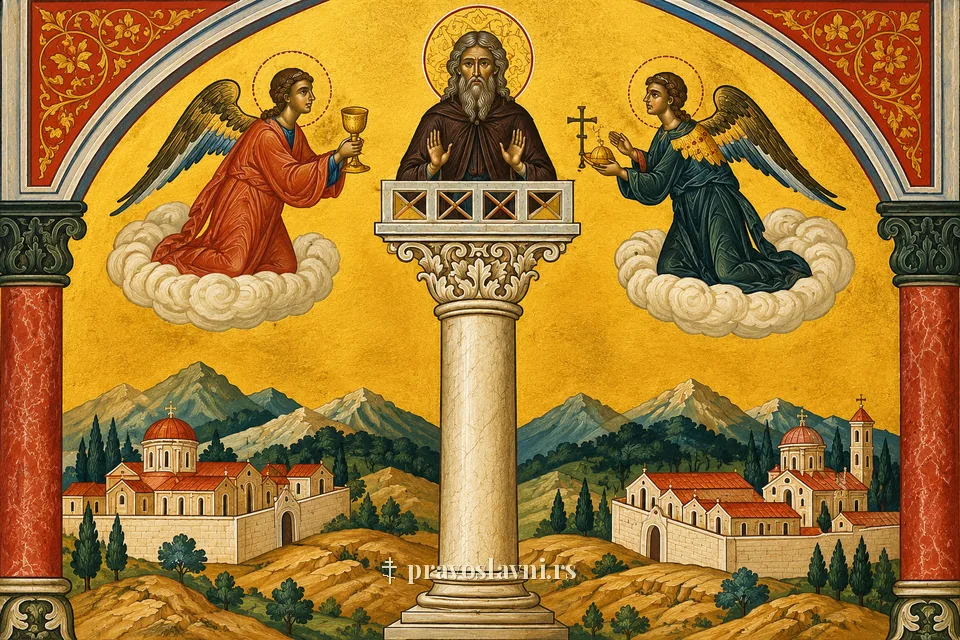
Sung at the Slava (family patron saint's feast) and on the saint's feast day.
A pillar of patience wast thou, O venerable one, emulating the forefathers, Job in sufferings and Joseph in temptations, and living the life of the Bodiless Ones while in the body, O Alypius our father: entreat Christ God that our souls be saved.
Venerable Alypius came from Adrianople in Paphlagonia. His Life mentions the meaningful dreams which his mother had before and after his birth. When she was left a widow, his mother, following the example of Hannah and Samuel, dedicated him to God and handed him over to Bishop Theodore. Studying beside the bishop, Alypius became a steward, and then a deacon.
He tried to go away into the desert, but he was brought back, and an angel, according to the Life, comforted him by saying that every place is made holy by the devout life of one who loves God. So he settled where no one dared to live — in the pagan cemetery in front of the city, which was held to be a place of demons. On one grave he replaced an idol with a cross, and after St Euphemia had appeared to him in a dream and promised her help, the townspeople helped him to build her church among the graves, although he himself had nothing.
Then, following the example of St Symeon the Stylite, he went up on to a high pillar beside the church. For a long time the demons tried to frighten him and showered him with stones, but he, according to the Prologue, resisted them with the sign of the cross and the name of Jesus. The Life adds that he even removed the shelter above his head, remaining exposed to every kind of weather. There he spent fifty-three years in prayer.
The people came to him for counsel and healing, and beside the pillar two monasteries were built, one for monks and the other for nuns, among whom were also his mother and his sister. The Prologue and the Life say that a heavenly light often shone above the pillar. He was clairvoyant, and the sick and the possessed found healing with him. For the last fourteen years, according to the Life, a disease of the legs kept him lying on one side, and he bore it without complaining. According to the Prologue, he lived to be a hundred years old and reposed in the year 640, and his head is kept in the Monastery of Koutloumousiou on the Holy Mountain.
Alypius teaches us that holiness does not depend on the place, but on the heart: by humility, patience, prayer and the cross he turned an accursed cemetery into a place of churches and monasteries.
Full Life
Who he was
Venerable Alypius the Stylite, whom we celebrate on 9 December (26 November, Julian calendar), spent more than half a century on a pillar. He was a native of Adrianople in Paphlagonia. While he was still small his mother dedicated him to God and brought him to Theodore, the bishop of the city, comparing herself to Hannah, the mother of the Prophet Samuel. His Life adds that his father died early, that the widow lived in fasting and prayer, and that his birth was accompanied by signs: his mother's dreams and a light in the room.
Theodore, according to his Life, grew fond of him and taught him the Scriptures, and in wisdom the boy quickly left his companions behind. When he grew up, he was given the care of the church's goods as steward, and then also the rank of deacon.
A desert right outside the city
His Life tells that the young deacon wished to go to the east, to the hermits. His mother, who had already given away her property to the poor and become a deaconess, did not stand in his way; it was the bishop who held him back. Once he even ran away, but the bishop, through his own men, brought him back from Euchaita. An angel then explained to him that a holy place is not made by the place, but by the man who lives there devoutly and loves God.
And so he did not look for a desert far away. Outside the city there was a pagan cemetery, which people avoided because of demonic apparitions. He settled in one of the tombs, and his first task was to take down the statue from the pillar above it and smash it, and to raise a cross up there. His Life tells that in a dream two men in priestly vestments told him to begin glorifying God in that very place.
A church among the graves
Help for the church came from the holy martyr Euphemia. Both sources record that he dreamed of her in Chalcedon, in the church by the sea, while he was accompanying the bishop on a journey to the emperor; she told him to go back and promised that she would help him. He had no money, but the townspeople made offerings, and among the pagan graves there rose a church of St Euphemia. His Life adds that later the relics of those two men from the dream were found — who they were, no one ever learned — and that Alypius placed them in the new church.
When the church had been consecrated, Alypius, following the example of St Symeon the Stylite, climbed up a high pillar beside it. He remained on it for fifty-three years, in fasting and prayer.
A long struggle and quiet endurance
Both sources say that for a long time, by day and by night, the demons frightened him with apparitions and pelted him with stones, and the mockery of men did not shake him either. According to the Prologue, he had two weapons against them: the sign of the cross and the invocation of Jesus. His Life preserves his rebuke: “What have you to do with me, you man-hating and ruinous demons?” and their cry as they fled: “Alypius has driven us out of our dwelling!” His Life also says that he removed the small roof above his head, and so stood exposed to every kind of weather.
The greatest trial came towards the end: his Life says that because of his diseased legs he lay on the same side for fourteen years. He would not even accept help in being turned; his model of endurance was Job.
What remained after him
People began to come to the pillar, some for advice and prayer, some for healing and a word of comfort, and some never went away again. In this way two monasteries arose on either side of the pillar, one for men and one for women. Alypius gave them rules, and he forbade the nuns to be seen by men. Among the sisters were also Alypius's mother and his sister Mary. His Life tells that at first his mother would not agree to be tonsured; she changed her mind after a dream in which, without monastic clothing, she was left standing before closed gates, and after that she lived for a long time as a nun.
Both sources also mention a light which people often saw above the pillar, especially at night and in storms. The sick and the possessed went back from him healthy, the future was not hidden from him, and the miracles did not cease even after his death. His Life says that he died joyful and that many healings flowed from his relics. The Prologue records that he lived to be a hundred, that he reposed in the year 640, in the time of Emperor Heraclius, and that his head is kept in the Monastery of Koutloumousiou on the Holy Mountain.
Alypius teaches us that holiness does not depend on the place. Where a man lives with God, in humility, obedience and endurance, even an accursed place becomes holy.
Other saints of the day
Venerable Stylianus
Stylianus was by origin a Paphlagonian, from the same region and the same period as Venerable Alypius the Stylite. He loved the Lord Jesus with a love that he did not wish to share with anything else, and for that reason he renounced everything. His Life adds that he was dedicated to God even before his birth, that he gave his property to the poor and that as a monk he stood out for his strictness among the monks of his time. His ascetic struggle was very hard: according to his Life, he lived in the desert, in a cave, and his food was brought to him by an angel. When his end was drawing near, his face shone like the sun, and angels came for his soul. Wonderworking power accompanied him during his lifetime and did not cease even after his death. He is a special helper of sick children, and also of married couples who have no offspring. His Life remembers a plague among children, when those children recovered whose parents had turned to the saint with faith: by coming to him, calling on him for help or having his icon painted. His undivided love for Christ made him an instrument of God's mercy towards the weakest.
The Prologue records only two years about him: 1731, when he died, and 1804, when his relics were uncovered; everything else about his life is told by his Life. Before his monastic tonsure his name was John; he came from the noble family of the Kulchitskys, and his parents were deeply devout. He became a monk in 1706 in the Kiev Caves Lavra, in the same year in which he finished the Kiev Academy, and before that he had attended the brotherhood school at the Theophany Monastery in Kiev. In the year 1721 he became Bishop of Pereyaslavl and was appointed to the Russian mission in Peking. The Chinese authorities refused to receive him, and so instead of in China he spent three years preaching the Gospel to the peoples among whom he found himself. In the year 1727 he became Bishop of Irkutsk and laboured to bring the Buryats and the Tungus to Christ. His health was soon broken by the harsh Siberian climate, by many hardships and by the zeal with which he worked. He was buried in the Ascension Monastery, about five kilometres from Irkutsk. During repairs to the church the grave was opened, and the body was found untouched and fragrant, as were the coffin and the velvet covering. Many miracles and healings took place at the relics, and after the Holy Synod had examined them, the relics were solemnly uncovered. The missionary who was turned back from the border did not give up, but preached in the place where God had set him, and his labour was crowned with incorrupt relics and miracles.