Save your slava — you'll get a reminder a week and a day before.
Monday01November 202719 October (according to the Julian calendar)
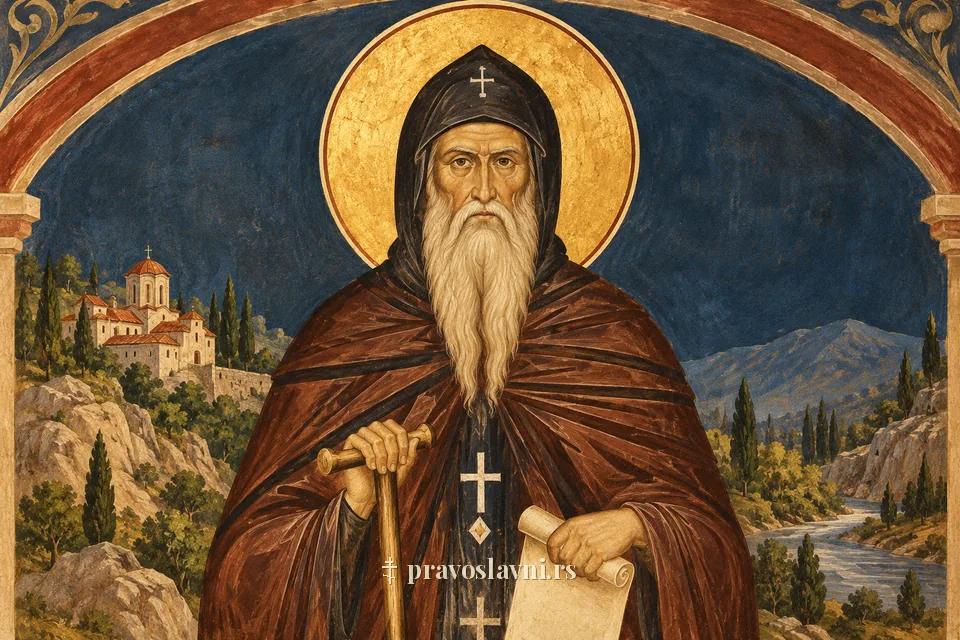
Illustration
Saint of the day
Venerable Prohor of Pčinja
What happenedA hermit who for thirty-two years had not seen another human being foretold, according to his Life, the imperial throne to the hunter Diogenes — this was Prohor of Pčinja.
“But you, when you pray, go into your room, and when you have shut your door, pray to your Father who is in the secret place; and your Father who sees in secret will reward you openly.”
— Mt 6:6
About the feast
Beside the Pčinja stands the monastery of Venerable Prohor, and the Prologue and his Life bear witness that fragrant myrrh flows from his relics and that the healings do not cease. How the body came to be in that very place is told by his Life.
John and Anna of Ovče Pole, merciful towards the poor and towards the churches, were given their son Prohor only in their late years. Good at his studies from the age of eight, he did not agree to the marriage that his parents intended for him, because his heart drew him to the church and to prayer. He gave away his property and sought solitude, believing that God must be given the first place, before both parents and home.
In the Nagoričane wilderness decades went by for him in complete solitude: wild animals kept him company, and he ate little and seldom, only a few herbs. The only man whom, according to his Life, he met in that time was Diogenes, who while hunting reached the cave. From the hermit he heard that he would become emperor — and that he should remember him then. Diogenes did indeed sit on the throne of Constantinople. He remembered the hermit, however, only when Prohor appeared to him in a dream and asked for a church.
The cave in Žegligovo had by then already been abandoned: at an angel's bidding, Prohor had withdrawn to Mount Kozjak. It was his home for the next three decades, spent in fasting and prayer, and there, according to his Life, God granted him to prophesy and to work miracles. The Prologue, otherwise brief, names another corner of his ascetic struggle — an oak grove by the Pčinja — and says that he reposed in the eleventh century.
After Prohor's death, too, a dream directed the emperor to Kozjak, where after a long search the relics were found incorrupt. The relics, however, would consent neither to Nagoričane nor to the journey to the capital: his Life cites several signs by which the saint clearly showed where he wished to remain. That is why today they rest in the monastery that Diogenes built on the Pčinja.
Prohor shows that a hidden life with God does not remain without fruit: whoever puts God before everything becomes a source of blessing for others as well.
Full Life
The story of Venerable Prohor of Pčinja, as his Life preserves it, has two heroes: a hermit who for decades did not meet a single person, and a ruler who forgot easily. Between them stand one hunt, one prophecy fulfilled and several dreams. The Prologue knows far less: that he lived in the eleventh century and that he shared his time and his ascetic struggle with John of Rila and Gabriel of Lesnovo.
From Ovče Pole to the wilderness
Prohor comes from Ovče Pole, in the region of Skopje, and was, according to his Life, a long-awaited son. Childless for years, John and Anna helped the poor and gave gifts to churches. His mother bore him only in her late years.
From the age of eight, learning came more easily to him than to others, which his Life ascribes to the Spirit of God. He did not accept the marriage his parents wished for, because he was drawn to the church and to prayer. Christ's word that whoever loves his parents more than Him is not worthy of Him, and the call to take up the cross, became a decision for him. He gave away everything he had. His road into solitude was accompanied by David's psalm about the soul's thirst for God.
Three decades of silence, and then one hunt
His Life names two desert caves in his lifetime. The first is in the wilderness of Nagoričane, in the Žegligovo region, beside a spring. There he spent thirty-two years; his food was herbs, and that only rarely, and of living creatures he saw only wild beasts.
That solitude was broken by Diogenes, who lost his way while hunting and wandered as far as the cave. The first meeting very nearly ended with Diogenes running away, but once he had calmed down, the hunter heard from the hermit a prophecy about the throne. Along with it he received two charges as well: not to forget his prophet, and to keep his old clothes as a reminder.
Diogenes did indeed become Emperor in Constantinople. His Life records without embellishment that both the clothes and the hermit quickly slipped from his memory.
The Emperor in his dreams
The forgetting, by the reckoning of the Life, lasted about thirty years; it was broken by a dream in which Prohor reproached the Emperor for his unfaithfulness and asked him for a church, even if only a modest one. Then the Emperor took those old clothes into his hands, remembered the prophecy and set out for Žegligovo — in vain, for the hermit was no longer there. The hermit, at an angel's command, had gone to Kozjak, to another cave. On Kozjak he remained another thirty years. His Life says that during that time God granted him the gift of seeing the future and of working miracles.
Diogenes did build the church in Nagoričane all the same, but only after a second dream, when the hermit was already far advanced in years.
The Prologue says something different here, and that ought to be stated honestly: according to it, God, at Prohor's prayer, showed him an oak grove beside the Pčinja as the place of his ascetic struggle, and there the saint grew old and died. The full measure of his labours, the Prologue adds, can be measured by no one but God.
Where the saint wishes to remain
The place where the relics rest Diogenes learned, after the saint's death, from a dream: on Kozjak. The soldiers wandered over Kozjak for a long time in vain before the body was found, and found incorrupt. His Life then describes a series of signs by which the saint himself chose where he would rest: the relics would not stay in the church at Nagoričane, nor could they be carried off to the capital. Diogenes understood and gave way. The body is incorrupt to this day in the place where the saint wished — in the monastery which Diogenes built on the Pčinja for that reason, and to whose consecration he came in person, and with him a great multitude of people. Of the relics, only the left hand went to the capital.
About what happens beside the relics both the Prologue and his Life agree: myrrh flows from them, and the healings are beyond number even today.
Prohor put God before both his parents and his comfort, and he spent his life hidden in prayer; that is why God granted him to prophesy and to work miracles. And the wondrous fate of his body — incorrupt, myrrh-gushing, faithful to its chosen place — bears witness that God does not abandon those who please Him and that their help reaches all who believe.
Other saints of the day
Holy Prophet Joel
“Consecrate a fast, and cry out to the Lord” — with that call, which the Prologue preserves, the Prophet Joel summoned his people to repentance. To a people that sins he foretold hard days and captivity in Babylon, but he also showed how God may be moved to mercy: a fast for everyone, and for the priests prayer with tears. Joel was the son of Pethuel, of the tribe of Reuben, a native, according to his Life, of Methomora, and he lived about eight centuries before Christ; among the twelve minor prophets he stands in the second place. His words did not concern his own time alone. He looked far into the future, as far as the Last Judgement and the glory of the Church, and especially as far as Pentecost, when the Spirit would come down upon the apostles and grace would then be poured out upon all Christians. In his book it is written that God will pour out His Spirit on all flesh, that sons and daughters shall prophesy, old men shall dream dreams, and young men shall see visions — and that everyone who calls on the name of the Lord shall be saved. Joel teaches that repentance, fasting and prayer turn punishment away, and that the Spirit and salvation are promised to all who call upon God.
The Venerable John of Rila is commemorated today, according to his Life, because of the translation of his relics from Sofia to Tarnovo in the year 1238. The son of devout and modest parents from Skrino near Sofia, born in the days of Tsar Boris, while still young he gave away his property to the poor and the infirm and became a monk. After a cave and years in a hollow tree on Rila, where he lived on grass and berries, shepherds were the first people to see him, and from then on he was no longer alone: the sick came, and many were made well. He did not acknowledge his power of healing: even over a man tormented by an unclean spirit he said, “I am a weak man just as you are”, and the healing, as his Life records, came only when he turned to God. To Tsar Peter, who wished to meet him, he sent a letter in place of himself. In time disciples gathered round him and a monastery with a church arose, and he passed away in peace in the year 946; for centuries his relics were moved from place to place until they found a home in the Rila Monastery. He teaches us humility: he ascribed healing to God alone and fled from worldly glory, even when a tsar sought him out.
Varus commanded a Roman company in Egypt, in Alexandria, under the Emperor Maximian, and he kept his faith in Christ hidden from others. His service to the martyrs was by night and in secret: for money the guards looked the other way, and he brought the prisoners food and relief and asked of them nothing but their prayers. Among them there happened to be seven teachers of the faith from the desert; Varus complained to them that fear was holding him back from becoming a martyr himself, and they gave him courage. One of them died in prison before the trial, and so when the governor demanded the seventh, Varus, according to the Prologue, came forward himself: “I am the seventh!” He was tortured first and, according to his Life, after about five hours he breathed his last. Cleopatra, a widow from Palestine, secretly preserved his body and, when she was returning to her homeland, took it with her to Edra near Tabor; later she built a church for him there, where, according to his Life, the sick found healing. According to his Life, Cleopatra also buried her son John, who died young, with joy after a certain dream, because she saw him in radiance beside Varus, as a soldier of the heavenly host. Varus teaches us that fear gives way to courage in the company of the confessors of the faith, and that faithful love for a martyr is returned through his intercession.