Save your slava — you'll get a reminder a week and a day before.
Friday18December 20265 December (according to the Julian calendar)
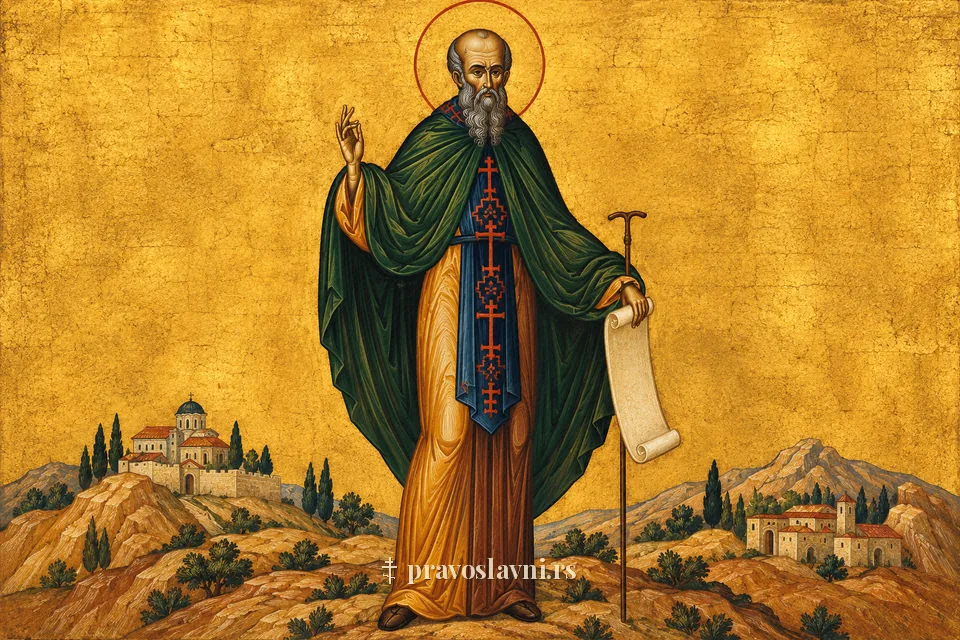
Illustration
Saint of the day
Venerable Sabbas the Sanctified
What happenedFrom a boy who went to a monastery at the age of eight, Sabbas became the father of a great lavra in the desert and a pillar of Orthodoxy in the East.
“My sheep hear My voice, and I know them, and they follow Me.”
— Jn 10:27
About the feast
St Sabbas the Sanctified was born in the village of Mutalaska, near Caesarea in Cappadocia, of noble and devout parents, John and Sophia. When he was five years old, his parents went away to Alexandria, and he stayed with his mother's brother and then with his father's brother, who quarrelled over the estate. At the age of eight he went by himself to the Monastery of Flavian and became a monk. His Life remembers that he once trampled on an apple that had tempted him and vowed never to eat apples again.
At eighteen he went to Palestine and stayed longest with Euthymius the Great. Euthymius foretold for him the glory of an abbot and a lavra that would surpass all those of that time. After the death of Euthymius, Sabbas withdrew into the desert. An angel showed him a cave near Siloam, where he lived alone for five years, feeding on what the Saracens brought him.
Disciples began to come, at first some seventy, then about a hundred and fifty. Sabbas built a church and cells, and thus the Great Lavra came into being. His Life adds that a wild ass revealed water to him by digging at night, and that a pillar of fire showed him a cave resembling a church, which became the church of the lavra. When discontented monks accused him before Patriarch Sallustius, the patriarch, against his will, ordained him a presbyter and said: “I have only confirmed the Divine choice.” His mother Sophia too, when she had grown old, he tonsured and settled in a separate cell.
When a part of the brotherhood rose up against him, he withdrew to Scythopolis, where, as his Life says, a lion yielded its cave to him. Patriarch Elias sent him to Constantinople to Emperor Anastasius, and Sabbas reconciled the emperor with the patriarch.
The Prologue credits him with seven monasteries and the first order of monastic services, known as the Jerusalem Typikon, and holds that in the East at that time there were no greater defenders of Orthodoxy than he and his neighbour Theodosius the Great. According to the Prologue, he reposed in the year 532, at the age of ninety-four.
St Sabbas teaches us that meekness overcomes strife, and firm faith overcomes error. The Church remembers him as the father of the Jerusalem Typikon, by which Orthodox worship is ordered to this day.
Full Life
A Monk at Eight Years Old
Venerable Sabbas the Sanctified was born in the village of Mutalaska, near Caesarea in Cappadocia. His Life says that this was in the thirty-first year of the reign of Emperor Theodosius the Second. His parents John and Sophia were noble and pious, and his father was a high-ranking officer in the imperial army. When Sabbas was five years old, his parents went away to Alexandria and left him with his maternal uncle Hermias, whose wife was harsh, and then with his paternal uncle Gregory in Scandos. His Life records that the two uncles quarrelled over the estate.
His monastic path began when he was an eight-year-old: he left his relatives and entered the Monastery of Flavian, not far from home. His relatives tried to bring him back to marriage and to the estate, but he did not give way. His Life also remembers two incidents from those years. Once an apple tempted him; he trampled it underfoot and vowed that he would never eat apples. Another time he leapt into a red-hot baker's oven to take out a brother's clothes and came out unharmed.
A Disciple of the Great Euthymius
As an eighteen-year-old, a decade later, he set out for Palestine — this was towards the end of Marcian's reign, while Patriarch Juvenal was governing the Church of Jerusalem. He stayed longest with Euthymius the Great and Theoctistus. Euthymius saw in the young monk a future renowned abbot and foretold that his lavra would surpass all those of that time.
His Life says that his parents in Alexandria begged him to return to the world. He refused, and of the forty gold coins they offered he took only three and handed them over to the abbot. At thirty years of age he was given a cave. He fasted five days in the week, wove ten baskets a day and every Saturday brought fifty of them to the monastery. When he collapsed from thirst in the desert of Rouba, Euthymius, as his Life records, prayed, struck the ground, and a spring flowed forth.
The Desert Becomes a Lavra
After the death of Euthymius, Sabbas withdrew into the desert. His Life says that demons attacked him in the form of snakes, scorpions and a lion, but that they fled from his prayer. An angel showed him a cave beside the brook of Siloam. There he lived for five years as a hermit; he climbed up to the cave by a rope, and his food was brought to him by Saracens.
Disciples gathered around him, at first about seventy, and later about a hundred and fifty. He built a church and many cells, and that was the core of the Great Lavra. His Life tells that a wild ass dug by night and uncovered a spring which never ran dry, and that a pillar of fire showed him a cave in the shape of a church, which became the church of the lavra. The Armenian monks received from him a cave of their own, in which they could celebrate the services in their own language.
Discontented monks accused him before Patriarch Sallustius. Instead, the Patriarch ordained him a presbyter, against his will, at the age of forty-eight, and commanded the monks to obey him. His Life records the Patriarch's words: “I have only confirmed the Divine choice.” Later Sallustius appointed him head of all the hermits around Jerusalem, and Theodosius head of the monks living in community.
From Scythopolis to Constantinople
When his mother Sophia, already old, came to him in Jerusalem, he tonsured her a nun and settled her in a cell of her own, in which she also died. During one Great Lent he stayed on the hill of Castellium, where demons in the form of beasts and birds fled from his prayer and from the cross, and there he founded a monastery.
When about forty rebellious monks turned against him, he withdrew to Scythopolis, where, according to his Life, a lion gave up its cave to him. When the rumour spread that he had been devoured by lions, Patriarch Elias, as his Life records, did not believe it: “I do not believe you, for I know that the Lord is righteous.” The Patriarch then sent him to Constantinople, to Emperor Anastasius, who rejected the Council of Chalcedon. His Life says that the guards drove him away as a beggar, but the Emperor saw an angel leading him. Sabbas reconciled the Emperor with Elias, received about two thousand gold coins for his monasteries and sent money to Mutalaska so that a church of Sts Cosmas and Damian might be built.
A Pillar of Orthodoxy
For the end of his life we are left with the Prologue. The number of monasteries that Sabbas built is, according to it, seven. The Prologue holds that in the East at that time there were no greater defenders of Orthodoxy than he and his neighbour Theodosius the Great, and Sabbas did not hesitate to admonish both emperors and patriarchs in matters of faith. The Prologue also attributes to him the first order of monastic services — what the Church knows as the Jerusalem Typikon. The Prologue states that he died in the year 532, as a ninety-four-year-old.
St Sabbas teaches us that meekness, faithfulness to Orthodoxy and prayer overcome every obstacle. The Church remembers him as the father of the Jerusalem Typikon, by which Orthodox worship is ordered to this day.
Other saints of the day
Venerable Nectarius of Bitola
St Nectarius was born in Bitola, of devout parents, and at his baptism he received the name Nikola. His Life also remembers his mother's vision: before the Turks invaded, the Theotokos warned her that the family must flee, and they all remained alive. His father, grown old, became a monk with the name Pachomius in the Monastery of Sts Cosmas and Damian near Bitola, and both his sons became monks together with him. At the monastery's patronal feast, according to his Life, the guests emptied a large barrel, and afterwards it was found full of fragrant wine. Moved by that miracle and by his mother's vision, the young Nikola went to the Holy Mountain of Athos. There he came to the elder Dionysius Iagaris, a disciple of the clairvoyant elder Philotheus Iagaris. His Life records that Philotheus, before anyone had told him who he was, welcomed him with the words: “You, my child, are Nicholas, the son of Pachomius”. The elders tonsured him a monk and gave him the name Nectarius. When an envious novice threatened him, the elders sent him to the protos Daniel in Karyes, and later he lived with Dionysius in the small cell of the Holy Archangels, called Kofou, where they worked at handicrafts and helped others. Not even the grave illness which God permitted at the end broke him: he bore it thankfully and patiently, and he passed away on 5 December 1500, having overcome everything that had befallen him. Over his relics, which have remained incorrupt and fragrant, miracles take place to this day; they are kept in the same cell on the Holy Mountain. St Nectarius teaches us that patience, gratitude and obedience overcome both envy and illness.