Save your slava — you'll get a reminder a week and a day before.
Tuesday20July 20277 July (according to the Julian calendar)
Illustration
Saint of the day
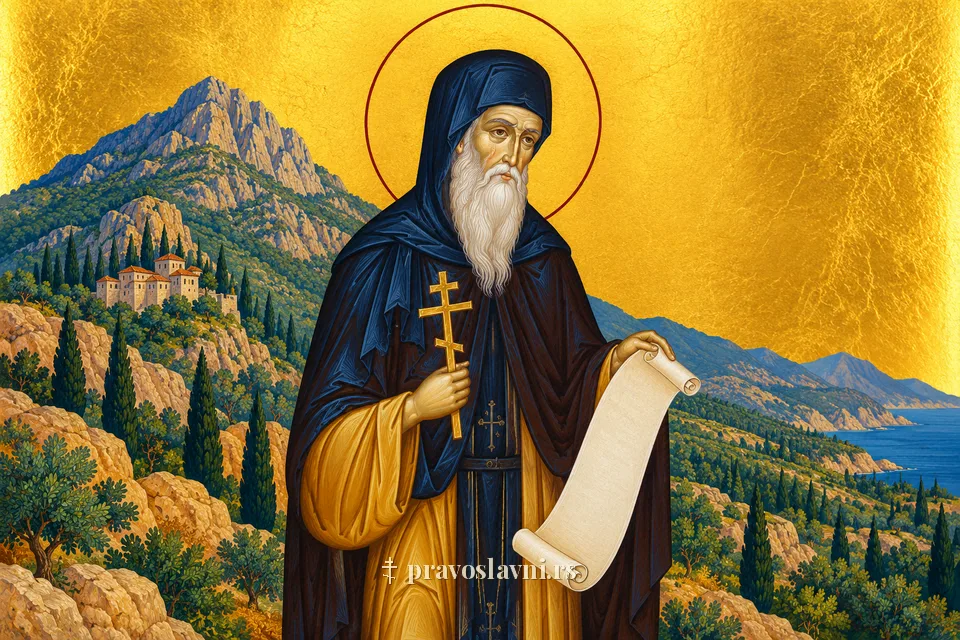
Venerable Thomas of Mount Maleon
What happenedVenerable Thomas of Mount Maleon, once a famous and wealthy commander, left all his possessions and lived the ascetic life in prayer on Mount Maleon, near the Holy Mountain.
“But what things were gain to me, these I have counted loss for Christ.”
— Phil 3:7
About the feast
Venerable Thomas of Mount Maleon fought two battles: first as a commander, brave, rich and strong, and then as a monk, by prayer. The Prologue says that he frightened his enemies by his very appearance, and his Life says that the armies of the enemy often gave way before him. His love for Christ was stronger than glory and wealth, and so he left everything and became a monk.
According to his Life, he first learned from experienced monks in the monasteries, striving after the poverty and humility of Christ, and then he longed for the desert. The Prophet Elijah led him to Mount Maleon, near the Holy Mountain (Mount Athos); his Life also mentions a pillar of fire that showed him the way by night. There he lived alone and prayed without ceasing, and according to his Life he had revelations and withstood the evil spirits by prayer.
Although he had withdrawn from the world, word of his holy life spread, and people began to come to him for counsel and help. God gave him the gift of working wonders and of healing, and so he helped in every illness and trouble with which they came to him. His Life recounts that the blind received their sight, the lame began to walk, and in a dry place, after his prayer, a spring appeared.
The Prologue says that he reposed in the 10th century. According to his Life, the healings continued at his relics too, for all who came with faith.
Full Life
Two kinds of strength
Thomas of Mount Maleon knew both the soldier's warfare and the spiritual one. Before he became a monk he was a commander, renowned for his courage and his wealth. The Prologue remembers that he was strong in body and that he frightened his enemies by his very appearance; according to his Life, the armies against which he fought were often defeated by him. Yet love for Christ overcame in him everything that the world offered him. He parted with all that he had and put on the monastic habit.
Even as a monk he did not cease to learn. His Life says that he went from one monastic community to another, watching how experienced ascetics lived, for he wanted to be poor and humble like Christ. In time he came to long for stillness and for the stricter struggle of the desert.
Alone on Maleon
The way, according to both sources, was shown to him by the Prophet Elijah. According to his Life, on that journey by night he was led by the prophet and by a pillar of fire. So he came to Mount Maleon, not far from the Holy Mountain (Mount Athos), and there he remained alone.
His weapon now was prayer, which he never broke off. His Life says that God gave him revelations and that by prayer he repelled the attacks of evil spirits. His Life also says that during prayer a radiance, like a flame, shone out from him, which only people of pure mind were able to see from afar.
The healer
The ascetic who had withdrawn from people nevertheless did not remain unknown to them. The fame of his life spread, and people came to ask for counsel and help. God gave him the gift of working miracles, so that no illness and no trouble that they brought to him remained without healing. According to his Life, he opened the eyes of the blind and raised up the lame, and in a place where there was no water a spring flowed after his prayer.
After death
He reposed, as the Prologue records, in the tenth century. His relics went on helping people. His Life states that the sick who approached them with faith recovered, and that even from incurable diseases, and that those who were tormented by demons were also set free.
The commander who had once won battles found a greater strength in humility and prayer, and with it he healed others, during his life and after it.
Other saints of the day
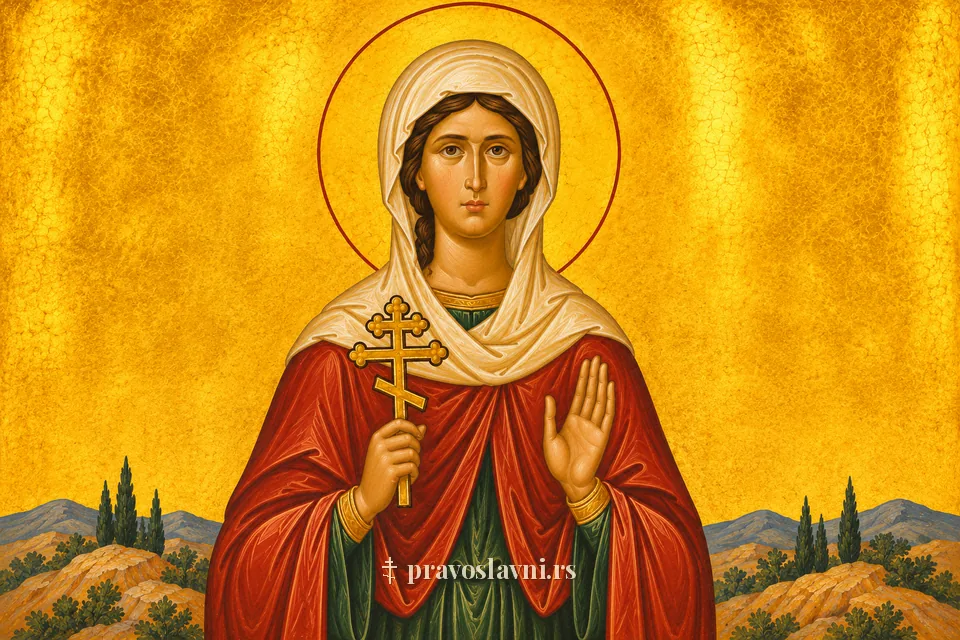
Great Martyr Kyriaki (Nedelja)
The holy Great Martyr Nedelja (Kyriaki) suffered in Nicomedia in the year 289, during the persecution under Diocletian and Maximian. Her parents Dorotheus and Eusebia, from Anatolia, were devout and well-to-do, and for a long time they prayed to God for a child; according to her Life, she received her name from the Lord's day, on which she was born. From childhood she lived for God, and when she grew up she refused her suitors, because she had already vowed herself to Christ. It was the revenge of a rejected suitor that revealed to the emperor that the family was Christian: after being tortured, her parents were sent into exile in Melitene and ended their lives there as martyrs. A longer suffering awaited her, before Maximian, and then before the governors Hilarion and Apollonius — scourging, prison, fire and wild beasts. The Prologue records that Christ visited her in prison, healed her wounds and said: “Do not fear the torments, Nedelja; My grace is with you.” According to her Life, neither the fire nor the beasts did her any harm, and Hilarion was struck by lightning; because of this many pagans believed and suffered. To Apollonius she answered: “In no way can you turn me away from my faith.” Fire did not frighten her because of the Three Youths, the beasts because of Daniel, the sea because of Jonah, and the sword because of the Forerunner, and so she said: “For me, to die for Christ is life.” Before her execution she asked to be allowed to pray, and she begged mercy for everyone who would remember her suffering, as well as repose for herself and her parents. Her soul departed to God even before the stroke of the sword. According to her Life, she is especially venerated in Dalmatia and Southern Italy.