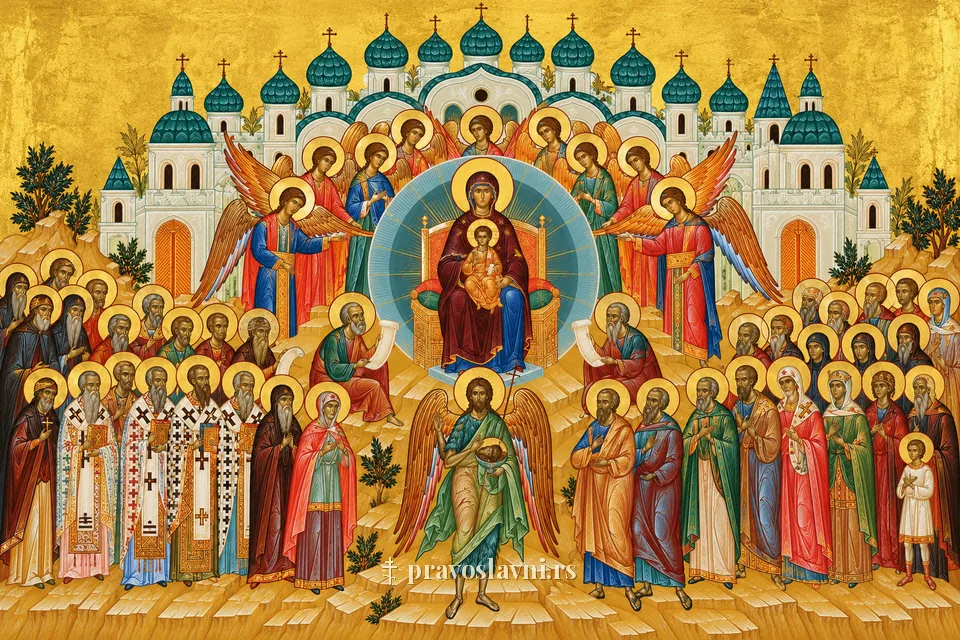
The Synaxis of the Most Holy Theotokos is celebrated on the second day of Božić (Christmas) — on 26 December according to the Church calendar, that is, on 8 January according to the civil calendar. On the day after the Nativity the Church turns her gaze towards the Mother of the newborn Christ.
The Prologue explains the name of the feast by the fact “that on this day all the faithful gather together” to pay Her honour, and so the divine services of that day also have a festive, congregational character. The Life explains why Her feast has been placed right beside the Nativity: no one had so great a share in salvation as She who gave birth to the Saviour. Ohrid, according to the Prologue, has from ancient times celebrated this synaxis in a special way: on the eve of the feast there was only one Vespers, in the Church of the Theotokos Čelnica, at which the entire clergy and all the people would be present.
On the same day we also remember the flight of the Holy Family into Egypt. When the wise men had departed, Herod resolved to kill the children in Bethlehem. The warning reached Joseph in a dream, from an angel, and he set out by night for Egypt with the Child and His Mother. The Life says that Joseph's son James went with them as well, as a helper.
The Prologue cites the prophecy of Isaiah that the Lord would come into Egypt on a swift cloud. The Life records that idols fell before Christ throughout Egypt. It also hands down the story that in the desert a band of robbers fell upon them, but that their chief, when he looked at the Child, gave up the robbery. The Prologue also mentions places in the neighbourhood of Cairo which are to this day connected with their stay in Egypt, among them a certain tree and a wonderworking spring.
How long they remained in Egypt is not known — the Prologue says several years. According to the Gospel, after the death of Herod an angel called Joseph to return. Since Archelaus was reigning in Judea, Joseph settled with his family in Nazareth, in Galilee.
The Life says that the flight into Egypt bears witness that Christ had a true human body, and that it teaches us humility: when people fly into a rage, it is better to withdraw than to stand in their way out of pride. And the feast of the Mother of God stands right beside Božić for good reason: the Saviour of the world came among men through Her, and so Her share in salvation is also the greatest.
Full Life
Why a Synaxis
As soon as Božić (Christmas) has passed, on the very next day, the Church turns her gaze towards the Mother of the newborn Christ — the Most Holy Theotokos. By the church calendar this is 26 December, and by the civil calendar 8 January.
The feast is called a Synaxis because, as the Prologue explains, “on that day all the faithful gather together” to give honour to the Mother of God. The divine service of that day is dedicated to her and has a festal, communal character. The Life also explains why her feast is placed right beside the Nativity: no one had so great a share in the work of salvation as she who gave birth to the Saviour, and that salvation embraces not only man but the whole of created nature as well. Neither the Prologue nor the Life says when this feast was introduced, or by whom.
Ohrid, according to the Prologue, has celebrated this Synaxis in a special way from ancient times. On the evening before the feast there was only one Vespers, in the church of the Theotokos called Čelnica, and all the clergy and all the people would be present at it.
The flight into Egypt
On this day the Church also remembers the flight of the Holy Family into Egypt. An angel told the wise men to return home by another way, and they obeyed. Herod then resolved to kill the children of Bethlehem, but Joseph received a warning from an angel in a dream to flee to Egypt. Joseph obeyed; according to the Gospel according to Matthew, he set out on the journey by night, taking the Child and His mother to Egypt.
The Prologue and the Life do not agree about where Joseph stopped first. James, the son of Joseph, joined them while they were still in Nazareth, which the Prologue gives as the first stopping place — there Joseph first finished what he had to do at home. The Life says that Joseph first went to the Temple in Jerusalem to fulfil the Law, where Simeon and Anna met the Lord, and only then to Nazareth. According to the Life, James, the eldest son of Joseph, called the brother of the Lord, went with them as a helper, and they set out for Egypt in secret, by night.
The road through the desert
The Prologue cites the prophecy of Isaiah that the Lord, riding on a swift cloud, will come into Egypt. The Life says that St Ambrose interprets that cloud as the Most Holy Virgin, and that the idols of Egypt trembled before the Lord.
The Life also passes on the story of the robbers, with the remark that this is what is told. When a band from the desert attacked the travellers, its leader looked at the Child and no longer allowed anything to be taken from them. The Life connects these robbers with the two who were later crucified with Christ — Dismas, the robber on the right-hand side, and Gestas, on the left.
According to the Life, the Holy Family entered the Thebaid and came to Hermopolis. There, the Life says, a great tree bowed down before the Lord and afterwards had healing power, and a demon fled out of it. In Hermopolis the idols in the temple fell, in the village of Sirene three hundred and sixty-five of them fell, and idols were falling throughout the whole of Egypt.
Where the Holy Family lived
The Life says that the Holy Family lived near Heliopolis, in Natarea, in a house beside a fig tree, which split open to shelter them, and that a spring of living water welled up there. The memory of the Holy Family, the Prologue records, lives on to this day in two places: in the village of Matarea near Cairo — the tree and the wonderworking spring where the family rested, and in old Cairo — the cave in which, as it is said, it lived.
How long they remained in Egypt is not known. The Prologue says a few years, while the Life cites various opinions, from two to seven years. The Gospel says that Christ remained in Egypt until the death of Herod, that the word of the prophet might be fulfilled. Here the Prologue quotes the words of the Prophet Hosea, in which God says that out of Egypt He called His Son.
The Gospel further records that, when Herod died, an angel told Joseph to return to the land of Israel. Since Archelaus was reigning in Judea, Joseph went to Galilee and settled in Nazareth. Galilee was then in the hands of Herod the younger, the brother of Archelaus, of whom the Prologue says that he was less cruel.
The lesson of the feast
The feast of the Mother of God stands right beside Božić for good reason: the Saviour of the world came among men through her, and so her share in salvation is the greatest as well. The Life sees three lessons in the flight into Egypt. First, Christ fled like any persecuted man, which bears witness that He had a real human body. Second, when people fly into a rage, a believer should not stand in their way out of pride, but should withdraw, as the Lord also withdrew. And third, His coming cleansed Egypt of idols.