Save your slava — you'll get a reminder a week and a day before.
Wednesday27October 202714 October (according to the Julian calendar)
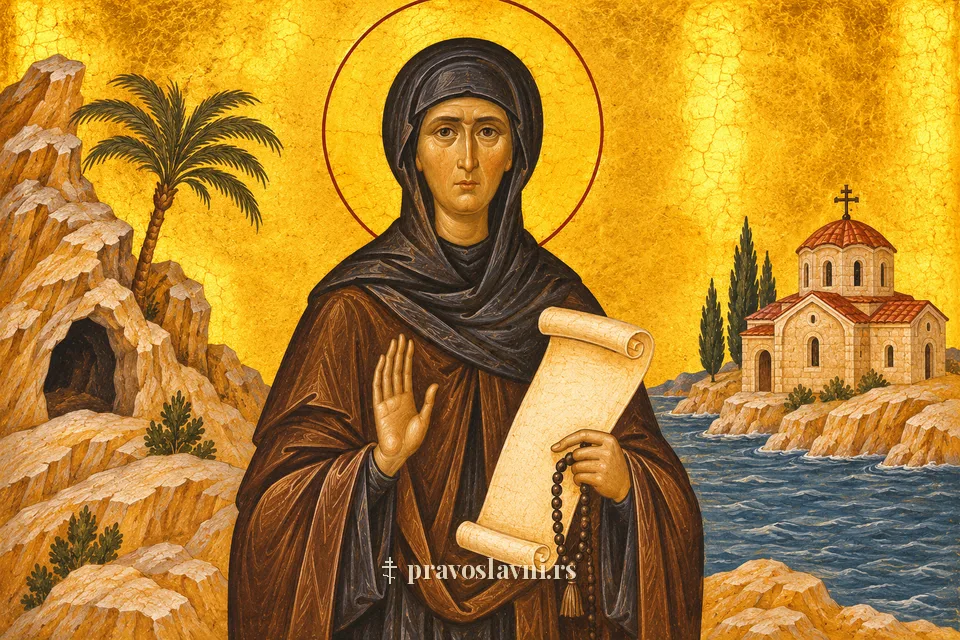
Illustration
Great feast
St Petka (Paraskeva)
Venerable Mother Paraskeva (Petka)
What happenedA maiden from Epivates who left everything for the desert, and whose relics were for centuries a consolation to Constantinople, Tarnovo, Belgrade and Iași.
Sung at the Slava (family patron saint's feast) and on the saint's feast day.
Having loved the life of the desert and of stillness, and having fervently run after Christ thy Bridegroom, and having taken his good yoke upon thee in thy youth, having manfully armed thyself with the sign of the Cross against the spiritual foes, by ascetic labours, by fasting, and by prayers, and by drops of tears thou didst quench the coals of the passions, O most glorious Paraskeva; and now, standing before Christ in the heavenly bridal chamber with the wise virgins, pray for us who honour thy precious memory.
Sveta Petka (St Petka) is the folk name of Venerable Mother Paraskeva. Her veneration is very widespread among the Serbian people, and many families celebrate her as their Krsna slava (family patron saint's day). She is distinct from two other women saints of the same name, although in popular piety their Lives and icons are often confused. Thus the dish with eyes, which is seen on some of her icons, in fact belongs to the story of the Roman martyr Paraskeva.
At Kalemegdan in Belgrade there is the church of St Petka with a spring, a hagiasma, and the faithful often visit them. It is believed that the spring heals the one who drinks from it believing in God and loving St Petka. For more on fasting on this day, see the guide “Fasting — simply explained”.
St Paraskeva, whom the Serbian people call Petka, was born in Epivates, a seaside town between Constantinople and Selymbria. According to the Prologue, she was of Serbian descent. She grew up in a well-to-do and devout family, and her brother Euthymius became a monk and later Bishop of Madytos.
The words of Christ “Whoever desires to come after Me, let him deny himself, and take up his cross” (Mk 8:34) touched her, according to her Life, while she was still a child, in church, when she was ten years old. From then on she began to give to the poor, even her own clothes, although her parents did not approve.
When her father and mother died, she left her home. Her Life says that she first spent five years in prayer in Constantinople, beside the church of the Theotokos, and then went to Palestine and withdrew into the desert by the Jordan. There she lived alone for years, in want and fasting. The devil, who tried to frighten her, she drove off, according to her Life, with prayer and the sign of the cross.
One night an angel, as the Prologue records, said to her: “leave the desert, and return to your homeland.” She obeyed. In Epivates she lived for two more years as an ascetic, and no one knew who she was. According to her Life, she died at prayer and was buried as an unknown woman. That, according to the Prologue, was in the eleventh century.
Much later, says her Life, her body was discovered quite by chance, during the burial of a sailor — and it had not decayed. The saint then appeared in a dream to the devout George and to a certain woman, said that she was from Epivates and asked that her relics be raised. So it was done, and from then on the healings began.
Her Life also follows the journey of her relics: from Tarnovo to Wallachia, then to Belgrade, at the request of Princess Milica, where a church was built for her, then to Constantinople, and from 1641 to Iași, where they are to this day. The Prologue also mentions her spring in Belgrade, from the water of which the faithful receive healing.
St Petka teaches us that whoever denies himself for the sake of Christ is not left alone, but becomes a comfort to many.
Full Life
A saint of many peoples
Few women saints have as many who honour them among different peoples as Paraskeva, whom the Serbs affectionately call Petka. According to the Prologue, she herself was of Serbian descent. She was born in Epivates, a small seaside town on the road from Constantinople to Selymbria, in a house where neither property nor faith was lacking. Her brother Euthymius became a monk, and later also the renowned Bishop of Madytos.
Petka's heart, according to the Life, turned to Christ early. While still a child — she was only ten years old — she understood the Gospel words “Whoever desires to come after Me, let him deny himself, and take up his cross” (Mk 8:34) as a call addressed to her in particular. Her first answer was to give her own fine things to a poor person, even the clothes she was wearing. Her parents did not like this, but Petka, the Life says, did not know how to live in any other way.
While her father and mother were alive, she stayed with them. When they were no longer there, according to the Prologue, she left her home in order to live for God alone.
Years in the desert
First she went to Constantinople. Five years of her life, according to the Life, were spent in a suburb of Constantinople, beside a church of the Theotokos, where experienced ascetics had directed her. Then she set out for the Holy Land, to venerate the places of Christ's earthly life, and from there she withdrew into the desert by the Jordan.
There she was alone with God for years. According to the Life, she ate very little and only in the evening, and she endured both scorching heat and bitter cold. The devil did not leave her in peace either. He tried to frighten her with terrible apparitions, but she, according to the Life, defended herself with prayer and the sign of the Cross. No one saw those years, and yet they were the heart of her life.
The return home
One night, at prayer, an angel appeared to her. The Prologue preserves his command: “leave the desert, and return to your homeland.” There, he said, she would end her earthly life and depart to the Lord. It was not easy for her to leave the desert, but she obeyed.
On her way back, according to the Life, she venerated in Constantinople the holy things of Hagia Sophia and Blachernae. In Epivates she lived for two more years, in the same ascetic way as in the desert, without anyone knowing who she was. The Life says that she spent her last hours too in prayer, in which there was room for all people. They buried her as an unknown woman, outside the cemetery. The Prologue records that this was in the eleventh century.
The dream that revealed a holy treasure
Much later, according to the Life, the body of a drowned sailor was washed up on the shore. The digging brought a surprise: a body untouched by decay was already lying there, so they lowered the sailor in beside it. George, one of the diggers, saw the saint in a dream that very night. She asked that her relics be taken out without delay and placed as is fitting, and she told him where she was from. The Life adds that George was not the only one: the saint appeared in the same way to a woman of Epivates as well. The next day the people, with candles in their hands, came for the holy relics, and the healings began.
The long journey of the relics
The Life also describes the further journey of the relics, which seems to follow the history of the Balkans. The Bulgarian Tsar Ivan Asen took them to Tarnovo in 1238. When Tarnovo fell to the Turks, they went to Wallachia. The Serbian Princess Milica obtained from Sultan Bayezid that they should come to Belgrade, where the Church of St Petka was built. The Prologue also mentions her spring in Belgrade, from whose water the faithful receive healing. In 1521 Sultan Suleiman took them to Constantinople. According to the Life, the miracles that took place there were respected by Muslims too. Since 1641 the relics have been in Iași, where they rest to this day.
Petka renounced her home, her property, and even being known by anyone. And she received the love of many peoples. Whoever denies himself for the sake of Christ is not alone — he becomes a comfort to many.